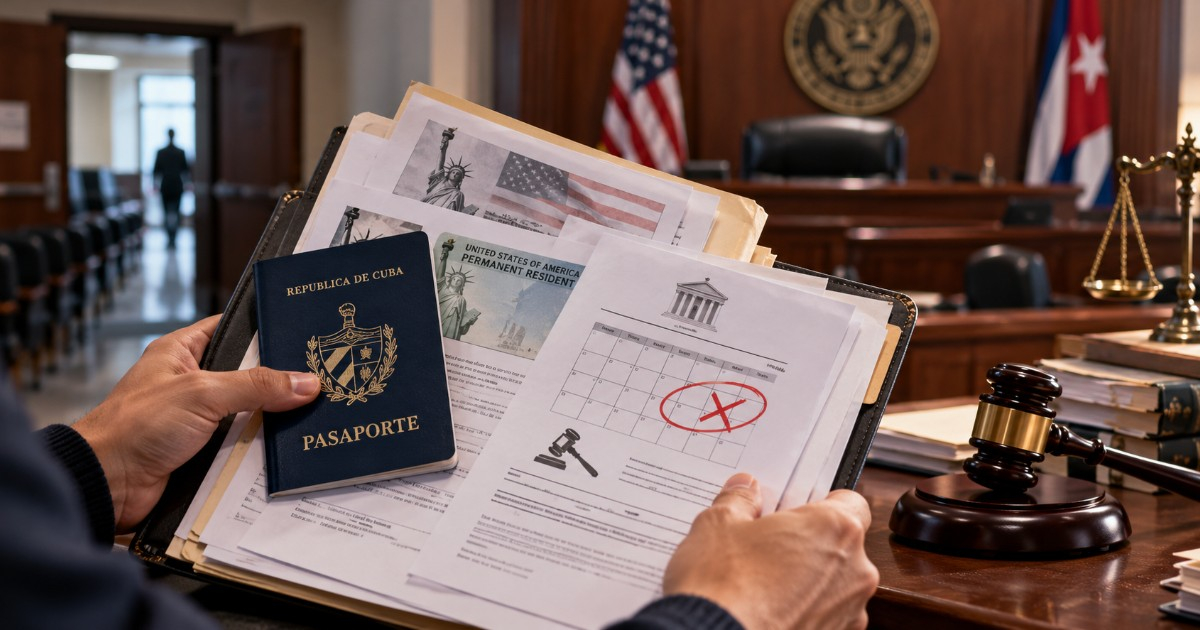
Missing a hearing before an immigration judge in the United States can have serious consequences, even if the person was unaware that they were required to appear.
In certain circumstances, the court may issue a deportation order in absentia, without the immigrant being present to defend their case.
For Cubans who find themselves in this situation, U.S. legislation provides mechanisms that allow the reopening of the case file and, when specific requirements are met, the cancellation of the order issued for failing to appear.
But it is not enough to explain that the hearing was missed. It is necessary to demonstrate a legally recognized cause, submit a formal request, and adhere to the corresponding deadlines.
The federal regulation 8 CFR 1003.23 establishes the conditions for filing a motion to reopen before an immigration judge.
On its part, section 240 of the Immigration and Nationality Act (INA) governs the deportation orders issued when a person fails to appear before the court.
What is an order of deportation in absentia?
A removal order in absentia, known in English as in absentia removal order, is a decision issued by an immigration judge when a person fails to appear at a scheduled hearing.
To issue it under the procedure outlined in section 240 of the INA, specific legal requirements must be met, including proper notification to the immigrant or their attorney and the demonstration by the Government that the individual is subject to deportation.
The immigrant's absence does not mean that the process disappears or remains pending indefinitely. The judge can continue the proceedings and issue an order that allows for the execution of their removal from the United States.
However, a default judgment is not always irreversible.
The Executive Office for Immigration Review (EOIR), an agency of the Department of Justice that oversees immigration courts, explains that there are three main grounds for requesting the reopening and cancellation of this type of orders.
1. If you were absent due to an exceptional circumstance: deadline of 180 days
The first possibility pertains to those who were unable to attend the hearing due to exceptional circumstances beyond their control.
The legislation mentions, among the examples, a serious illness of the immigrant themselves, a serious illness or the death of certain close relatives, as well as situations of violence or extreme cruelty.
Not every difficulty constitutes an exceptional circumstance. The cause must be of sufficient gravity and supported by evidence.
In these cases, the official EOIR guide on motions to reopen orders issued in absentia sets a deadline of 180 days from the date of the deportation order.
It is important not to confuse that period with the general 90-day timeframe set for other reopening requests. Orders issued due to non-appearance have specific rules.
For example, if a person was hospitalized due to a serious condition when they were supposed to appear, they can present medical documents, admission records, and other elements to demonstrate why it was impossible for them to attend.
The existence of that evidence does not guarantee that the judge will approve the motion: the court must assess whether the facts meet the legal standard.
2. If you did not receive the notification: you can request the reopening without the 180-day limit
The second possibility is particularly important for those who discover a deportation order months or years after it was issued.
If the immigrant demonstrates that they did not receive the legally required notification about their hearing, they can file a motion to reopen the proceedings at any time, without being subject to the usual 180-day deadline.
This exception is included in section 240(b)(5)(C) of the INA and in section 8 CFR 1003.23(b)(4)(ii).
However, claiming that a letter never arrived does not mean that the reopening is automatic.
The judge will examine the circumstances of the notification, the information in the file, and the immigrant's obligations to keep their address updated.
The legislation provides for situations where it is not necessary to send a new notification of a change in the date or location of a hearing if the person has failed to fulfill certain obligations to provide their address.
For this reason, those who changed their address and did not inform the court may face additional difficulties in proving that their absence should be excused.
The EOIR provides official instructions to update contact information. Keeping the address properly registered is a fundamental obligation during the immigration process.
3. If you were detained and it was not your fault that you missed the hearing
There is a third exception for those who were in federal or state custody and could not appear for reasons beyond their control.
In these cases, the law also allows for a request to reopen at any time.
To benefit from this provision, it is not enough to indicate that the person was detained on a date close to the hearing.
It must be demonstrated that the custody prevented attendance and that the absence was not the immigrant's responsibility.
Pertinent evidence may include arrest records, admission and release documents, communications with authorities, and other elements related to the obstruction.
How to request the reopening of an in absentia deportation order
The procedure requires submitting a Motion to Reopen an In Absentia Order, that is, a motion to reopen an order issued in absentia.
According to the EOIR Immigration Court Practice Manual, the application must explain the reasons for the failure to appear and meet the relevant procedural requirements.
These are the essential steps:
- Confirm the status of the case. Verify if there is a default judgment, when it was issued, and which court has the file.
- Determine the legal reason for reopening. Identify whether it concerns exceptional circumstances, lack of notification, or inability to appear due to being in custody.
- Gather the evidence. Prepare medical documents, detention records, correspondence, proof of address, or other relevant evidence.
- Prepare the written motion. Explain the facts and the legal basis, identify the case, and explicitly request that the proceedings be reopened and the order in absence be annulled.
- Present it before the appropriate court. Generally, the application is directed to the immigration court that has administrative control over the file.
- Notify the other party. Comply with the requirements to deliver a copy of the motion to the appropriate office of the Department of Homeland Security (DHS).
The regulation requires that the documents submitted are either in English or accompanied by a certified translation into English.
If the immigrant has legal representation, the requirements regarding the appearance of the attorney or authorized representative before the EOIR must also be met.
The manual recommends including the EOIR-33/IC form to ensure that the court has the applicant's current address.
The presentation of the motion does not imply that the order has been annulled. The judge must review the arguments and issue a decision.
Can deportation be carried out while the judge reviews the motion?
This is one of the most important differences between reopening requests due to orders in absentia and other immigration motions.
The legislation establishes that the submission of a motion to annul an absent order under the specific provisions of section 240(b)(5)(C) automatically suspends the execution of the deportation while the judge decides on the request.
This is stipulated in section 8 CFR 1003.23(b)(4)(ii) and is confirmed by the EOIR manual.
However, this protection should not be confused with a general authorization to remain indefinitely in the United States, nor does it automatically apply to any type of motion to reopen an immigration case.
The suspension is linked to the legally contemplated request to rescind an order in absentia and remains in effect while the judge decides on that motion.
If the request is denied, the consequences and possible subsequent courses of action will depend on the specific procedural situation.
How much does it cost to reopen the case in 2026?
The fees for immigration procedures have undergone changes in 2026, making it important to distinguish between the cost of filing a motion and other charges related to the application of immigration laws.
According to the official EOIR fee schedule, updated on October 5, 2026, the general fee for filing a motion to reopen or reconsider before an immigration judge is $1,095.
The same page establishes a fee of 950 dollars for certain motions based exclusively on requests for immigration benefits that do not require payment.
But not all motions intended to overturn an in absentia deportation order are subject to those fees.
The EOIR explicitly states that payment is not warranted when the basis set forth in section 240(b)(5)(C)(ii) of the INA applies, which refers to a lack of proper notification or the inability to appear due to being in federal or state custody without the immigrant's fault.
Therefore, before making a payment, it is essential to correctly identify the legal basis of the request and verify if there is an applicable exemption.
As of February 23, 2026, the EOIR requires that the immigration fees it manages be paid electronically through its official portal, instead of accepting checks or money orders.
The new fee of $5,300: who does it affect?
In addition to the costs of filing motions, there is a separate federal fee that may affect certain individuals with in absentia deportation orders.
The DHS published on October 1, 2026, a notice in the Federal Register regarding immigration fee adjustments for fiscal year 2027.
The regulation, effective from October 16, 2026, establishes a fee of 5,300 dollars for certain individuals who received a deportation order in absentia and are subsequently arrested by the Immigration and Customs Enforcement (ICE).
It is essential to clarify that this is not a fee that every person with an order in absentia must automatically pay, nor is it the cost of filing a motion to reopen.
The charge corresponds to a situation defined by law: an order issued under section 240(b)(5), followed by an arrest by ICE.
The regulation also includes an exception for those who manage to have the order in absentia rescinded in accordance with section 240(b)(5)(C).
The DHS states that this immigration compliance fee does not allow for discretionary payment exemptions, although it must be applied in accordance with the legal exception related to the rescission of the order.
Thus, the $1,095 for a court motion subject to the general fee and the $5,300 associated with certain ICE arrests are different concepts and should not be confused.
How to know if you have an absence deportation order
A person who missed their court date or is unaware of what happened with their case file can consult the official case information system of the EOIR. The service is available in Spanish at acis.eoir.justice.gov/es.
To carry out the inquiry, the foreigner number, known as number A (Alien Registration Number), is used, which identifies the immigrant in the records of U.S. authorities.
The system can display information about hearings, decisions, and the status of the procedure. However, the data available online do not replace the complete judicial file or official notifications.
Those who need to locate their court or contact the EOIR can also use the official directory of immigration court contacts.
If there is a deportation order, it is important to obtain the judicial documentation and verify the dates before deciding which procedure is appropriate.
What happens if the person has already been deported?
The cases of immigrants who have already left the United States require additional analysis.
The regulation 8 CFR 1003.23 contains restrictive provisions regarding motions filed after departure or deportation, the application of which may involve legal controversies and judicial precedents.
Therefore, it would not be correct to guarantee that a deported person can reopen their case using the same procedure and under the same conditions as someone who remains in U.S. territory.
A case that illustrates the complexity of the problem is that of a Cuban deported to the Island after a default order was issued while he was in a coma.
The situation, which became public in September, highlighted the difficulties that can arise when a person is unable to participate in their process due to a serious medical condition and subsequently faces obstacles in challenging the decision.
The fact that you have been seriously ill may be relevant for requesting a reopening, but it does not mean that any request will automatically succeed.
What you should consider before submitting your application
In deportation proceedings under section 240 of the INA, only one motion to rescind an order issued in absentia is generally allowed, in accordance with the specific regulation.
This makes it especially important to properly prepare the application, accompany it with documentation, and determine which legal exceptions apply to the case.
It is also important to distinguish between reopening the procedure and obtaining a migration benefit.
If the judge grants the motion and dismisses the order in absentia, the case may continue its course in court. This does not automatically grant permanent residency, asylum, immigration relief, or permanent protection against potential deportation.
For Cubans, the possibility of applying for a future immigration adjustment or other benefits will depend on their background, the manner of entry into the United States, the existence of other impediments, and the regulations applicable to their situation.
The procedure for challenging an in absentia order is a distinct procedural issue from the requirements necessary to obtain residency under the Cuban Adjustment Act.
Therefore, those who find out that they have a deportation order should avoid assuming that missing a hearing can simply be resolved by requesting a new appointment or filing another immigration procedure.
The legislation offers concrete alternatives, but each one requires specific grounds, evidence, and procedures.
In particular, the 180 days for exceptional circumstances and the possibility of filing a motion at any time due to lack of notification or involuntary detention are the two fundamental deadline rules that must be reviewed before taking action.
Aviso legal: este artículo ofrece información general con fines exclusivamente informativos y no constituye asesoría legal. Las leyes y políticas migratorias de EE.UU. cambian con frecuencia. Para evaluar tu caso concreto, licenciado o un representante acreditado por el Departamento de Justicia.
Related videos:
Filed under: