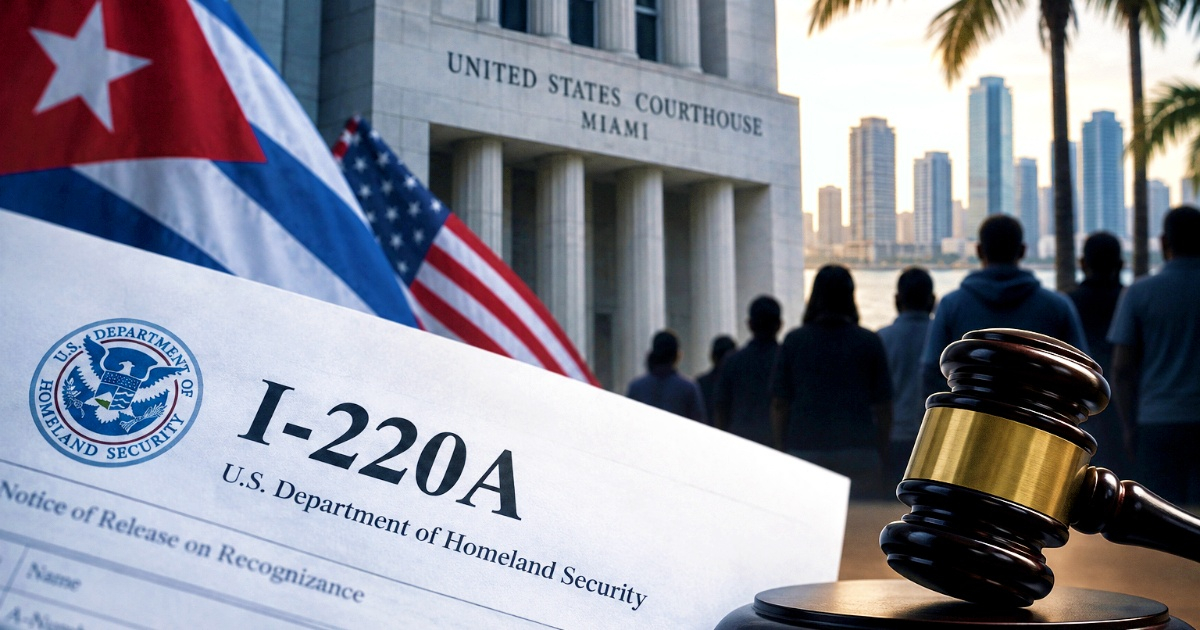
If you crossed the border and were released from immigration custody through a I-220A form, you were probably told that "you have parole" or, conversely, that the document "is worthless." Neither of these statements is accurate.
The I-220A is a release on recognizance order (Order of Release on Recognizance): it allows you to await your immigration process in freedom, but with conditions, and it is not the same as a humanitarian parole.
Difference is not a technicality.
The Cuban Adjustment Act requires that one has been “inspected and admitted or paroled into the United States”, and the Board of Immigration Appeals (BIA) has determined that release on parole does not meet this requirement.
That is why many Cubans with an I-220A do not meet the conditions to obtain residency through this means, even though they can submit an application if they believe they meet the requirements due to other circumstances.
In this guide, we explain what the I-220A is, how it differs from the I-220B and parole, the current status of the legal battle as of Tuesday, October 20, and what obligations you have in the meantime.
What exactly is the I-220A?
The I-220A is a form from ICE (Immigration and Customs Enforcement) titled “Order of Release on Recognizance.”
The official form published by ICE states that release is granted "in accordance with section 236 of the Immigration and Nationality Act (INA)," which is the regulation governing the arrest and detention of foreigners while their case is being decided.
In practice, it means that the government has allowed you to leave detention in exchange for your commitment to comply with certain conditions. Among those listed in the form are:
- Introduce yourself to any audience or interview when ICE advises you to do so.
- Hand you over for deportation if ordered.
- Enroll and comply with a Diversion Program if your release depends on it.
- Do not change your place of residence without first obtaining written permission from the official indicated in the document.
- Do not violate local, state, or federal laws.
- Collaborate with ICE to obtain travel documents if necessary.
That is to say, the I-220A does not give you immigration status. It allows you to remain free while your case is still open, usually before an immigration court.
I-220A, I-220B, and parole: three distinct documents
It's easy to confuse them because all three involve being in the United States without residency. However, they correspond to different situations:
- I-220A (order of release on parole): is issued under section 236 of the INA to individuals whose proceedings have not yet concluded.
- I-220B (supervision order): according to the official ICE form, it is issued to those who already have a final deportation order that the government has not executed within the timeframe required by law. Among other things, it requires the individual to report to ICE whenever requested and to notify in writing of any change of address or employment 48 hours in advance.
- Humanitarian parole: is granted under section 212(d)(5) of the INA. It is a permit to enter or remain in the country for humanitarian reasons or for the public benefit, and it is typically recorded on form I-94.
The I-94 is the arrival and departure record from the Department of Homeland Security (DHS). According to the CBP fact sheet, you can check and print it on the official site i94.cbp.dhs.gov.
The USCIS Policy Manual mentions the I-94 among the valid proofs of inspection, admission, or parole for requesting adjustment of status.
Why is the I-220A no longer valid for the Adjustment Law today?
The key decision is Matter of Cabrera-Fernández, published by the BIA on September 11, 2023.
The Board concluded that release on parole under section 236 is "legally distinct" from humanitarian parole under section 212(d)(5).
He added that admission applicants released in that manner are "not eligible" to adjust their status under the Cuban Adjustment Act.
The BIA maintained that criterion in Matter of Roque-Izada, dated June 20, 2025.
There, he also refused to close a deportation case simply based on the possibility that USCIS may grant a parole in the future.
The preceding decisions of the BIA are the ones applied by immigration judges. Therefore, as long as they do not change or a federal court does not state otherwise, an I-220A alone does not open the door to residency under the Adjustment Act.
What is the status of the legal battle?
The debate is still ongoing in the federal courts.
In Matter of Q. Li, dated May 15, 2025, the BIA itself stated that anyone detained upon arrival in the country falls under section 235(b) of the INA and that the only way to release them is through the parole of section 212(d)(5).
That reasoning opened a new discussion about what legal basis there really was for the release of many migrants at the border.
On February 23rd, the Eleventh Circuit Court of Appeals (which covers Florida) overturned the decisions of the BIA in two cases involving Cubans who were seeking Adjustment of Status, and sent them back to the Board for review.
The court noted that the government had changed its position regarding the rule governing the detention of those migrants and that the appeal courts are divided on the issue.
The resolution did not establish that all migrants released with an I-220A had received parole.
That ruling did not declare the I-220A to be a parole nor did it grant residency to anyone. It only ordered the BIA to reexamine those cases.
In Miami, there are still ongoing lawsuits from Cubans with I-220A: the government has requested again that one of them be dismissed, and there is no substantive decision yet.
Beware of anyone who promises they can "convert" your I-220A into parole in exchange for money.
What obligations do you have if you have an I-220A?
Although the document does not grant you status, violating its conditions can greatly worsen your situation. The most important thing:
- Do not miss any ICE appointments or court hearings. Attending when you are summoned is the first requirement of the form.
- Request permission before moving. The form requires written authorization from the officer before changing your residence. Additionally, you must separately fulfill the obligations of notifying your new address to USCIS and to the immigration court, when applicable, within the relevant timeframes.
- Follow your case in court. With your A number (the alien number that appears on your documents), you can check dates and status in the EOIR case information system, the office that manages immigration courts.
- Complete the Alternatives to Detention program if you have been enrolled in it.
What to do now?
- Check what document you have. Look at the title of the paper you received upon leaving custody and consult your I-94 on the official CBP website. If you have an I-94 with parole, your situation may be different from that of an I-220A.
- Keep copies of everything: I-220A, citations, court notifications, proof of your visits to ICE, and any applications submitted, such as asylum or work permits.
- Consult with a lawyer or accredited representative. Cada caso es distinto: hay cubanos con I-220A que tienen un asilo pendiente, otros con una orden de deportación y otros con una apelación ante la BIA. Te puede servir lo que explicó una abogada sobre the I-220A with a deportation order.
- Learn about the requirements of the Adjustment Law en nuestra , para saber qué te pedirían si algún día cambia tu situación.
- Follow the legal news from reliable sources. A favorable ruling in a specific case does not automatically apply to all Cubans with I-220A.
Aviso legal: este artículo ofrece información general con fines exclusivamente informativos y no constituye asesoría legal. Las leyes y políticas migratorias de EE.UU. cambian con frecuencia. Para evaluar tu caso concreto, licenciado o un representante acreditado por el Departamento de Justicia.
Related videos:
Filed under: