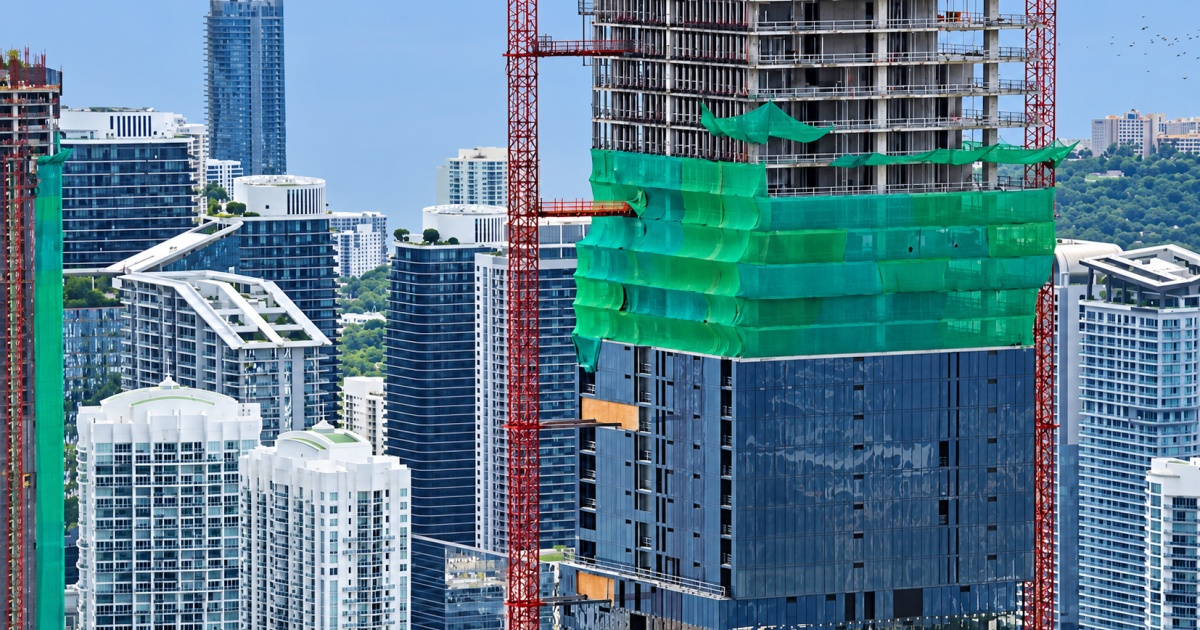
The city of Miami was selected as one of the first 14 cities in the United States to receive support from Bloomberg Philanthropies to accelerate housing construction and reduce administrative obstacles that delay new housing projects.
The initiative, announced on October 15, aims to implement three models developed in San Diego, Austin, and Atlanta in up to 30 U.S. city halls to streamline permitting, facilitate new construction, and reactivate stalled projects.
Miami is part of the first round of selected cities, along with Albuquerque, Alexandria, Charleston, Chattanooga, Cleveland, Columbia, Durham, Louisville, Nashville, Omaha, Pittsburgh, Providence, and San José.
How much money will Miami receive and what will it be used for?
Each participating municipality will receive between $450,000 and $750,000, although the exact amount allocated to Miami has not yet been announced, nor which of the three models it will implement.
The funds will not be given directly to families or residents as housing subsidies, but will be allocated to enhance the municipality's capacity to promote housing projects and expedite the processes related to their construction.
Possible measures include the incorporation of technology to expedite the review of permits, the development of housing plans ready for construction permit applications, and the creation of specialized teams to coordinate the agencies involved in the projects.
The program will have technical assistance from Accelerator for America and other specialists, as well as facilitating the exchange of experiences with cities where these strategies are already being implemented.
The initiative is directed at the municipal government of Miami, not at Miami-Dade County, which has its own administration and permitting procedures.
What changes could take place in Miami?
Bloomberg Philanthropies outlines its goals for the next two years to halve the approval times for permits, double the portfolios of accessory housing projects, and make progress in housing supply.
These are the general goals of the program, not guaranteed results for Miami. A specific implementation timeline has not been announced, nor how many additional homes could be built in the city.
The mayor Eileen Higgins has prioritized affordable housing in her administration.
In March 2026, he launched an express permit review program for certain minor residential projects.
In the statement from Bloomberg Philanthropies, Higgins celebrated Miami's selection and emphasized the importance of expediting approvals to build new housing.
"Housing is the number one priority for U.S. mayors, and working with Bloomberg Philanthropies to adapt successful practices from other places provides Miami with more resources to lead with the boldness that the challenge demands," he stated.
"We expect quick results, which will be reflected in a greater number of authorized homes for construction, and we take pride in doing this work alongside leading local governments throughout the country," the mayor added.
The three models that could be applied
The program draws on experiences from San Diego, Austin, and Atlanta, cities that have developed different strategies to expand housing availability.
In San Diego, the measures include the digitization of procedures and an executive order aimed at limiting the approval deadlines for permits to 30 days.
According to Bloomberg Philanthropies, authorized housing units increased by 82% in one year, and the city recorded nearly 8,800 authorized units in 2024.
The Austin model focuses on facilitating the construction of more housing on existing residential land.
Among its reforms is the allowance of up to three units on numerous lots previously designated for single-family homes, as well as the reduction of the minimum size for certain parcels from 5,750 to 1,800 square feet.
The city has built approximately 120,000 housing units since 2015, a figure that spans a broader period than that of the recent reforms. The measures aim to expand construction opportunities, but this accumulated volume cannot be attributed solely to them.
In Atlanta, the strategy involves bringing together various municipal agencies to identify obstacles and reactivate stalled housing projects. According to figures released by Bloomberg Philanthropies, this model has successfully unlocked more than 2,000 affordable homes.
The three experiences will serve as a reference for the selected municipalities, which will need to adapt the solutions to their own needs and regulations.
How could it benefit the residents of Miami?
The initiative comes to a city where high housing costs present a challenge for many residents, including the Cuban community.
The housing access crisis in South Florida has intensified the economic pressure on households that rely on rentals, while the permitting processes and construction costs hinder the expansion of housing supply.
For residents, the potential benefit of the program would be indirect: if Miami can reduce administrative times and facilitate new developments, it could increase the availability of housing. However, Miami's selection does not mean that rents will decrease immediately.
Bloomberg Philanthropies asserts that municipal governments can intervene particularly in three aspects: what types of housing are allowed to be built, where they can be constructed, and how long it takes to receive approval.
«Municipalities are taking local measures to increase the housing supply and alleviate the shortage that is driving up rents and making the dream of homeownership out of reach,» stated Michael R. Bloomberg while introducing the program.
The former mayor of New York explained that the initiative aims to make it easier for more local governments to adopt solutions that have already shown results in other U.S. cities.
Related videos:
Filed under: