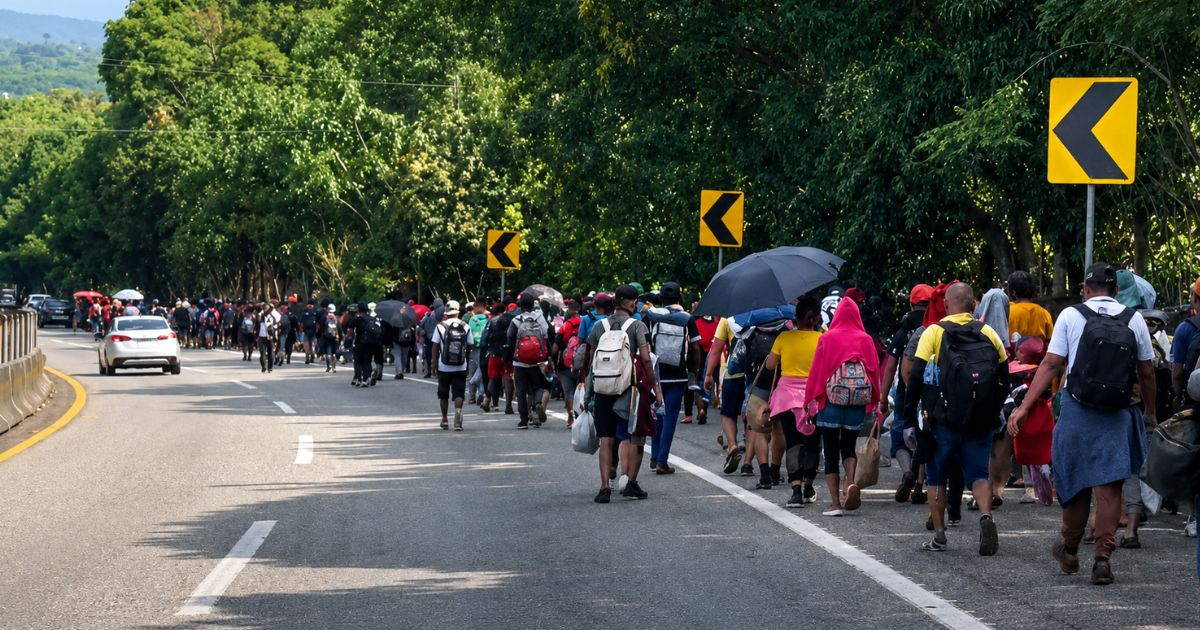
A new caravan of migrants, including Cuban citizens, departed this Tuesday from Tapachula, Chiapas, with the intention of moving towards central and northern Mexico.
Some of its members claim that they are hoping for a victory for the Democratic Party in the upcoming legislative elections in the United States, given the possibility that immigration conditions may change in that country.
The contingent is primarily composed of individuals from Honduras, El Salvador, Guatemala, and Nicaragua, although migrants from Cuba, Haiti, and Venezuela are also participating, according to reported Breitbart News, which gathered reports from the Mexican press about the displacement.
Estimates of the number of participants vary. The Mexican newspaper Milenio reported that around 400 migrants were preparing to continue their journey, while a report from Diario del Sur, cited by Breitbart, placed the number at approximately 700 people after leaving Tapachula.
The mobilization occurs just a few weeks before the U.S. legislative elections in November, where seats in the House of Representatives and part of the Senate will be at stake.
The independent journalist Julio Rosas, who specializes in immigration and border issues, spoke with several members of the caravan who expressed their hope that the Democrats will achieve an electoral victory, according to the U.S. report.
The expectation would be linked to the possibility of a more favorable political landscape for migrants, following the tightening of border and deportation policies during President Donald Trump's administration.
The group’s motivations are varied. While some intend to approach the border with the United States, others seek to stay in Mexico, obtain immigration protection, and access job opportunities.
Several participants have noted that economic difficulties, lack of employment, and lengthy procedures to regularize their situation led them to join the caravan.
According to Milenio, some migrants are considering settling in states like Oaxaca and Nuevo León, particularly in Monterrey, where they hope to find employment and more stable conditions for their families.
The members of the mobilization had gathered at Bicentenario Park in Tapachula, where they stayed for several days while awaiting the arrival of other groups from Central America.
The march resumed on Tuesday afternoon along the Coastal Highway of Chiapas.
According to La Jornada, the participants had arrived in Tapachula from various locations in Central America and began a new phase of their journey towards other regions of Mexico.
Among the travelers are families with minors and individuals who have walked long distances, facing rain, financial difficulties, and challenges in obtaining food and other basic necessities.
A Salvadoran migrant interviewed by Milenio reported that during the journey, some people suffered injuries to their feet, while several minors experienced dehydration and fainting.
The woman explained that religious organizations had provided food and hygiene items to members of the group during their journey through Guatemala and their stay in Tapachula.
The organization of caravans allows numerous migrants to travel in groups and highlights the challenges they face in obtaining immigration documentation in Mexico.
However, participating in a mobilization of this kind does not guarantee the granting of asylum, transit permits, or authorization to enter the United States.
The new departure comes after Mexican authorities intervened in another caravan that had traveled through Chiapas for several weeks.
On October 12, La Jornada reported that the caravan "Faith and Hope with God" was dissolved near the border between Chiapas and Oaxaca, after the authorities offered documents for participants to continue their journey by other means of transportation.
That mobilization had started in San Pedro Sula, Honduras, on September 20, with migrants seeking to move towards the United States or find alternatives to settle in Mexico.
The presence of Cubans in the caravans crossing Mexican territory has been documented on various occasions throughout 2026.
In August, another mobilization was organized from Tapachula while thousands of Cuban citizens remained stranded in that city, affected by delays in immigration procedures and difficulties in finding employment.
At that moment, a report cited by this outlet estimated that there were between 20,000 and 25,000 Cuban migrants in Tapachula, although this was an estimate from August and not an updated count of the participants in the October caravan.
The Mexican Commission for Refugee Assistance (Comar) was facing a high number of applications for refugee status, with foreigners claiming to have been waiting for responses for months and even over a year.
Months earlier, in March, a Cuban who had been unable to regularize his situation for over a year had joined the "Genesis 2026" caravan, made up of around 500 migrants, after facing challenges in obtaining documents and finding work.
Related videos:
Filed under: