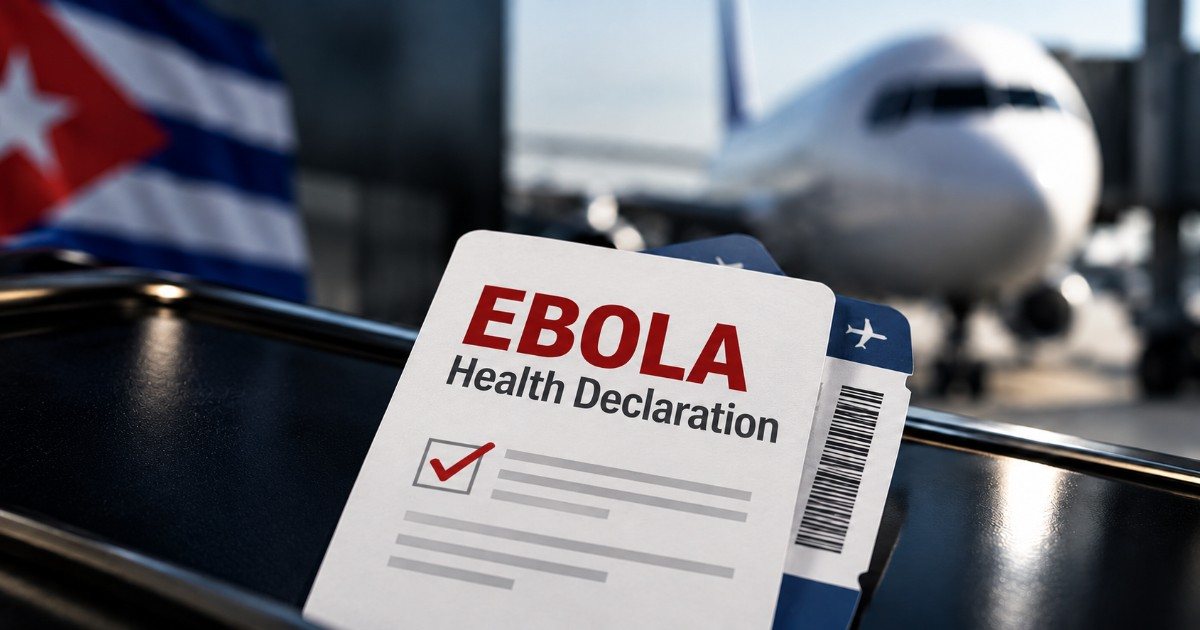
The United States will require a new health declaration related to Ebola from all passengers boarding international flights to its territory, including those traveling from Cuba, Spain, and any other country, as part of the measures to reduce the risk of the disease's introduction.
The order was issued this Thursday by the Centers for Disease Control and Prevention (CDC) and will take effect on November 3 at 11:59 p.m. Eastern Standard Time (EST).
The order stipulates that each passenger must confirm, through a signed statement either on paper or in digital format, that they have not been in the Democratic Republic of the Congo during the 21 days prior to boarding a flight to the United States.
The measure is part of the efforts by U.S. health authorities to prevent the entry of the Ebola virus from that African country, where outbreaks of the disease have been reported.
However, its scope is much broader than flights coming from Africa: the declaration will be mandatory for passengers on international flights to the United States, regardless of the country from which they depart, except for the official exceptions provided.
This means that a person traveling directly from Havana to Miami, or from Madrid to New York, will have to meet the new requirement even if they have never visited the Democratic Republic of the Congo.
The obligation will also apply to passengers who layover at a U.S. airport before continuing on to another country.
According to the official order, airlines and other aircraft operators will be responsible for collecting the attestations and ensuring that each passenger has completed the document before allowing them to board.
Those who do not submit the required declaration will not be allowed to board the flight, unless they have an exemption approved by the United States government.
The CDC explains that the process can be carried out using a signed physical document, an authenticated digital signature, or an electronic mechanism enabled by the airline.
Therefore, the passenger will not necessarily have to print a form. Airlines will be able to incorporate the procedure into their passenger check-in platforms or their pre-boarding verification systems.
Health authorities recommend that operators collect information during the billing or boarding process at the last foreign airport from which the flight departs to the United States.
The requirement will also be mandatory for U.S. citizens and legal permanent residents. Holding a U.S. passport or a residence card, known as a green card, does not exempt one from completing the declaration.
The measure does not make a distinction between travelers for tourism, business, study, or family visits. What matters is that the person is about to board an international flight to the United States.
In the case of individuals under 18 years of age, a parent, guardian, or other authorized adult must complete and sign the statement on their behalf.
The same can be done by passengers who, due to a disability or other limitation, are unable to complete the document on their own.
However, each traveler needs their own declaration. It will not be sufficient to present a single collective form for the entire family.
One of the most important aspects of the new regulation is the calculation of the 21 days prior to the trip.
For the CDC, being in the Democratic Republic of the Congo includes any physical presence in that territory, whether by air, land, or sea.
It also counts as having made a stop at a Congolese airport, even if the passenger has not left the terminal or disembarked from the plane.
On the contrary, flying over Congolese territory without landing is not considered presence in the country for the purposes of this declaration.
Those who have stayed in the Democratic Republic of the Congo must wait a full 21 days after leaving that territory before they can board a flight to the United States, unless there is an applicable official exemption.
The regulations state that the day of departure from Congo is considered day zero, and the first full day outside that country is day one. The traveler may board a flight to the United States starting on day 22, provided they meet the other travel requirements.
The 21-day timeframe corresponds to the maximum incubation period of the Ebola virus disease, meaning the time that can elapse between exposure to the virus and the onset of the first symptoms.
U.S. authorities warn that willfully providing false or misleading information in the declaration may have legal consequences, including criminal penalties.
In addition to verifying the forms, airlines must retain the documentation and make it available to U.S. authorities when required to confirm compliance with the order or to investigate a public health situation.
The new requirement does not mean requesting an additional visa, presenting an Ebola diagnostic test, or proving that the passenger has received a vaccine for the disease.
For Cubans traveling to Miami, Tampa, or other U.S. cities, the practical effect will be to incorporate this declaration into the boarding process, in addition to meeting the immigration and documentation requirements that apply to their particular situation.
Cuban permanent residents returning to the United States after visiting the Island must also present the declaration, even though their immigration status will not change due to this health measure.
People traveling from Cuba to another country without landing in U.S. territory are not included under this specific order.
The provision does not apply to land or sea crossings, as it is intended for passengers entering or transiting through the United States via flights arriving from abroad.
The new requirement is added to other health restrictions related to Ebola that the CDC had adopted in 2026 for certain travelers with recent histories of being in the Democratic Republic of the Congo, Uganda, or South Sudan.
In a previous order, which was updated on October 11, U.S. authorities established entry restrictions for certain categories of foreigners who had been in those African countries.
The difference is that the new document will need to be completed by practically any passenger taking an international flight to the United States, even if their trip has no connection to Africa.
According to the CDC, the purpose of the declaration is to strengthen preventive measures to prevent individuals who have recently been in high-risk areas from traveling during the disease's incubation period.
The CDC contemplates limited exceptions, including special authorizations for certain medical transfers related to Ebola and individual exemptions granted for humanitarian reasons or other significant governmental considerations.
These exceptions are not automatically granted based on having U.S. citizenship, permanent residency, or a family emergency.
The official guide for individuals returning from areas affected by Ebola also distinguishes the restrictions related to the Democratic Republic of the Congo from other provisions applicable to individuals who have recently been in Uganda or South Sudan.
Regarding its duration, the order states that it will remain in effect until December 18, 2026, unless the authorities withdraw or modify it beforehand. It also provides for the possibility of an extension if a subsequent assessment of the epidemiological situation justifies it.
For now, travelers with flights scheduled from November 3 should check communications from their airlines and verify how the declaration procedure will be implemented before arriving at the airport.
The CDC has published an official reference form and instructions for its application. Airlines will be able to provide versions in other languages and use electronic procedures to collect the information.
The new statement is part of a series of measures that the United States has adopted in 2026 to prevent the arrival of Ebola on its territory.
In May, U.S. authorities tightened health controls in response to the outbreak spreading in Africa, with restrictions for certain foreigners who had recently been in the Democratic Republic of the Congo, Uganda, or South Sudan.
At that time, Secretary of State Marco Rubio stated that Washington's priority was to prevent the virus from reaching the United States.
Related videos:
Filed under: