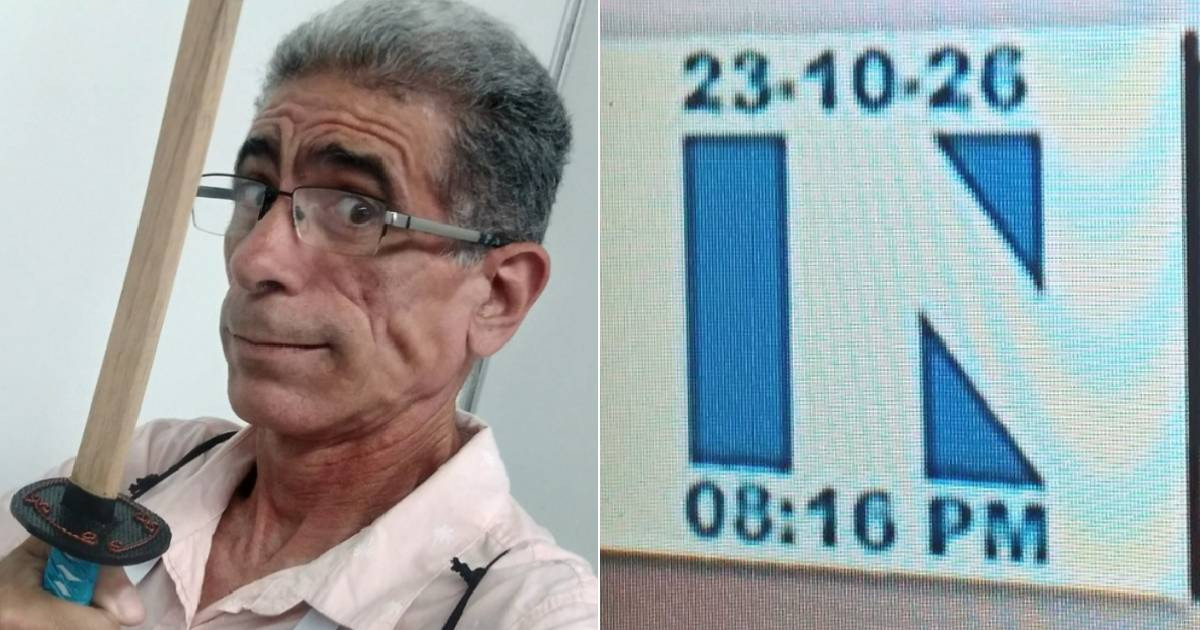
Francisco Rodríguez Cruz, Vice President of the Cuban Journalists Union (UPEC), acknowledged that the National Television News (NTV) does not connect with the public, a criticism that resonated with users who questioned the credibility and focus of official journalism.
He also known as Paquito from Cuba, published this Friday on his Facebook profile his thoughts while watching the NTV, a program that, as he mentioned, he hadn't tuned into for a while "due to the oil blockade and the lack of electricity."
"I'm at the 16-minute mark of the news... Meetings and long faces. Nothing that connects with ordinary people. It's very difficult to win the cognitive war against the Revolution like this," he wrote.
The reflection drew attention as it came from a vice president of the organization that groups recognized Cuban journalists by the authorities.
Although the comment remains within the official narrative about the so-called "cognitive war," it acknowledges a central difficulty for institutional discourse: connecting with a population whose everyday concerns do not always find space on state television.
The responses to the post indicated that the problem is not limited to the lack of electricity. One commenter questioned the credibility of the NTV and the repetition of meetings where issues are discussed that reemerge without visible solutions.
"The disconnection is not always related to the lack of electricity, but rather to credibility. How many meetings discussing 'core issues' have we witnessed? Yet, the same 'cardinal' problems (with no solutions beyond the reports) stubbornly return to the agenda of those meetings, in an infinite loop," he wrote.
Other users described how power outages affect their habits. One noted that the few hours of electricity are used for cooking, washing, or catching up on Turkish series and novelas saved on USB drives.
Another person stated that he hadn't seen the NTV in over a year, not due to a lack of interest, but because there was never electricity in his area during the broadcast hours.
There were also comments from people who haven't tuned into the program in years. One user, who claimed to have not watched it for 23 years, recalled that the news used to combine international stories that caused him "stress, anxiety, anger, and even shame" with national information about the fulfillment of production plans, which were frequently reported as exceeding 100%. His question was whether that structure was still the same.
One of the most poignant responses summed up the discontent in a single sentence: "Cuba is in pieces, but NTV doesn't know it."
Other commentators directly questioned the tone of Rodríguez's post. One labeled his message as "tasteless sarcasm" and "mockery of the people," while another contrasted the television content with the situation observed on the streets.
"It's all achievements and meetings. Step outside and you'll see how far the NTV is from reality. Official journalism is the most outdated thing in this country," he wrote.
The discussion highlighted a contradiction between the objective of winning the so-called "cognitive war" and the criticisms from the viewers themselves regarding the content and credibility of the main news program on Cuban television.
At the end of August, an electrical failure at the studios forced a presenter to apologize live on air. Days later, another blackout interrupted the signal for several minutes.
In mid-October, the NTV mistakenly aired the subtitle "The United States embargo against Cuba does not prevent the people of the island from capitulating", which led to widespread mockery before the segment was removed.
Rodríguez's behavior on social media tends to be mocking and contradictory. In May, he mocked the threat from President Donald Trump to send an aircraft carrier to the Cuban coast, and at the beginning of October, he dressed in a wig to ridicule the opposition activist Anna Bensi, shortly after her sentencing.
Meanwhile, the UPEC, which in April called for the construction of a "global propaganda front" against the "lies" about Cuba, is facing its own crisis.
On July 22, during the Plenary of the National Committee of the official organization, Ariel Terrero, dean of the Faculty of Communication at the University of Havana, expressed concern about the enrollment in the Journalism program with only 17 students registered for the 2026-2027 academic year, the lowest number recorded.
In light of that debacle, the Faculty of Communication issued an extraordinary call for the Journalism program aimed at university students who are already enrolled in other disciplines.
Related videos:
Filed under: