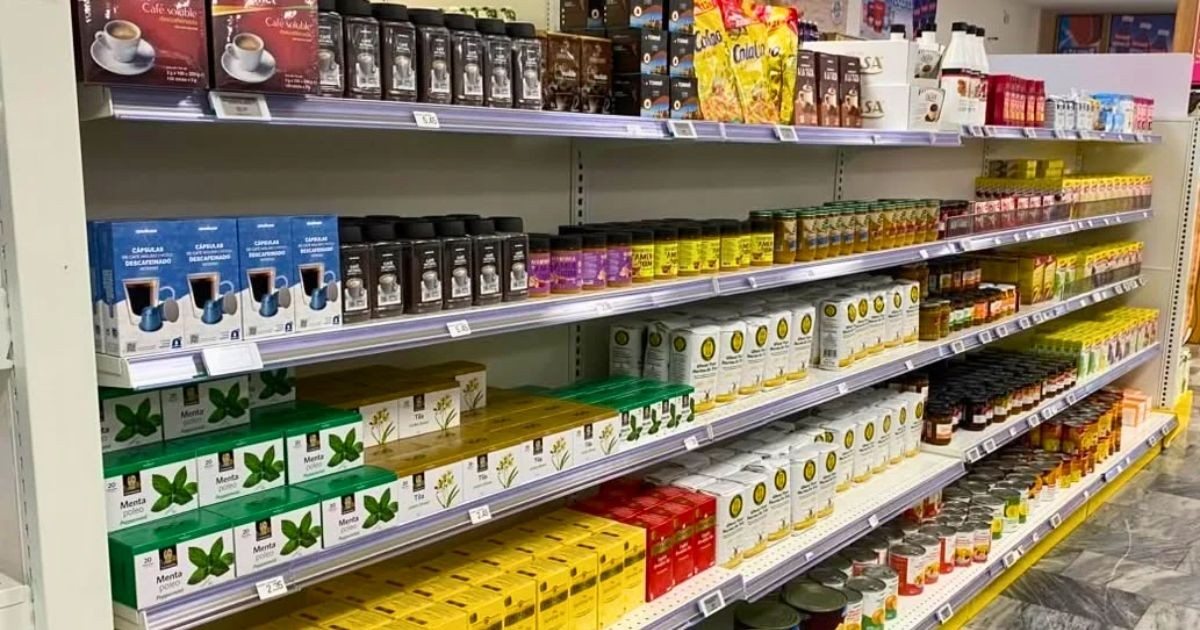
The Caracol Market Comodoro Branch, a state-run store that operates exclusively in dollars next to the Comodoro Hotel, in the municipality of Playa in Havana, published a promotion of its tempting range of items for home, food, beverages, and fresh products this week on Facebook, which is out of reach for most of the impoverished Cuban population.
The response from internet users was immediate: a flood of ironic and furious comments that depicted, better than any analysis could, the gap between certain provisions of the regime and the reality of the people.
The official publication from Tiendas Caracol enthusiastically invited: “Mercado Caracol Comodoro awaits you with a wide and attractive variety of household items, food, beverages, fresh products...!!!! A whole array!! Visit us.” The images displayed shelves filled with toilet paper, pasta, grains, teas, creams, and utensils. A visual luxury that, for most Cubans, belongs to another dimension.
A user summed up the collective sentiment with a single phrase: "Wait: when they pay my retirement in dollars, I'll buy [...]. What a lovely picture." The comment became the perfect epitaph for an economic policy that pays meager salaries and pensions in Cuban pesos while selling basic goods in dollars.
Another internet user asked bluntly: "Excuse me: can you pay in CUP?" The implicit answer is known by any Cuban: no. The establishment, which reopened in July 2026 under the brand name Supermix, only accepts cash in dollars or magnetic cards in this currency.
The figures explain the outrage. The official minimum pension in Cuba is 4,000 Cuban pesos per month since September 2025, equivalent to less than five dollars at the current unofficial exchange rate exceeding 800 CUP per dollar. The estimated cost of living to cover basic needs exceeds 96,000 CUP per month, according to independent calculations, around 24 times that minimum pension.
The prices at the Mercado Caracol Comodoro at the time of its reopening further highlighted the absurdity: pork chops at nearly 130 dollars each, smoked Norwegian salmon at over 100 dollars, and even shopping bags priced at three dollars each.
The irony about the embargo—the regime's favorite argument to justify shortages—was not omitted either. “There’s no blockade when it comes to selling everything for dollars, right?” wrote a user.
Another internet user added: "And the people are incredibly hungry. This is an abuse, and where is the blockade? I don’t see it." When it comes to supplying stores with foreign currency, the embargo seems nonexistent; when it comes to providing the warehouses in pesos, the blame always falls on him.
But the outrage didn't end with dollarization. Several commentators pointed to the blackouts that even prevent people from going out to shop. "Girl, there's never any power," wrote one user. Another was more explicit: "To buy something, you have to make 5 or 6 trips because there's never any power." A third commentator, who claimed to have visited the store five times, reported that "card payments hardly exist," attributing the issue to connectivity problems.
It is not an isolated phenomenon: in June 2026, customers at currency stores were already reporting that terminal failures forced them to carry cash in dollars, a currency that the Banco Popular de Ahorro itself acknowledged it could not provide due to a shortage of freely convertible currency.
The currency stores system was launched in July 2020 with 72 establishments, operating in Convertible Currency (MLC) and by mid-2025 already operated at least 80 state-owned stores exclusively in dollars, while stores in Cuban pesos faced chronic shortages. It is estimated that large segments of the population cannot purchase basic products in these establishments due to their limited income in foreign currency.
The question that no one in the regime answers is for whom they really work, when a 70-year-old Cuban retiree with 4,000 pesos can barely afford to eat in a month. However, the standard of living of the power elites in Cuba provides clues about where the money flows.
"Everything is so good, the power that the dollar holds: long live the dollar," concluded another commentator, with an irony that speaks volumes.
Related videos:
Filed under: