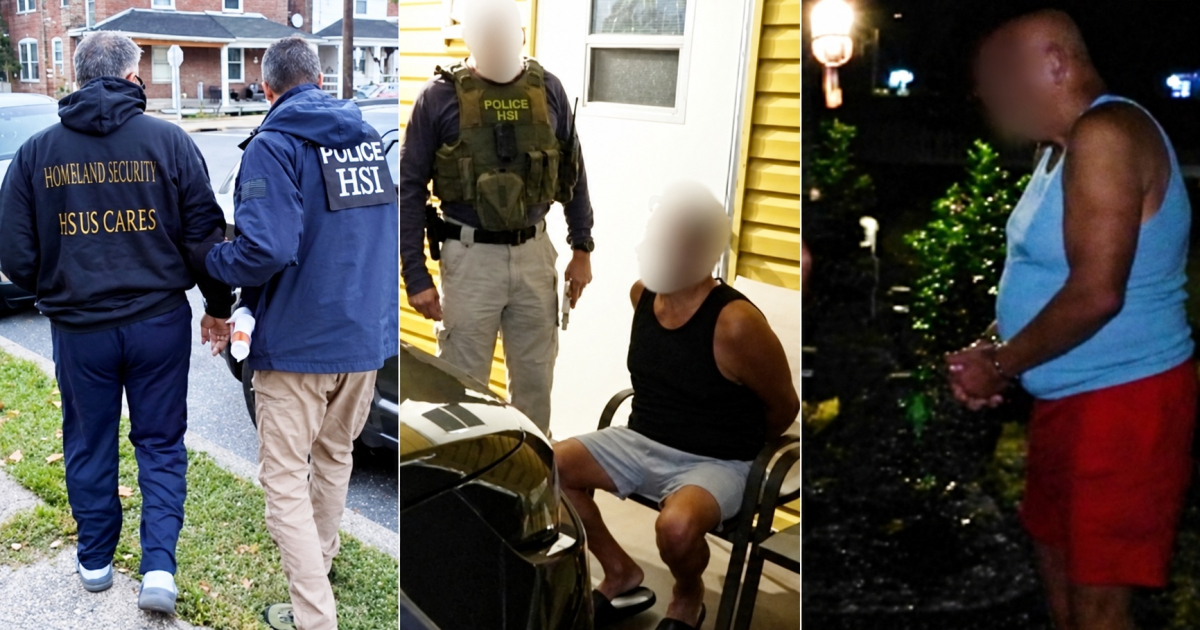
Four Cuban citizens are included in a group of 48 foreigners against whom the U.S. Department of Justice announced criminal charges this Monday, October 26, for alleged election-related offenses in Pennsylvania, California, Florida, New York, and Nevada.
The four Cubans, aged between 60 and 73, are accused of voting illegally in federal elections held in 2022 and 2024.
Two of the cases are from Florida and the other two are from Pennsylvania.
Three of the Cubans involved are legal permanent residents of the United States, while the fourth is an undocumented immigrant.
The accusations include illegal voting by foreigners and, in one case, an alleged false statement of U.S. citizenship to register and vote.
Two Cubans accused of voting illegally in Pennsylvania
Alfredo Santiesteban, 73 years old, is the only undocumented immigrant among the four Cubans mentioned in the statement.
He was formally charged with illegal voting for allegedly participating in the general elections of November 2024.
Also in the Eastern District of Pennsylvania, Osmal Loy, a 70-year-old Cuban citizen with legal permanent resident status in the United States, was charged.
In his case, federal authorities argue that Loy voted illegally in the 2024 general elections, for which he faces a corresponding charge.
Both are part of a group of four foreigners accused in that judicial district, which also includes citizens from Poland and Israel.
Two more Cubans face charges in Florida
In the Florida Middle District, Jamie Orlando Sosa Sardina, a 60-year-old legal permanent resident, is facing accusations of allegedly falsely declaring that he was a U.S. citizen in order to vote and of illegally voting as a foreigner.
According to the Department of Justice, Sosa Sardina registered to vote in 2022 and participated in the federal general elections of that year and in 2024.
His case includes, therefore, both the alleged false declaration of citizenship and the illegal exercise of voting.
The other Cuban accused in Florida is Luis Manuel Pérez, 72 years old, also a legal permanent resident.
In the case of Pérez, authorities claim that he voted illegally in the federal general elections of 2022 and 2024.
The two Cubans are among six foreigners accused of electoral offenses in the Middle District of Florida.
The other four are citizens of Ecuador, Canada, and Brazil.
The 48 defendants face various electoral offenses
The operation announced by the Department of Justice covers five states and various types of offenses, ranging from illegal voting by non-U.S. citizens to false statements for voter registration and alleged irregularities in naturalization procedures.
California accounts for 28 of the 48 defendants, distributed among the Central, Eastern, Northern, and Southern judicial districts.
In several of those cases, authorities claim that permanent residents registered to vote by asserting they were United States citizens and subsequently concealed that information in their applications or naturalization interviews.
In Pennsylvania, nine charges were announced, and in Florida, another six. New York has four defendants, and Nevada has one.
Among the cases described in California is that of a citizen of Belize accused of registering to vote in 2019, participating in several elections between 2020 and 2024, and falsely stating during his naturalization process that he had never claimed to be a U.S. citizen.
In New York, three permanent residents of Irish, Guyanese, and Jamaican nationalities are accused of having voted in the 2024 federal elections.
According to the statement, the three individuals acknowledged during voluntary interviews with federal agents that they were not U.S. citizens and had voted despite being aware of that fact.
What does U.S. law state about voting by foreigners?
U.S. federal law prohibits, with specific legal exceptions, non-U.S. citizens from voting in federal elections, including presidential elections and those held to elect members of Congress.
Legal permanent residency, known as green card, does not grant the right to vote in those elections.
Although some jurisdictions allow certain foreign residents to participate in local elections, those exceptions do not apply to federal elections.
The illegal vote of a foreigner in a federal election can carry a maximum penalty of one year in prison, while certain false statements regarding U.S. citizenship may lead to more severe criminal penalties, depending on the charges filed.
The Department of Justice emphasized that all the announced charges consist solely of allegations and that the defendants are presumed innocent until proven guilty beyond a reasonable doubt in a court of law.
The announcement comes eight days before the midterm legislative elections, scheduled to be held on November 3rd.
Related videos:
Filed under: