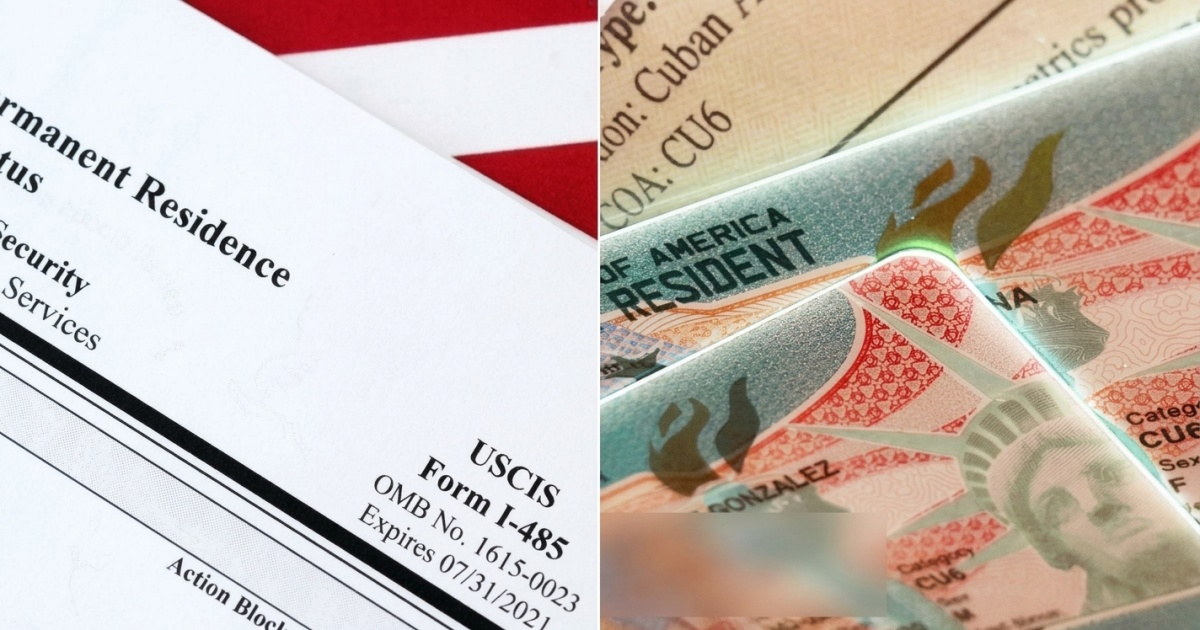
If you entered the United States on parole and have had at least one year of physical presence in the country, you meet one of the requirements to apply for permanent residency under the Cuban Adjustment Act. The process is carried out using Form I-485, but meeting that timeframe alone does not guarantee that you will obtain residency; you must also meet the other eligibility and admissibility requirements.
To submit the application, you need:
- the I-485 signed in its current version.
- two photographs, identity documents.
- proof of birth or Cuban citizenship.
- evidence of your entry or parole.
- documents proving at least one year of physical presence in the United States and, when applicable, the I-693 medical examination and court records.
Documentation must be prepared carefully. USCIS may reject applications due to filing errors and, under certain circumstances, deny them for lack of initial evidence without first issuing a request for additional evidence.
Why you should submit a complete file
Federal regulations allow USCIS to deny an application when the required initial evidence is missing, without needing to request it later. This authority is outlined in 8 CFR 103.2.
On August 5, 2026, USCIS announced a strengthening of its evidence standards and reminded that its officers can deny certain applications without first issuing a request for additional evidence, known as an RFE (Request for Evidence), or a notice of intent to deny. CiberCuba explained the scope of this policy.
This does not mean that all incomplete applications are automatically denied. USCIS may request additional documentation depending on the circumstances of the case.
It is also important to distinguish between rejection and denial. A request submitted without a valid signature or with an incorrect payment may be rejected before processing. In this case, it usually does not retain the submission date and must be resubmitted. A denial, on the other hand, means that USCIS has reviewed the application and determined that it cannot be approved.
The list of documents for the I-485
USCIS publishes a general checklist of initial evidence for Form I-485.
Applicants under the Cuban Adjustment Act must also meet the specific requirements of this category.
- Completed and signed Form I-485. Debe utilizarse una edición aceptada por USCIS en la fecha de presentación. La agencia anunció que, desde el 18 de septiembre de 2026, dejaría de aceptar determinadas ediciones anteriores. Antes de presentar el expediente, comprueba la edición vigente y las instrucciones en the official page of the I-485.
- Two passport-style photos. They must be recent, identical, and meet USCIS specifications.
- Identification document with photograph. A copy of the biographical page of the Cuban passport or another acceptable official document may be used.
- Birth or Cuban citizenship certificate. According to the eligibility criteria, a Cuban birth certificate, Cuban passport, or other documentation accepted by USCIS may be submitted. If the document is in Spanish, it must be accompanied by a complete and certified translation into English.
- Inspection and admission test or inspection and parole. The I-94 form is typically used, although there may be other official documents that certify the manner of entry or the parole granted.
- Proof of physical presence in the United States for at least one year. This may include rental agreements, receipts, employment records, school documents, medical records, bank statements, or other dated evidence that can attest to residency during the required period.
- Medical Examination I-693. It generally must be submitted along with the I-485 when the applicable instructions require it. There are situations where it is not necessary to submit a new complete examination or certain parts of the form.
- Police and court records. If you have had arrests, charges, or convictions, you must review the USCIS instructions and submit the corresponding certified documents, even if a proceeding has ended without a conviction.
- Waivers of inadmissibility requests. Forms such as the I-601 may be necessary in certain cases, but they are not part of every file. Their submission depends on the reason for inadmissibility and the legal availability of a waiver.
If your spouse or children are applying for residency as derivative family members, each must submit their own application and the relevant documentation.
Proof of family ties is also required, such as marriage or birth certificates, as well as documents regarding previous marriages when applicable.
How to prove a year of physical presence in the United States?
One of the fundamental requirements of the Cuban Adjustment Act is to prove at least one year of physical presence in the United States before applying for status adjustment.
To demonstrate this, you can gather documents that allow you to reconstruct your presence in the country during that period:
- Rental contracts and housing payment receipts.
- Electricity, water, telephone, or other service bills.
- Employment records and salary slips.
- Bank account statements with dates and transactions.
- Medical or school records.
- Official documents that confirm your presence on specific dates.
It is advisable to provide evidence spread throughout the period you need to substantiate, rather than relying on a single document.
The assessment of the year should be evaluated according to each person's circumstances.
In certain cases, the required physical presence may have accumulated prior to the granting of parole, as long as the other legal requirements are met.
Therefore, the date of entry into the country should not be automatically confused with the date when parole was granted.
The I-94: How to Prove Your Entry or Parole
The Cuban Adjustment Act requires, among other criteria, to have been inspected and admitted or to have received parole after a migratory inspection.
The I-94 form is one of the most common pieces of evidence for that situation. The Customs and Border Protection (CBP) allows you to check and print the electronic record from the official I-94 site.
Before submitting the document, check that your name, date of birth, entry information, and immigration status are correct. If you find any discrepancies, refer to the appropriate procedure to request a correction.
Not all applicants have the same type of immigration documentation. In some cases, there may be passport stamps, official records, or other relevant evidence that must be reviewed together.
If you received an I-220A instead of documentation that certifies admission or parole, you should not assume that both documents have the same legal effect. Eligibility under the Cuban Adjustment Act depends on your specific immigration situation and the applicable legal criteria. Before submitting the I-485, it is advisable for an immigration attorney to review your case.
The medical examination I-693
Most adjustment of status applicants must meet the medical requirements set by USCIS. The examination is conducted by a physician authorized by the agency, known as a civil surgeon.
You can locate one through the official tool to find USCIS-authorized doctors.
- USCIS requires submitting the I-693 along with the I-485 cuando el examen médico sea obligatorio conforme a las instrucciones aplicables.
- The doctor hands over the form in a sealed envelope. You must not open it, because USCIS may consider a form invalid if the envelope has been opened or altered.
- The cost is paid directly to the doctor. Before going, ask if it includes tests, vaccines, and other services.
- If you have your vaccination card from Cuba, bring it to the appointment. It can help document the vaccines you have already received.
Some individuals may be exempt from retaking certain parts of the exam or may have prior valid medical immigration documentation. Check the official I-693 instructions to determine what applies to your situation.
Translations, copies, and signatures
USCIS establishes specific requirements for the documentation that accompanies immigration applications.
- Translations: any document in a language other than English must be accompanied by a complete translation into English and a certification from the translator confirming its accuracy and their qualifications to perform it.
- Copies: generally, legible photocopies should be sent, unless the instructions explicitly require original documents. Keep the originals in case USCIS requests to examine them.
- Signatures: forms submitted on paper must adhere to USCIS signature rules. The agency accepts certain reproductions of handwritten signatures, but simply typing a name is not sufficient as a valid signature. In the case of individuals under 14 years old, a parent, guardian, or legal representative may sign in accordance with the applicable instructions.
Signature-related errors can lead to the rejection of an application. CiberCuba explained the signature requirements and their consequences.
Rates and address for sending the I-485
The cost of Form I-485 depends on the current fees and the applicant's circumstances. Before making a payment, please check the official USCIS fee schedule (G-1055) and the form instructions.
If you are also requesting employment authorization through the I-765 or a travel document through the I-131, check the corresponding fees and filing conditions. You should not assume that these procedures are included for free in the payment of the I-485.
The address to send the package depends on the immigration category and the place of residence. USCIS publishes the official filing addresses for Form I-485.
Applicants under the Cuban Adjustment Act must accurately identify their category on the form and use the address provided by USCIS for that classification. Before submitting the application, also review the accepted payment methods and the current submission instructions.
To learn about the procedure, you can consult the and the published by CiberCuba.
Errors that can lead to rejections or denials
Among the issues you should avoid when preparing your application are:
- Using a version of the I-485 that USCIS no longer accepts.
- Submit the form without a valid signature or with an incorrect fee.
- Failure to provide sufficient proof of birth or Cuban citizenship, as applicable.
- Omitting necessary documentation to prove admission, parole, or the year of physical presence.
- Failing to submit the I-693 when required or providing an open medical envelope.
- Send documents in Spanish without the corresponding certified translations.
- Omit police or judicial records that must be declared and documented.
- Submitting the application without meeting the applicable eligibility requirements.
Not all these mistakes have the same consequence.
Some may cause the initial rejection of the application; others may lead to a request for additional evidence or a denial after reviewing the file.
What to do before submitting the application?
- Check that you meet the requirements of the Cuban Adjustment Act and that you can verify your admission or parole.
- Gather documents that prove your birth or Cuban citizenship and at least one year of physical presence in the United States.
- Download the I-94, if available, and check that your information is correct.
- Check if you need to submit the I-693 and request an appointment with an authorized physician when necessary.
- Download the I-485 edition accepted by USCIS and complete all applicable sections.
- Check the rate, payment method, and delivery address before sending the package.
- Keep a complete copy of the file and use a shipping service with tracking.
If you have a criminal record, received an I-220A, have undergone deportation proceedings, or there are doubts about your entry or immigration status, consult with an immigration attorney before submitting the application.
Legal notice: this article provides general information and does not constitute legal advice. Immigration requirements and policies may change. To assess your specific situation, consult with an authorized immigration attorney or a representative accredited by the U.S. Department of Justice.
Related videos:
Filed under: