A year after Hurricane Melissa devastated Santiago de Cuba, more than 70,000 families in the province are still waiting to recover their homes, as acknowledged by the provincial government itself on the first anniversary of the disaster.
The cyclone made landfall in the early morning of October 29, 2025, at El Francés beach in the municipality of Guamá, with sustained winds of 195 km/h and a category 3 on the Saffir-Simpson scale.
The impact was devastating: more than 106,000 homes damaged, over 22,000 total collapses, 851 educational institutions affected, and crops lost across more than 40,000 hectares, in addition to the destruction of electrical and telecommunications infrastructure.
The recovery began with some speed. Yasmín Tortoza Sánchez, program coordinator of the Provincial Government, noted that "between November and December, we received over 100,000 tiles and other materials that allowed us to recover the bulk of those homes," and that by early 2026, around 20,000 had been rehabilitated.
However, that progress came to a halt.
Ángel Hechavarría Hechavarría, one of the thousands affected who still await reparations, describes it clearly: "Since oil and other resources stopped coming into the country, what was moving swiftly has practically come to a halt."
Ángel's testimony summarizes the situation of tens of thousands of families: until January 2026, he held hopes that the partial collapse of his roof would be resolved soon, but everything changed in February.
Five months after the hurricane, only 17% of the damaged homes had been rehabilitated, according to data from April 2026, highlighting that the paralysis was not temporary.
The shortage of fuel prevents the transportation of materials to rural and mountainous municipalities, and received donations remain undistributed for the same reasons, as acknowledged by the provincial government itself.
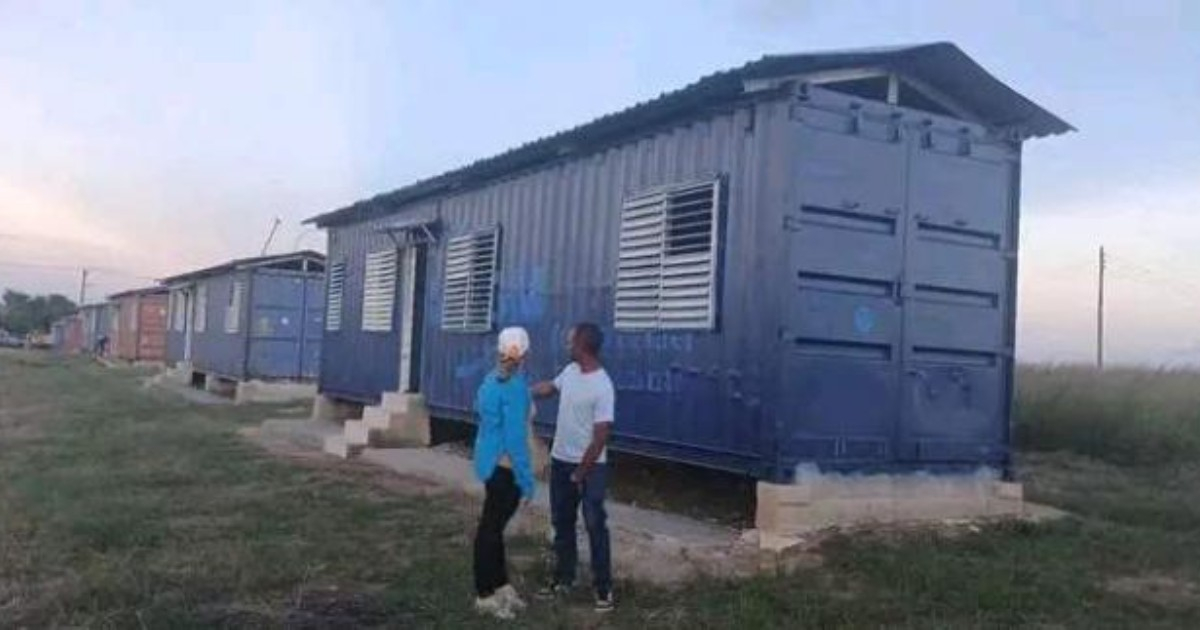
As alternatives, the regime promotes the adaptation of metal containers, the construction of type IV housing, and the local production of bricks, pipes, and lime in the nine municipalities of the province.
The international response has been significant but insufficient given the magnitude of the damage.
The UNDP mobilized 2.6 million dollars and distributed over 6,400 metal roofing modules and 26,000 tarpaulins for temporary coverings, while the Cuban Red Cross and the International Federation assisted more than 35,000 vulnerable individuals and installed 14 photovoltaic systems in clinics in the eastern part of the country to ensure medical care during power outages.
The UN, for its part, requested 74.2 million dollars to assist nearly one million affected individuals, stating this week that "recovery continues" in Cuba, although it acknowledged the deep scars left by the phenomenon.
The energy crisis that the island is experiencing —prolonged blackouts, critical fuel shortages, and deterioration of the electrical system— is the main structural obstacle to reconstruction, warned the Red Cross on the first anniversary of the hurricane.
That crisis is not a result of the cyclone, but rather the outcome of decades of mismanagement by the Cuban dictatorship, which has left the country without the capacity to respond to a disaster of this magnitude.
A year later, the most striking image of Santiago de Cuba is not that of a province in reconstruction, but rather that of more than 70,000 families who continue to live under broken roofs or in temporary solutions, waiting for materials that have not arrived.
Related videos:
Filed under: