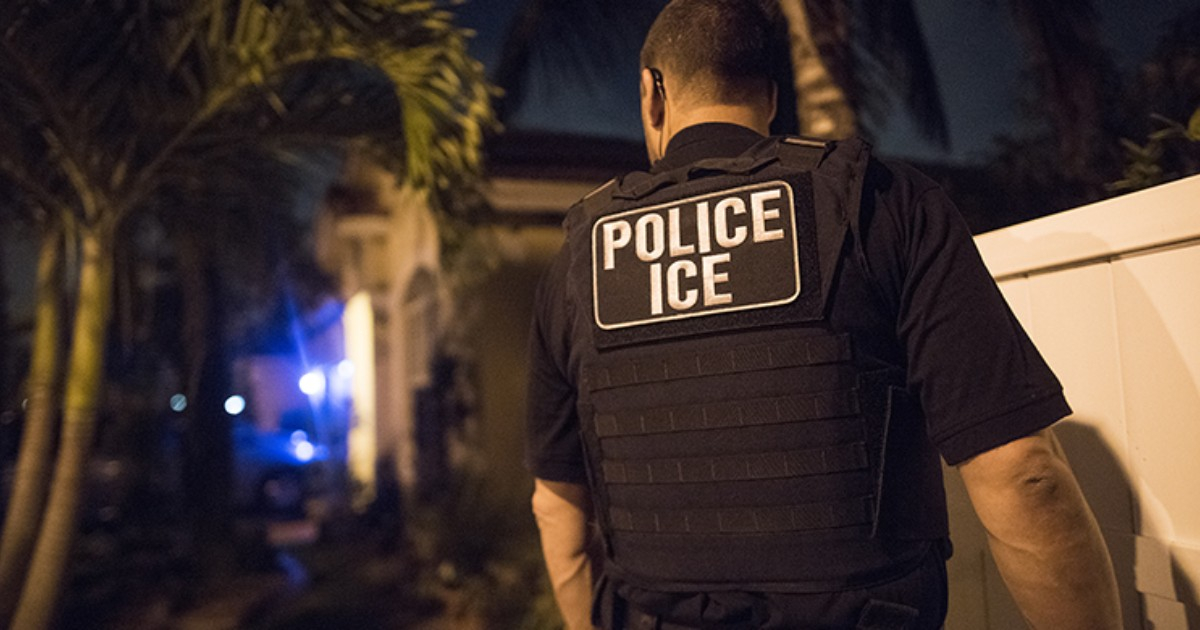
A new report reveals that more than 29,000 state and local agents were authorized by Immigration and Customs Enforcement (ICE) to carry out immigration functions between January 2025 and October 2026, a number that has doubled from just eight months ago and significantly exceeds the 11,600 deportation officers directly employed by the federal agency.
The analysis was published this Wednesday by FWD.us —a U.S. nonprofit organization focused on immigration reform and the criminal justice system— based on public records from ICE and data from the Deportation Data Project, an academic project by UC Berkeley and UCLA.
The Department of Homeland Security defends the program as a critical tool to reduce crime and illegal immigration.
The mechanism behind this expansion is the 287(g) program, which authorizes police departments and sheriff's offices to carry out immigration arrests.
More than 1,850 agencies in 30 states are currently participating in its most aggressive model, covering jurisdictions where at least one in three people in the country reside.
Felicity Rose, Vice President of Research at FWD.us, described the tactical shift of the Trump administration: “These state and local agents are a key leverage point in the more subtle approach to law enforcement. They are replacing what used to be high-profile operations in cities like Chicago and Minneapolis with simple routine traffic stops under the 287(g) program.”
Florida and Texas account for nearly half of the more than 47,000 immigration arrests made under 287(g) nationwide between January 2025 and August 6, 2026.
Florida has accumulated about 29,000 total ICE arrests so far in 2026, ranking second only to Texas, which exceeded 63,000 in the same period.
During the summer, Florida averaged more than 200 arrests per day—almost double that of the first part of the year—with over half of those detained having no charges or criminal convictions.
Independent analyses from the Cato Institute and the New York Times agree that only between 5% and 7% of those arrested by ICE had convictions for violent crimes.
The impact is particularly severe for the Cuban community in South Florida. Arrests of Cubans by ICE skyrocketed by 463% between late 2024 and early 2026, according to the Cato Institute.
More than 42,000 Cubans have active final deportation orders, and those who carry form I-220A, have expired parole, or pending cases are particularly vulnerable: a traffic stop can end in ICE custody, as Florida law requires the 67 county sheriffs to sign 287(g) agreements.
The Miami Police lead arrests under 287(g) in Miami-Dade with 451 arrests between August 2025 and August 2026, of which 131 —29%— are of Cubans. WUSF documented multiple cases of immigrants initially detained for traffic violations and then transferred to ICE.
Money drives this expansion. The Department of Justice offered this summer $3 billion in grants for agencies to join the program, while Florida manages a state fund of up to $250 million to reimburse participants; as of June 30, it had already approved about $148 million.
Joseph Nohava, organizer of the Tampa Immigrants Rights Committee, summarized the structural dependence created: "It would be impossible for ICE to do its job without the help of local law enforcement." He added that in no recent community walk has there been a lack of someone recounting the detention of "a friend, coworker, or family member" at the hands of ICE.
Rose anticipates that growth will not stop: the promise of funding, she claims, will continue to attract more agencies. For Cubans with uncertain immigration status in Florida, this means that the risk of an unexpected detention will only increase.
Related videos:
Filed under: