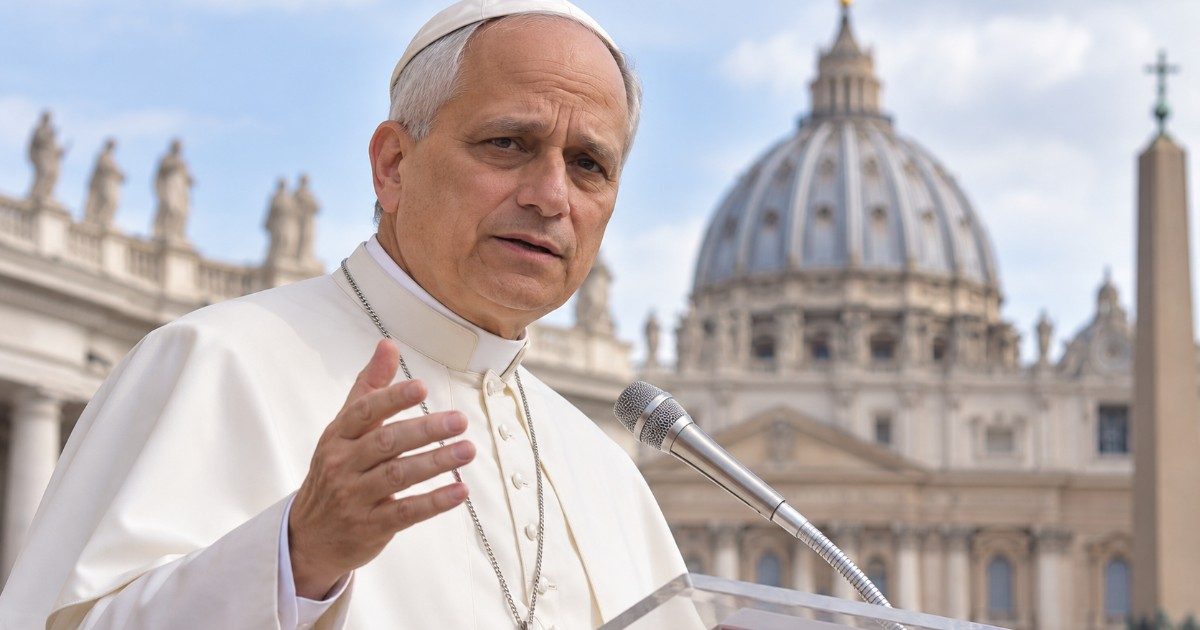
The pope Leo XIV became the first pontiff in history to vote in a general election in the United States, after sending his ballot by mail to Chicago to participate in the legislative elections on November 3rd.
The Press Office of the Holy See confirmed this Friday that Leo XIV, born in the United States, exercised his right to vote, following a practice he maintained since before becoming the leader of the Catholic Church.
«Pope Leo XIV has exercised his right to vote as a citizen of the United States whenever he has met the requirements to do so,» the Vatican stated in a release also shared by Vatican News on the social network X.
The institution explained that, in line with that trajectory of civic engagement, the pontiff cast his vote by mail to Chicago, the city where he was born in 1955 under the name of Robert Francis Prevost.
The Holy See added that León XIV also exercised his voting rights during his years of residence in Peru, as long as he met the requirements to do so.
"The Holy Father expresses his conviction that citizens have the right and the duty to participate in democratic processes," the statement concluded.
The decision sets a precedent for the papacy, although the exercise of voting is not a novelty in the personal life of Leon XIV.
The current leader of the Catholic Church retains his American citizenship and is registered in the voter registry of Illinois.
According to a report by the Associated Press (AP), the pontiff requested his ballot on October 3 from the election authorities of Will County, where he is registered at an address in New Lenox, a town near Chicago.
The absentee voting mechanism allows U.S. citizens residing abroad to participate in federal elections without the need to physically return to the country.
In the elections on November 3rd, all 435 seats in the House of Representatives will be renewed, and 35 Senate positions will be contested.
There will also be gubernatorial elections in 36 states, as well as numerous state and local contests.
In Illinois, where León XIV is registered, voters will need to decide, among other positions, who will fill the Senate seat being vacated by Democrat Dick Durbin and whether Governor JB Pritzker will secure a third term.
One of the most striking aspects of the pope's electoral history is that he has requested ballots from both the Democratic and Republican parties to participate in primary elections.
According to records from the Illinois Board of Elections reviewed by AP, the pontiff participated in five primaries since the year 2000: he requested Democratic ballots in 2008 and 2010, and Republican ones in 2012, 2014, and 2016.
However, these documents do not reveal who they voted for. In Illinois, citizens must select a party's ballot to participate in its primaries, but that choice does not necessarily indicate their political affiliation or identify the candidates they supported.
Records also show that he participated in all general elections held since 2000, except for those in 2020 and 2022.
The pope's vote comes at a particularly significant moment due to his relationship with President Donald Trump, with whom he has had public disagreements over the war in Iran and the treatment of immigrants in the United States.
In April of this year, Trump publicly attacked the pontiff, describing him as "weak on crime" and "terrible in foreign policy", questioning his positions on international politics and even asserting that Leo XIV would not occupy the Vatican if he were not in the White House.
The pope responded that he was not afraid of the Trump administration and that he would continue to advocate for his calls for peace, dialogue, and the pursuit of diplomatic solutions for international conflicts.
Days later, during a tour of Africa, Leo XIV sought to ease tensions and stated that he had no interest in engaging in a debate with the U.S. president. He also clarified that some of his messages had been misinterpreted as direct responses to Trump.
The differences have extended to immigration policy. In July, on the occasion of the 250th anniversary of American independence, León XIV delivered a message to his homeland in which he highlighted the historical contribution of immigrants to the construction of the United States.
On that occasion, he advocated for the need to welcome, protect, and assist those who arrive in the country in search of freedom and opportunities, linking respect for human dignity with the responsibilities of citizenship.
Related videos:
Filed under: