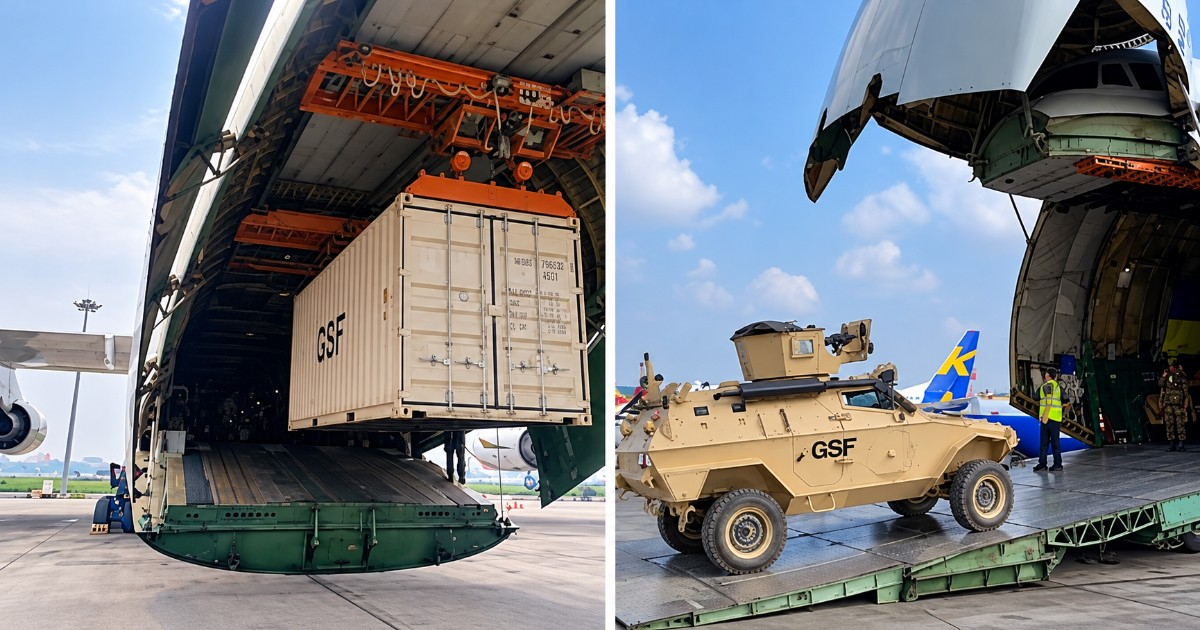
The United States highlighted this Friday the airlift of over 600 tons of priority equipment from Bangladesh to reinforce the Gang Suppression Force (GSF) in Haiti, in an international operation supported by Germany that aims to strengthen the response capacity against armed groups operating in the Caribbean nation.
The U.S. Assistant Secretary of State for Western Hemisphere Affairs, Juan Pablo Segura, publicly thanked the German Government for its contributions to the international mission, as he stated in a message posted on his official X account.
“We thank the German Government for its generous contributions to the Gang Suppression Force in Haiti,” stated the U.S. official.
Segura explained that the airlift to transport more than 600 tons of priority equipment from Bangladesh will enhance security operations and contribute to joint efforts to restore stability in Haiti.
The German support is part of efforts to overcome transportation difficulties that have delayed the deployment of personnel and materials from various countries to Haiti.
On October 19th, the United Nations Under-Secretary-General and head of the UN Support Office in Haiti (UNSOH), Daniela Kroslak, confirmed before the Security Council that Germany and Belgium had contributed to strategic airlift operations to facilitate the deployment of the mission.
The official also thanked the United States for its cooperation in mobilizing personnel and the Dominican Republic for its support in facilitating logistical operations.
Kroslak explained that the United Nations had managed to reduce costs by coordinating international flights, including taking advantage of available capacity on aircraft used to transport personnel from Asia to Port-au-Prince.
As an example, he pointed out that a coordinated operation to transport an advance group from Bangladesh via a stopover in Sri Lanka saved more than one million dollars on an additional charter flight.
Bangladesh's participation is especially important for the expansion of the Gang Suppression Force.
On October 15, a first group of 50 Bangladeshi soldiers departed for Haiti to prepare for the arrival of new contingents and coordinate operational and logistical needs.
The deployment is part of an announced contribution of approximately 1,600 members of the military and police forces of Bangladesh, whose integration has been organized in stages.
During his address to the Security Council, Kroslak reported that the international force had approximately doubled its deployed personnel since July, when it had just over 1,000 troops.
The expansion includes new contingents from Bangladesh, Chad, Guatemala, and Sri Lanka, as well as other international contributions.
The Gang Suppression Force was authorized by the UN Security Council on September 30, 2025, through Resolution 2793, with the aim of replacing the previous Multinational Security Support Mission, led by Kenya.
The new mission received a broader mandate to work alongside the Haitian National Police and the country's armed forces, combat criminal groups, protect strategic infrastructure, and facilitate access to humanitarian aid.
The approved design considers a force of up to 5,550 members, although its deployment has been gradual and still faces challenges related to personnel, equipment, and funding.
On September 29, 2026, the Security Council approved Resolution 2829, which extended the force's mandate for an additional six months, until March 31, 2027.
The UN has also confirmed the expansion of international operations outside Port-au-Prince. In August, the deployment of personnel and equipment began in the Artibonite department, one of the areas affected by the activities of armed groups.
To support this expansion, the United Nations is working on the development of eight operational and logistical bases, including Camp Vertières, identified as the primary operations and supply center for the force.
The need to bolster security resources coincides with an escalation of violence that has also affected members of international missions.
On October 24th, it was reported that the president of El Salvador, Nayib Bukele, had ordered the deployment of elite troops to Haiti in an effort to locate four Salvadoran military personnel who went missing following an attack attributed to gangs.
The personnel were carrying out aviation support and medical evacuations within the international force when they were attacked near Port-au-Prince, according to reports about the incident.
The disappearance prompted a new mobilization of Salvadoran resources and statements from Bukele against the criminal organizations responsible for the violence.
On Thursday, Bukele shared a message addressed to the Haitian population in which he asserted that the deployment of his forces did not constitute an invasion and promised to intensify operations against the gangs.
The Salvadoran president defended the intervention as part of international efforts to restore security and stated that his military would return to their country once the mission was completed.
For its part, the United States has reiterated throughout 2026 its support for the stabilization of Haiti and the strengthening of security institutions.
In April, Secretary of State Marco Rubio met in Washington with Haitian Prime Minister Alix Didier Fils-Aimé, expressing U.S. support for security efforts and preparations for holding elections.
During that meeting, Rubio emphasized the importance of deploying the Gang Suppression Force and international cooperation to restore the country's stability.
Related videos:
Filed under: