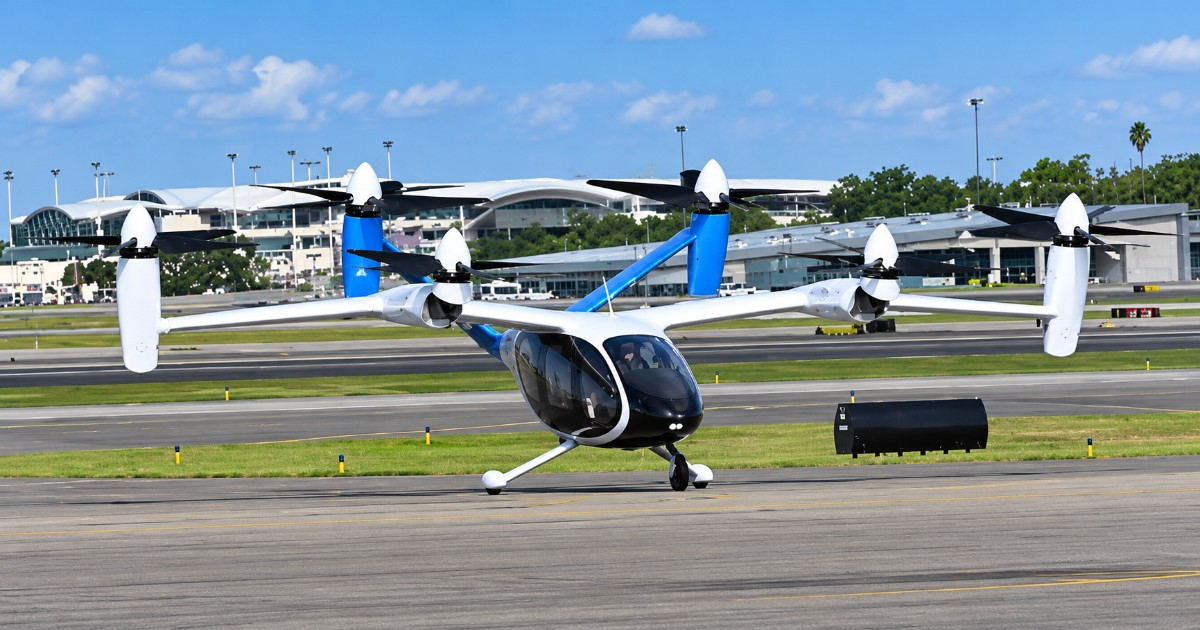
Florida took another step towards the future of air transportation this Friday with the successful test flight of an electric flying taxi between the cities of St. Petersburg and Tampa.
The aircraft took off vertically, crossed Tampa Bay, and landed at Tampa International Airport in a demonstration of a technology that could transform intercity travel.
According to reported by FOX 13 Tampa Bay, the aircraft from the American company Joby Aviation departed from Albert Whitted Airport, located in downtown St. Petersburg, and completed its journey in the morning, kicking off a series of experimental flights that will take place over a week in various locations across Florida.
The Federal Aviation Administration (FAA) officially confirmed the testing, which is part of a federal program to study how to integrate these new aircraft into the U.S. transportation system.
The electric aircraft from Joby belongs to a category known as eVTOL, which stands for electric vertical takeoff and landing aircraft.
Unlike a conventional airplane, it can ascend and descend without using a traditional runway, thanks to a system of six tiltable propellers.
During the flight, those propellers allow for a transition from vertical takeoff to forward movement, a combination of features that sets it apart from traditional helicopters.
The model is designed to carry four passengers and a pilot, reach speeds of approximately 200 miles per hour (322 kilometers per hour), and make trips of up to 100 miles (161 kilometers), according to the manufacturer's specifications.
Joby Aviation also claims that its electric propulsion system produces significantly less noise than a conventional helicopter and generates no direct emissions during flight.
However, the demonstration does not mean that Florida residents can already book flights in flying taxis. The company is still working on the final stages of the certification process for its aircraft with the FAA.
The authorities have not announced how much a trip between St. Petersburg and Tampa would cost or when a commercial passenger service would begin.
The flight was witnessed by state authorities, including Governor Ron DeSantis, who celebrated the test by referencing the famous movie Back to the Future.
“Roads? Where we’re going, we don’t need roads,” DeSantis said after landing, alluding to one of the movie's lines.
The governor added that this technology is, for now, the closest thing to flying cars that have appeared in movies and science fiction stories for decades.
The Florida Secretary of Transportation, Jared Perdue, also highlighted the potential of electric aircraft to transform regional travel.
Perdue explained that it is not just about electric helicopters, but rather a new mode of transportation that could allow for the transfer of people and goods between different locations without relying solely on roads.
The test takes on a special meaning due to the chosen path
On January 1, 1914, the aviator Tony Jannus conducted a flight between St. Petersburg and Tampa, which is recognized as the first regular commercial passenger air service in the world.
On that occasion, he transported former St. Petersburg mayor Abe Pheil, inaugurating a route that would set a precedent in the history of commercial aviation.
More than 112 years later, Joby Aviation decided to traverse Tampa Bay once again, this time with a fully electric aircraft capable of taking off and landing vertically.
The demonstration is part of the Pilot Program for the Integration of Electric Vertical Takeoff and Landing Aircraft, a federal initiative announced in March to assess how to integrate these vehicles into the existing airspace.
Florida was selected from among eight participating jurisdictions and became the seventh to initiate demonstration operations within the program.
The tests aim to gather information on safety, integration with airports, noise levels, passenger and cargo transportation, automation, and potential medical response operations.
The FAA administrator, Bryan Bedford, noted that each flight will allow for the gathering of data and experiences necessary to develop safety standards that will facilitate the everyday operation of these aircraft.
In addition to Joby Aviation, the company BETA Technologies participated in the demonstrations held in the Tampa area, using a conventionally designed electric aircraft for takeoff and landing.
According to the U.S. Department of Transportation, the tests are part of efforts to evaluate new air routes and technologies that can expand regional mobility options.
After Tampa, Joby Aviation plans to conduct demonstrations at Orlando International Airport and the Kennedy Space Center, as part of its tour of Florida.
These flights will help study the development of the so-called Florida Air Highway Network, a project that aims to connect various cities using electric aircraft.
The state is also working on facilities known as vertiports, spaces designed for the takeoff, landing, and electric charging of these types of vehicles.
In April 2026, Florida approved a law that paved the way for the construction and funding of infrastructure for flying taxis, allowing the state Department of Transportation to participate in vertiport projects.
The legislation also incorporated these facilities into public-private collaboration mechanisms and established new funding opportunities to develop a network of electric air transportation.
As part of this preparation, the Florida Department of Transportation is developing SunTrax Air, a testing space located near Interstate 4, aimed at evaluating advanced air mobility technologies.
The use of electric air taxis is not entirely new in the state.
In November 2023, the company Volocopter conducted a demonstration of its electric air taxi at Tampa International Airport, as part of its plans to introduce this type of transportation in the United States.
Unlike that previous test, the flight by Joby Aviation conducted this Friday connected two airports in different cities and is part of the new federal program for the integration of electric aircraft.
Related videos:
Filed under: