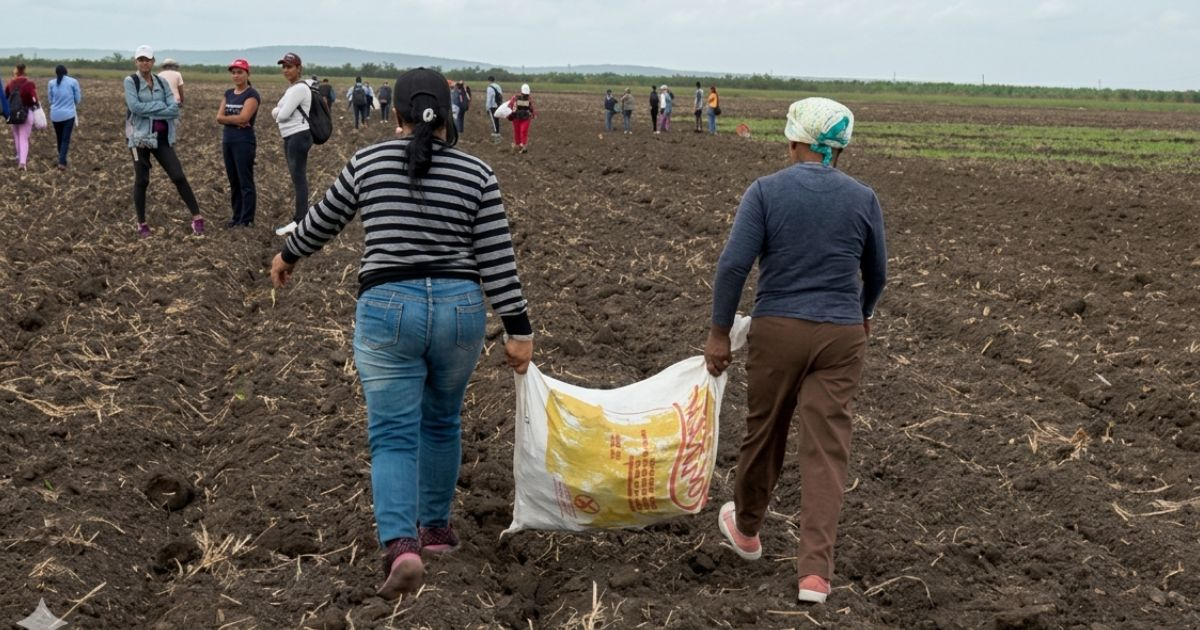
Only one in four agricultural landholders in Cuba is a woman: women make up 23% of those who possess rights over agricultural plots on the island, compared to 77% of men, according to official data from the Cuba Gender Equality Observatory (OCIG) collected by the magazine Alas Tensas.
The figure, corresponding to the end of 2024, represents a nearly imperceptible increase compared to the 22.6% recorded in 2023, with just 0.4 percentage points of growth in one year.
The gap widens when analyzing the size of the plots: 36.1% of female holders own less than one hectare, double the equivalent proportion among men, which stands at 18.3%.
Regarding the mode of ownership, 62% of women holders have land in usufruct —meaning they can use it without being the owner— and only 38% own it. Combining these percentages with the total number of holders, women would represent approximately 25.6% of the landowners of agricultural land in the country.
This inequality in access to land is compounded by an equally serious income gap. A publication from the Women's Studies Center, created with support from the United Nations Population Fund (UNFPA) and released in 2025, states that around half of rural women lacked their own income in 2024.
A study by the Friedrich Ebert Foundation conducted by specialists from FLACSO-Cuba documented that "the proportion of men with their own income exceeds that of women by more than 20 percentage points across the country, a difference that is more pronounced in rural areas."
The 2019 data collected in that study showed that women accounted for only 13% of the individuals associated with agricultural cooperatives and 33% of the personnel in agricultural companies.
The national report Cuba 2019. Rise to the Root already noted that women constituted 46.3% of the rural Cuban population, but only 26.1% of its economically active population.
"The lack of independent income can limit women's economic independence, especially when they depend on other members of the household," concludes the analysis from Alas Tensas, which emphasizes that the documented inequalities are not new, but rather the result of decades of policies that have systematically ignored the situation of rural women in Cuba.
Many Cuban women who work in agriculture do not even appear in official records. They participate in animal husbandry, tending to minor crops, and other tasks on family farms without being recognized as official holders, often on land registered in the name of their partners or other relatives.
This statistical invisibility is compounded by the disproportionate burden of domestic work: according to the 2016 National Gender Equality Survey, 98.39% of rural women participated in domestic tasks, compared to 94.49% of men, and 55.96% took on caregiving activities, compared to 29.67% of men.
In this context, the Latin American Federation of Rural Women (FLAMUR), an independent organization that celebrated its thirtieth anniversary on October 15, has been demanding reforms to the Cuban agrarian model for years.
Since 2019, it has been promoting the campaign "Without the countryside, there is no country." Its president in Cuba, Katia Hernández Torres, has called for farmers to be able to decide what to produce, sell their harvests directly, and set prices without relying on mandatory state intermediaries.
The organization has paid a price for its activism: in February 2026, Hernández Torres and other activists were summoned and interrogated by the Technical Investigation Department in Pinar del Río. Hernández Torres publicly held the State Security responsible for any harm against her or her husband.
The regime approved in July 2026 the 185th Law on Agricultural and Forestry Land, effective from September, which acknowledges gender equality for the first time as a principle of agricultural policy and establishes preferential access for women and youth.
However, the Food Monitor Program warned that the regulation maintains structural restrictions: private ownership is limited to 67.10 hectares, leasing and sharecropping remain prohibited, and the State retains control over the transmission and productive use of the land.
Related videos:
Filed under: