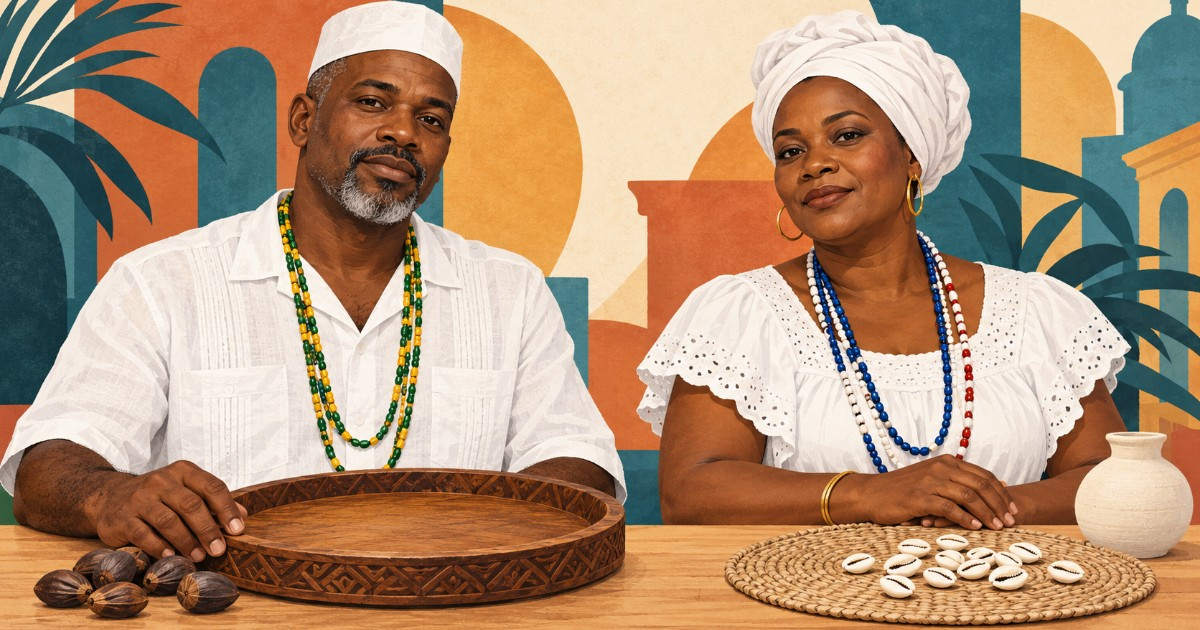
A babalawo is a priest of Ifá, specialized in its system of divination. Santero and santera refer, in the Regla de Ocha, to those who have undergone the initiation known as becoming a saint. They have different religious roles within related traditions, each with their own knowledge, ceremonies, and responsibilities.
The distinction appears in the sacred arts project of the Atlantic at Duke University, which describes santeros as initiates of Ocha and babalawos as specialists of Ifá. Both traditions share Yoruba roots and the worship of the orishas, the deities revered by their followers.
What does babalawo mean and what is its function?
The word babalawo is often translated as "father of secrets." Its role is connected to the learning and interpretation of Ifá, a religious tradition that preserves stories, teachings, and a system of signs used in consultations.
The UNESCO describes Ifá as a system practiced by Yoruba communities and the African diaspora in America and the Caribbean. It explains that its signs are interpreted by a specialized priest and that consultations accompany important decisions for individuals or communities.
Within this belief system, Ifá is associated with Orunmila, known in Cuba as Orula, whom his devotees attribute wisdom and the ability to provide guidance. Speaking of the work of a babalawo thus implies referring to a specific religious formation and the interpretation of that knowledge.
What is a santero or a santera?
In Ocha, initiation establishes a religious connection with the orichas and membership in a community. The glossary of the Historical Museum of Oslo identifies a santera or santero as a person who has undergone the ceremony of becoming a saint.
Learning continues after that consecration. According to the Harvard Pluralism Project, the Ocha communities are organized into religious houses, also known as ilés, where initiated individuals and aspirants live together under the guidance of priestesses or priests.
In this context, the terms iyalocha and babalocha emerge, associated with priestesses and priests of Ocha. Over time, the initiates may take on responsibilities in the training and consecration of their own godchildren. The title of santero, by itself, does not encompass the entire experience or the functions of a person.
Can a person go through Ocha and Ifá?
There are religious paths that include both consecrations. The babalawo Fernando Buján explained in an interview with CiberCuba that in Cuba, a journey from Ocha to Ifá can exist, and he pointed out differences with the order of initiations in Nigeria.
This helps to understand why two related terms do not mean the same thing: an initiation in Ocha does not automatically equate to consecration as a babalawo. To describe someone's role, it is important to know their background and the tradition of their religious house.
Is the babalawo above all santeros?
The religious organization recognizes hierarchies, knowledge, and ritual responsibilities, but it does not have a single central authority that governs all houses. The Oslo Historical Museum explains that these may be led by a babalawo, a santera, or a santero, and that the practices may present variations.
Therefore, describing the babalawo as the chief of all santeros simplifies a diverse organization. Authority and participation in each ceremony must be understood within the relevant community, taking into account the consecrations and the knowledge that it recognizes.
Women and Names of Religious Kinship
Santeras can lead religious houses and serve as godmothers. They are not merely companions of a priest; they train and guide their godchildren within Ocha.
In Ifá, there are differences between traditions. Buján described in his interview the male consecration of the Afro-Cuban tradition and the existence of priestesses called iyanifás in Africa. This diversity requires clarity regarding which community is being referred to when explaining the roles of women and men.
Other terms refer to stages or relationships. Iyawó designates the recent initiate; padrino and madrina identify those who accompany him or her during initiation and later provide guidance. This religious kinship is formed within the house and does not require a blood relationship.
Related videos:
Filed under: