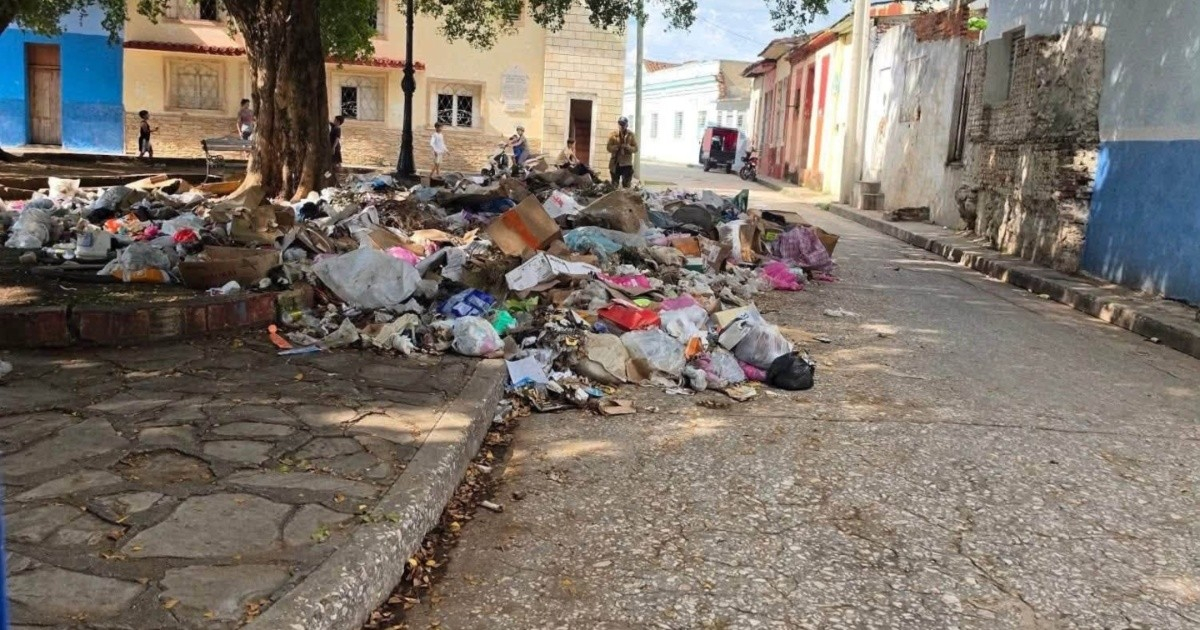
The Santana Park, one of the most emblematic historical spaces in Sancti Spíritus, is buried under mountains of plastic bags, cardboard, and household waste, as reported on Facebook by neighbor Yanetsy Pino in the last days of October.
The photographs accompanying the publication show the cobblestone square of the park covered in debris, with colorful colonial buildings in the background, and at least one person rummaging through the trash in search of recyclable materials.
"What you see is a huge dump, a filthy mess, a mountain of garbage that is literally and metaphorically consuming the neighbors alive," wrote Pino, who added that "under the shade of those beautiful trees that have witnessed so much history, the only thing passing by today is the foul smell and the flies."
The Santana Park is part of the historical center of Sancti Spíritus, declared National Monument of Cuba in 1978. The city was founded in 1514, and in the park area, the Hermitage of Veracruz was built in 1690 and the Convent of San Francisco in 1716. The space was restored in 2014 to commemorate the fifth centenary of the town.
"This park has a rich history, being part of the historic heart of the town of Sancti Spíritus. Festivities were held there, one of the best carnival groups in the city rehearsed there, serenades were sung, and it was the meeting point for families and lovers," Pino recalled, for whom the contrast with the present is devastating: "It's a place that breathes tradition, or should breathe it, because now the only thing it breathes is decay."
The author of the complaint ruled out holding the neighbors responsible and pointed directly at the regime: "It's not the neighbors who, 'in the absence of bread, make do with cassava,' throwing their trash wherever they can because the garbage truck simply doesn't come. The blame lies with a government that does not prioritize this."
Pino also rejected the official argument of the embargo as a justification. Citing data from the U.S.-Cuba Economic and Trade Council, he pointed out that between January and August 2026, exports of fuels and petroleum products from the United States to Cuba totaled 231.7 million dollars, peaking at nearly 75 million just in August. “The fuel comes in and is paid for, but the gasoline never reaches the sanitation trucks in the communities, nor public transport, nor ambulances. Where is that fuel?” he asked.
What happened in Santana Park is not an isolated case in Sancti Spíritus. A mountain of trash formed in front of the Yayabo Bridge —also a National Monument— in June, and previously, dumps had been documented on Carlos Roloff Street and at the intersection of Carlos Roloff with Tello Sánchez.
The waste collection crisis is nationwide. In Havana, only 44 out of the 106 collection trucks were operational at the beginning of the year, leaving over 20,000 cubic meters of garbage uncollected daily. This past Saturday, a huge dump was documented in the main avenues of Camagüey, a city whose historic center is a UNESCO World Heritage site.
"It's a disgrace, a crime against public health and our heritage. People want solutions, cleanliness, and dignity," concluded Pino.
Related videos:
Filed under: