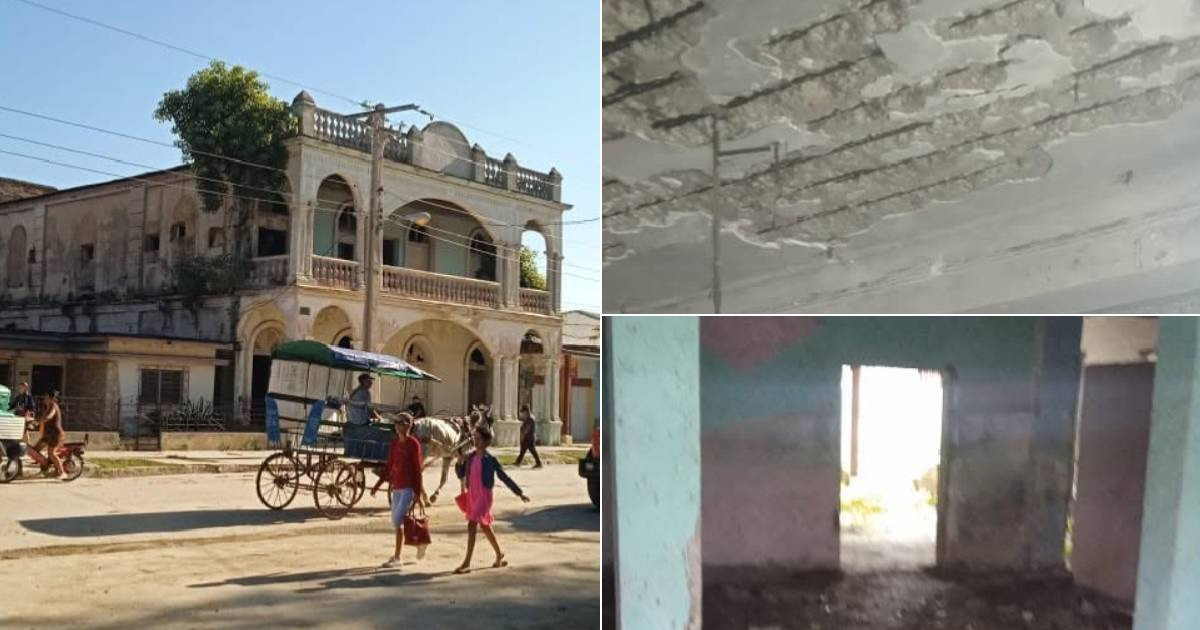
Photographs of the Hotel Europa, which has been turned into a ruined building in the town of San Germán in the province of Holguín, were shared on social media and sparked outrage among residents, who criticized the intervention in the property and held the authorities responsible for its subsequent neglect.
The images, published on Thursday by Ramiro Gómez, administrator of the Facebook group "Club de San Germán, Holguín", show walls with peeling paint, floors covered in rubble, moss and trash, and ceilings with exposed rebar.
According to one of the participants in the online debate, the hotel has been abandoned for over 15 years. Several contributors to the discussion nostalgically recalled the spaces and elements that characterized the establishment, including the stained glass windows, the upholstered round seating, the drinks shelf, and the dining room tables.
One of the comments noted that the property was built by Francisco Martín, known as "Pancho," and expressed sorrow that his daughter, who according to the testimony still lives next to the building, has to witness the destruction of what her father built with his own hard work.
"The sad thing is... to see what his father built with dedication now destroyed... To those who took it over, and naturally, it cost them nothing; they merely seized it and did not care for or maintain it," wrote a participant.
Other users pointed out that the property is "on the brink of collapse" and noted that, without private investment, it could completely vanish in the coming years. One commenter also recalled another establishment in the area, called New York, which, according to them, has already disappeared.
The group administrator summarized the discontent with a statement that goes beyond the San Germán case, asserting that "destruction and neglect extend throughout Cuba, from Cape San Antonio to Cape Maisí."
The loss of these spaces is also part of the deterioration of the historical references of San Germán, a town that retains its original name, even though the central sugar mill was renamed Urbano Noris after the revolution of 1959, a designation that was also adopted by the municipality created in 1976 and which some residents reject.
The Urbano Noris sugar mill, which became one of the largest refineries in the country, also was reduced to ruins after decades of mismanagement and the widespread closure of mills initiated in 2002 by the dictator Fidel Castro (1926-2016).
In other areas of Holguín, the Vocational José Martí, the Holguín-Gibara train station, and the El Mambisito park are experiencing similar conditions of neglect.
San Germán has also faced other issues that reflect the deterioration of its services and infrastructure. In February, a fire destroyed three homes, while in August the water supply was halted due to the theft of dielectric oil from a transformer.
Related videos:
Filed under: