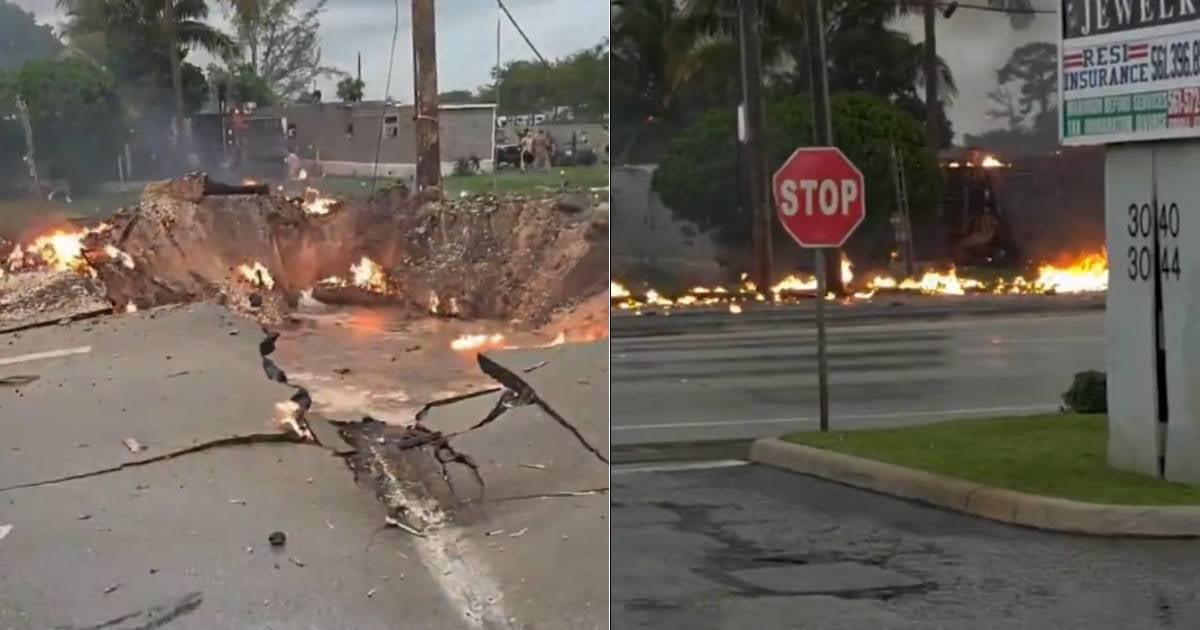
Federal investigators found more than six kilometers from the accident site part of the tail of the private plane that crashed on Sunday in Palm Beach County, Florida, resulting in the deaths of all nine occupants. This discovery confirms that the aircraft began to lose components before impacting the ground.
According to a report this Tuesday by the Associated Press (AP), Tom Chapman, a member of the National Transportation Safety Board (NTSB), explained that a large portion of the left elevator of the Learjet 60 was recovered in three pieces, found at distances ranging from 2 to 6.1 kilometers from the crash site in Greenacres, near West Palm Beach.
The elevator is a movable surface located on the tail of the aircraft that allows for controlling its tilt upward or downward. Its loss can prevent a pilot from regaining control during a steep descent.
Chapman explained that, without that intact piece, the crew would not have been able to pull the plane out of the nosedive.
However, he warned that, due to the speed it had reached, it is also unclear whether the mechanism would have been effective even if it had remained attached to the aircraft.
"We still do not know exactly what it means regarding what caused the loss of control of the aircraft, nor whether the separation of this part was a result of the forces acting on the airplane," the investigator noted.
The official described the discovery as a "very important" piece of evidence because it will help guide future investigations toward the factors that may have caused the loss of control.
The aviation security specialist Jeff Guzzetti, consulted by AP, believes it is likely that the fragments detached as a result of the violent fall and were not the initial cause of the accident.
Guzzetti explained that if the pieces had separated from the plane while it was still flying at high altitude, they would likely have appeared at much greater distances.
Its relatively close location to the impact point suggests that they detached when the aircraft had already descended significantly.
The discovery provides concrete information to a hypothesis that the NTSB had raised on Monday, when it reported indications that the plane began to break apart before crashing.
During that appearance, Chapman indicated that investigators might find components far from the scene of the incident.
The Learjet 60 had taken off from Austin, Texas, en route to the Bahamas when it lost control and crashed around 12:50 p.m. on Sunday, November 1, near the intersection of Military Trail and 10th Avenue North in Greenacres.
The impact created a large crater in the pavement and caused an explosion followed by a fire. The nine people on board were killed.
According to the latest information from AP, approximately 600 residents from the surrounding areas remained displaced and one person was injured on the ground.
Among the victims were technology entrepreneur Adam Robinson, his wife Helen Sharp, and their two young daughters, as well as the Colombian nanny Ana María Ramírez Cetina. The crew members also perished, including 55-year-old Captain Jeff Gregory.
The identities of the nine deceased were revealed later, as family members and close friends began sharing details about their lives.
Weather conditions continue to be one of the main lines of investigation. Co-pilot Nathalia Gadelha Filgueiras had reported over the radio about the accumulation of ice on the plane and severe turbulence shortly before the tragedy.
According to AP, the stepfather of the co-pilot, Thiago Corteleti, stated to the New York Post that the young woman sent a message to her partner about ten minutes before the accident, mentioning turbulence and ice formation.
The latest communications from the crew to air traffic controllers highlighted how quickly the emergency escalated. Filgueiras even warned that they would crash to the ground while the aircraft descended at more than 20,000 feet per minute, which is about 6,100 meters per minute.
"We're running out of time!" the co-pilot exclaimed before communication was interrupted.
Related videos:
Filed under: