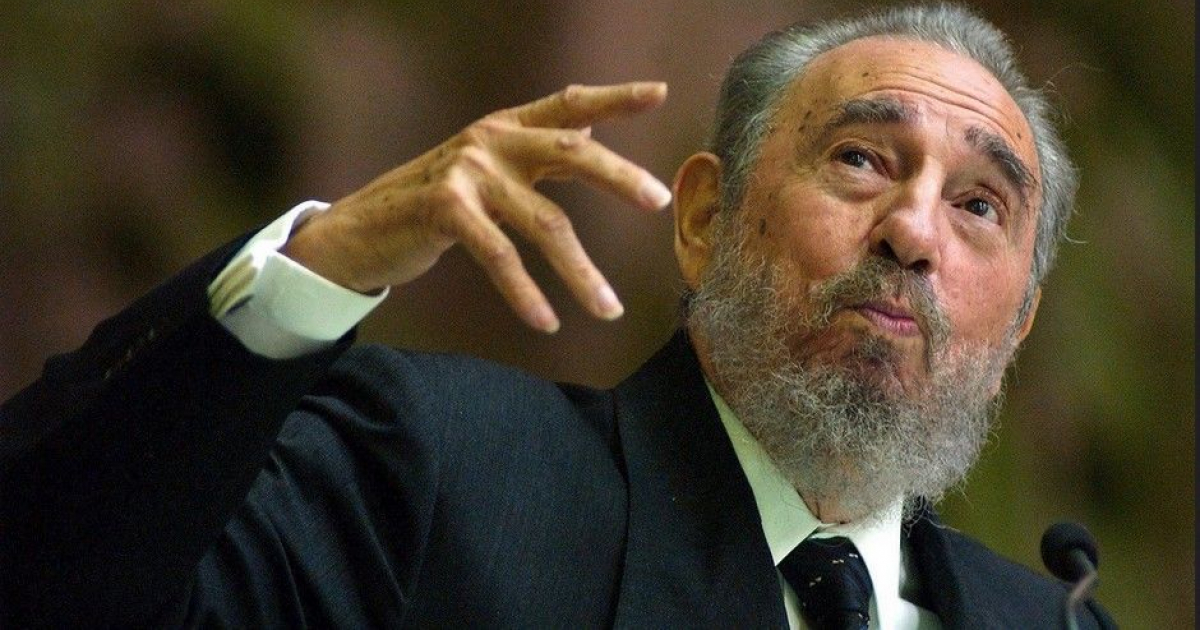
The Republican Coalition of Uruguay was unable this Tuesday to get the House of Representatives to speak out against an event organized by legislators from the Frente Amplio to pay tribute to the Cuban dictator Fidel Castro in the Legislative Palace of Montevideo, featuring the ambassador of the Cuban regime as the main speaker.
According to El Observador, the event —titled "100 Years of Fidel in Solidarity with Cuba"— is scheduled for this Thursday, November 5, at 19:00 in the Francisco Acuña de Figueroa Room of the annex building to the Legislative Palace.
Speakers will include the Cuban ambassador Lissett Pérez, MPP senator Bettiana Díaz, and deputies Magela Rinaldi, Carlos Reutor, and Cecilia Badín. The moderator will be deputy Víctor Aldaya. The program includes the screening of the documentary El sueño de Fidel, by deputy Agustín Mazzini, and will conclude with a performance by singer-songwriter Héctor Numa Moraes.
The opposition motion to address the matter as a "political issue" received only 37 votes in favor, compared to 51 against, out of a total of 88 lawmakers present. To enable the debate, 50 votes or two-thirds of those present were required, a threshold that the Republican Coalition—composed of the National, Colorado, and Independent parties—failed to reach, even with its own 47 legislators, as not all were in the chamber.
The main proponent of the motion was the Colorado deputy Felipe Schipani, who questioned the event before the lower house with strong words: "Paying tribute to a dictator is a limit we cannot cross, especially when we are talking about a dictator who for 49 years exercised state terrorism in Cuba, violated all human rights, murdered his opponents, kidnapped them, and pursued them, perhaps — and without perhaps — becoming the greatest enforcer of tyranny in our Americas in the 20th century."
Schipani also emphasized the offense that the act represents for the Cuban community residing in Uruguay: "It is an offense to the thousands of Cubans living in Uruguay who fled Cuba due to political persecution and hunger." He concluded with a statement that summarized the opposition's position: "If they want to honor dictators, they should go to a base committee; not in Parliament."
The National Party Congressman Juan Martín Rodríguez had anticipated the rejection days before on social media, denouncing that "the ambassador of the Cuban regime and her accomplices from the Broad Front pay tribute to the DICTATOR Fidel Castro" at "the House of Democracy."
The Broad Front member Sebastián Valdomir responded by pointing out a contradiction: Rodríguez holds the General Secretariat of PARLATINO, an organization that is precisely presided over by a Cuban deputy, and he has never questioned that situation in the regional context.
From Cabildo Abierto, Deputy Álvaro Perrone criticized the opposition motion, though for different reasons: "Today we are discussing Fidel Castro, tomorrow we will move on to Israel and Palestine, Iran, Nicaragua, Venezuela, Russia, Ukraine... We dedicate ourselves to discussing issues in this Parliament that have nothing to do with the daily lives of Uruguayans."
The event takes place in a context that sharpens the contrast: Uruguay has accumulated approximately 27,300 asylum requests from Cuban citizens that remain unresolved —89% of the total of 30,715 pending as of June 2026— with only 52 Cubans formally recognized as refugees.
While the regime's ambassador speaks at the Legislative Palace, tens of thousands of Cubans who fled that same dictatorship are awaiting a response to their protection requests.
The event is part of the Cuban regime's international campaign to promote the cult of Castro on his centenary. The National Assembly of Cuba declared 2026 "Year of the Centenary of Commander in Chief Fidel Castro Ruz," and Cuban embassies in various countries have organized similar activities, while the island marks 67 years of dictatorship, scarcity, and repression.
Schipani summarized it unequivocally: "The Cuban dictatorship has been marked by 67 years of lack of freedoms, a one-party system, persecution, and misery, and that cannot be celebrated in the house of democracy."
Related videos:
Filed under: