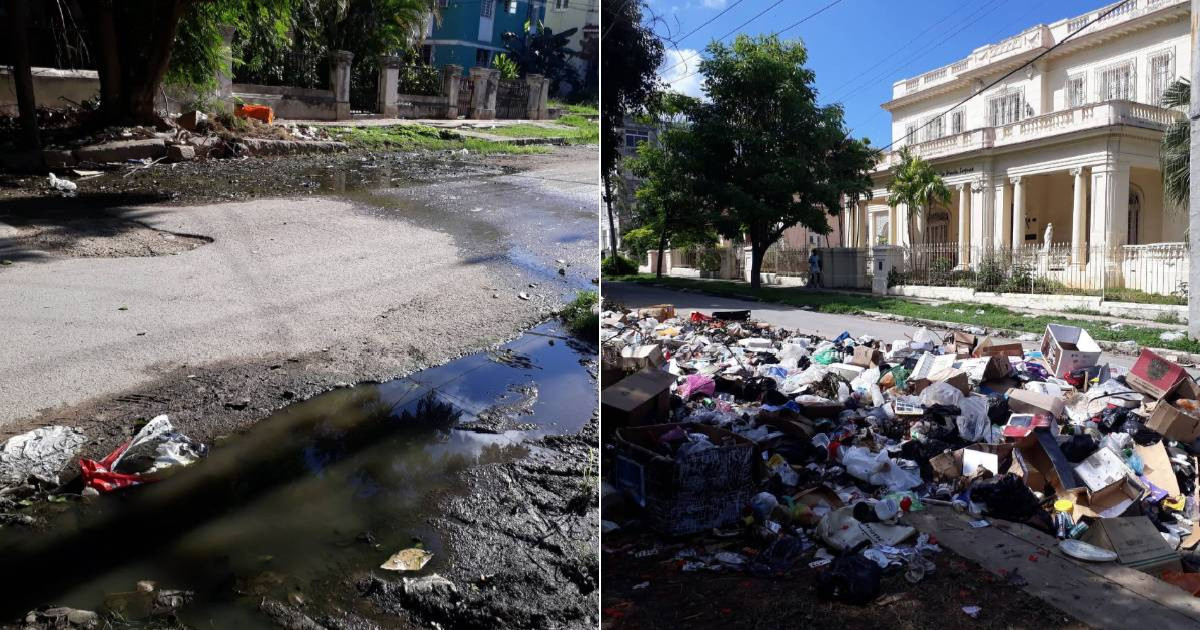
The house where the Cuban writer, storyteller, and poet Dulce María Loynaz (1902-1997), winner of the Cervantes Prize and one of the most renowned figures in Cuban literature, lived, has a garbage dump and sewage water in front of its entrance, which flows down the street without the authorities having addressed the issue.
The complaint was shared this Thursday on Facebook by Frank Coto Hernández, who described mounds of cardboard boxes, plastic bags, debris, and household waste reaching up to one and a half meters high, piled up from the corner of 19 and E to the middle of the block. This situation is compounded by an overflowing pit whose waste flows down the street and reaches the entrance of the institution.
While literary events are held and Cuban culture is promoted inside the center, outside, waste and sewage create a health hazard that affects the surroundings of one of the city's heritage buildings.
The house where Loynaz resided from 1947 to 1997 was declared a National Monument in the latter year and was transformed into a cultural center in 2005. The journalist and lawyer also received the National Literature Prize of Cuba in 1987 and the Cervantes Prize in 1992, an honor that made her the first Latin American writer to receive this award.
"It is unacceptable that a space which should be a tribute to the memory of the writer is overshadowed by neglect," Coto stated in his post.
The complainant demanded the immediate collection of waste at the corner of 19 and E, the repair of the overflowing pit, and a permanent sanitation plan for the block and its surroundings. They also called for respect for the historical value of the property and the memory of the writer.
In December 2024, an enormous dumpster had already been documented in front of the cultural center. Throughout this year, other reports have highlighted the sanitary deterioration of Vedado.
In July, a fire consumed part of the landfill at the corner of 15 and K, near the national headquarters of the Committees for the Defense of the Revolution (CDR), while that same month, independent journalist Yoani Sánchez reported the open burning of waste in the neighborhood.
In October, the Cuban writer and art critic Jorge de Mello criticized how the sewage was flowing through the flowerbeds for months without any visible repairs.
The situation is part of a waste collection crisis affecting all of Havana, with a collection fleet hampered by a shortage of diesel and mechanical deterioration.
At the beginning of September, the authorities presented 20 trucks and more than 240 containers made in China, with an investment exceeding one million euros, although they acknowledged that these resources "are not the definitive solution."
The discomfort has also been expressed on social media. "If Vedado looks like this, how will the rest be?", asked a citizen weeks ago in response to images of accumulated trash in the bustling neighborhood. Another resident summed up her outrage with a more forceful phrase: "What a tremendous lack of hygiene, Havana, Cuba, has turned into a complete dump."
Related videos:
Filed under: