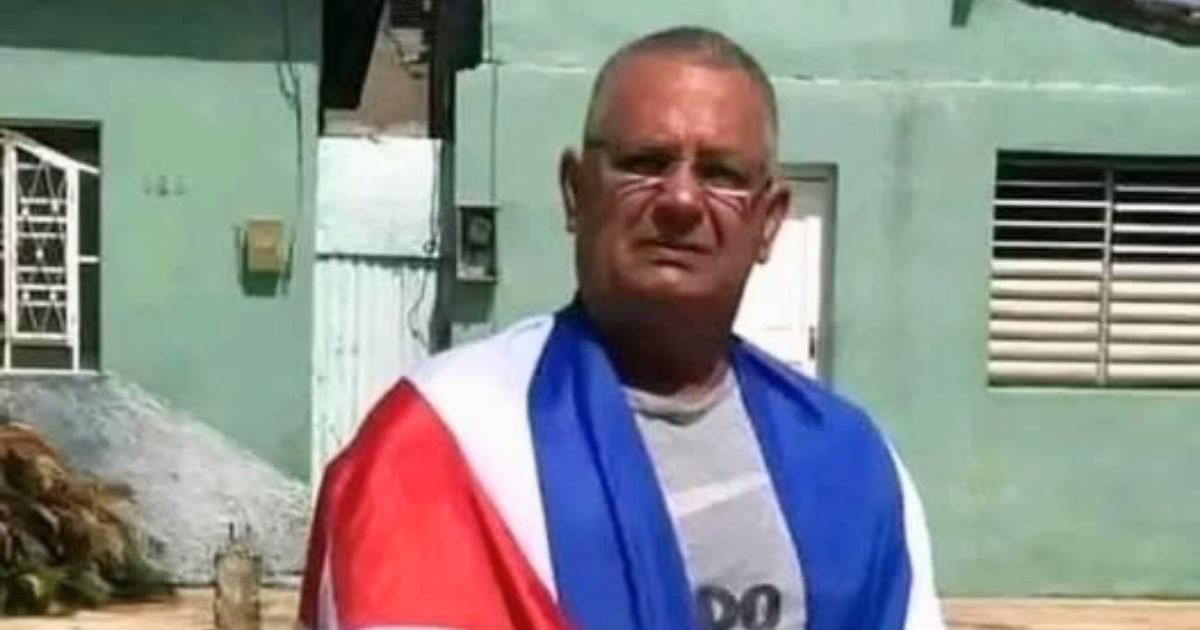
The family of Francisco Rangel Manzano arrived at the Canaleta prison in Perico, Matanzas, on November 1st with the expectation of bringing their loved one home. The prison authorities themselves had confirmed that date. They left without him: officials informed them at the gate that the political prisoner from 11J had to serve an additional six months of confinement due to an alleged "administrative error," as reported by Infobae.
Rangel Manzano is serving a six-year sentence for "public disorder" after participating in the protests on July 11, 2021, in Colón, Matanzas. He was tried in January 2022 and is a member of the Party for Democracy Pedro Luis Boitel.
His son, Hermes Rangel Naranjo, explained to Martí Noticias that the officials presented three justifications for blocking the release: errors in the calculation of the sentence, files that had not been updated digitally "due to the blackouts," and prior disciplinary sanctions that would have nullified previously granted sentence reductions.
The excuse of the blackouts—a power crisis caused by decades of mismanagement by the regime—is particularly revealing: the same shortages that plague the Cuban population on the streets are now being used as bureaucratic justification to keep a political prisoner locked away.
This is not the first time the regime has shifted Rangel Manzano's horizon of freedom. His release was initially scheduled for March 2026, but it was postponed following the withdrawal of prison benefits. November 1 was already the second date communicated to the family, and it was also canceled. The new date is now set for the early months of 2027.
The human rights organization Cubalex questioned the official arguments and demanded the immediate release of the prisoner, the cessation of the measures blocking his release, and the respect for his rights. The entity also warned that Rangel Manzano suffers from a high-risk heart condition and hypertension, and that prolonging his imprisonment poses a direct risk to his life.
The health condition of the prisoner is critical. In July, he suffered a severe cardiac crisis in Canaleta and was urgently transferred to the infirmary in the early morning due to intense shortness of breath, chest pain, and very high blood pressure. His wife, Regla Burunate, a nurse by profession, described the diagnosis as "a possible ischemic cardiomyopathy with moderate to severe systolic dysfunction of the left ventricle, which means it is a very serious condition."
Burunate directly held the authorities responsible: "I hold the State Security and the prison authorities accountable for anything that may happen. Pancho's health condition is very delicate, and they know it."
Cubalex frames the case within a documented pattern of administrative irregularities and the withdrawal of prison benefits against political prisoners nearing the completion of their sentences. During the first half of 2026, the organization recorded 43 cases of arbitrary denial or revocation of extrapenal licenses, parole, or progression to a different regime, more than double the 19 cases from the previous semester.
Among those affected by this pattern are Jorge Martín Perdomo, whose parole was revoked in March 2026 after he posted complaints on social media, and Leonel Tristá García, who was forced to return to prison in June 2026 to serve the remainder of an eight-year sentence related to 11J.
According to Prisoners Defenders, as of October 1, 2026, there were 1,372 political prisoners in Cuba, of which independent organizations have documented that more than 300 were imprisoned due to the protests on July 11th.
The family of Rangel Manzano is still awaiting an official explanation regarding the new sentence calculation and the conditions under which he will remain detained.
Related videos:
Filed under: