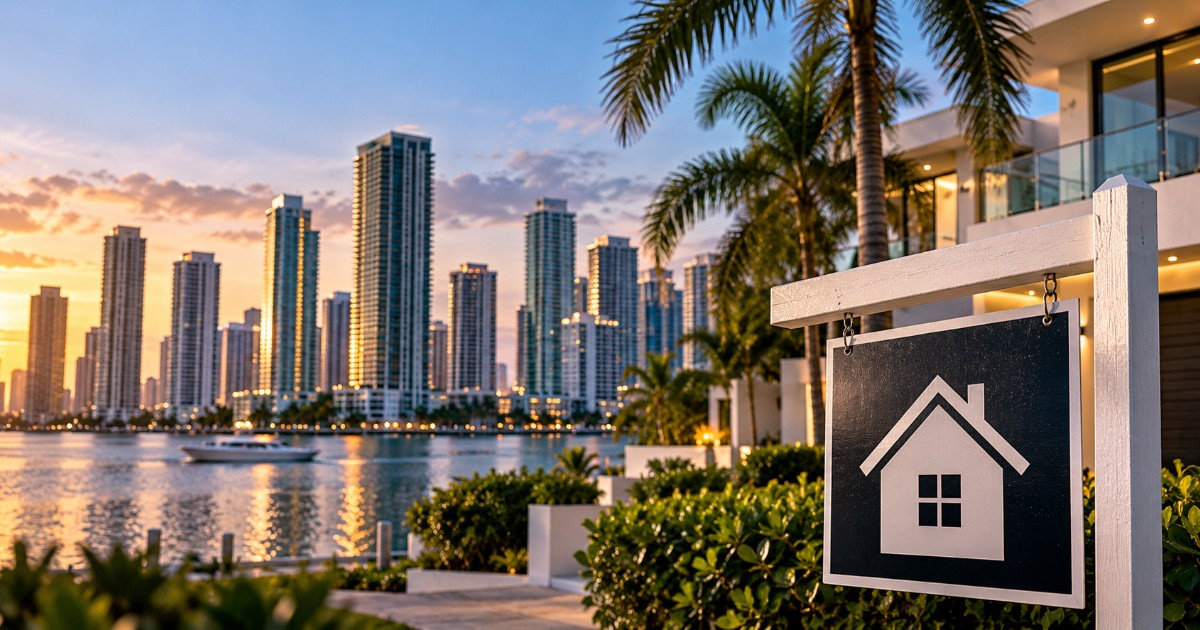
While the luxury housing market in the United States has experienced 31 consecutive months of year-over-year declines, Miami is swimming against the tide: the entry threshold for the luxury segment in the Miami-Fort Lauderdale-West Palm Beach metropolitan area rose by 4.1% to approximately $2.3 million in October, according to a report from Realtor.com published this Monday and reported by Fortune.
The contrast with the national landscape is striking. The threshold that marks the top 10% of listings nationwide dropped by 2.3% to $1,197,014 in October. The declines were even more pronounced in the upper strata: the top 5% fell by 4.1% and the top 1% plummeted by 6.2%, settling around $5.1 million.
Of the 43 metropolitan areas analyzed by Realtor.com, only 12 recorded increases of at least 1% in the luxury segment. Five of them are in Florida, making the state a significant outlier in the high-value real estate market in the country.
Naples-Marco Island topped the national ranking with a 9% increase, raising its luxury threshold to nearly $3.75 million — more than three times the national entry point. Additionally, it was the only market among the top 10 most expensive in the country where prices rose, and its most exclusive properties sold a median of 27 days faster than a year earlier. Following it were North Port-Bradenton-Sarasota (+7.7%), Cape Coral-Fort Myers (+4.1%), Miami (+4.1%), and Tampa-St. Petersburg-Clearwater (+2.1%).
The senior economist at Realtor.com Anthony Smith points to the shortage of supply as a key factor: "that smaller group of available homes may be helping to sustain prices, even as luxury thresholds decline nationwide."
Behind this phenomenon is a wave of great fortunes that has transformed the South of Florida in recent years. Ken Griffin, founder of Citadel, paid $106.9 million for a property in Coconut Grove in 2022, the same year he moved the headquarters of his hedge fund from Chicago.
Jeff Bezos has invested about 237 million in three adjacent properties on Indian Creek Island —nicknamed "Billionaire Bunker"— and in September, an entity linked to him disbursed an additional 69.5 million for a mansion in Golden Beach.
Mark Zuckerberg and his wife Priscilla Chan closed on a mansion in Indian Creek in March for $170 million, a record in Miami-Dade at that time, and Google co-founder Larry Page acquired properties in Coconut Grove for about $173.4 million.
That neighborhood has become the epicenter of extreme luxury. Raffles Hotels & Resorts, along with Mast Capital and BH Group, announced at the end of October the construction of 35 private residences in Coconut Grove starting at 4.5 million dollars, with construction expected to begin in 2027.
"We don't really play in the middle market. We continue to see tremendous amounts of wealth moving to Florida, especially to South Florida," stated Camilo Miguel Jr., founder and CEO of Mast Capital, one of the promoters of the project.
The reasons for attraction are well known: Florida has no state income tax, and between 2019 and 2023, the state received a net influx of $137 billion in revenue from other states.
"Someone who buys a house for 20 or 50 million dollars in Miami is attracted by the absence of state income tax, the lifestyle, and the business climate," summarized luxury real estate advisor Michael Martirena from South Florida.
For those not moving those numbers, the landscape is different. The condominium market in Miami-Dade recorded a median price of $417,090 in September, with 12.3 months of inventory available, well above the six-month threshold that defines a buyer's market, giving more negotiation power to those seeking in that segment.
Meanwhile, on the opposite side of the country, San José saw its luxury threshold drop by 12.1%, New York-Newark by 11.3%, and San Francisco by 7.1%. Realtor.com attributes this decline primarily to layoffs in the tech sector and the outmigration of residents from those areas.
Related videos:
Filed under: