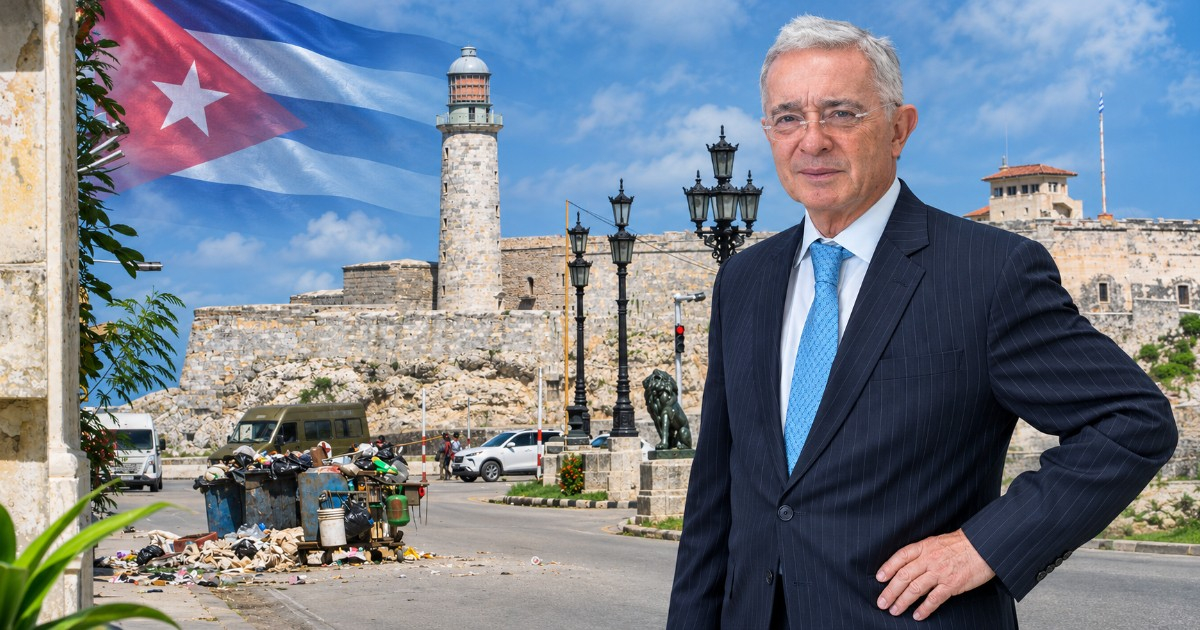
The former Colombian president Álvaro Uribe stated this Wednesday that Cuba could undergo a political transformation similar to that which ended the communist regimes in Eastern Europe, acknowledging that he has been waiting for that moment for decades. His remarks were made during the XI Presidential Dialogue of the IDEA Group held at Miami Dade College, where nine former Ibero-American presidents discussed the future of democracy in the region.
In an interview with journalist Gloria Ordaz from Telemundo 51, Uribe referenced the image of the Iron Curtain to argue that popular pressure can topple authoritarian systems. "When I was young, every January my generation would say that this would be the year the Cuban government would fall. We didn't get to witness it then, and I still hope to see it," stated the former president.
Uribe noted that the repression and humanitarian crisis affecting the island are, in his view, creating the necessary conditions for a political break.
Regarding Venezuela, the former Colombian president was equally direct: "Venezuelans have lost their fear of the dictatorship." He considered the capture of Nicolás Maduro, which took place on January 3, 2026, as a first step towards the end of the Chavista regime, and emphasized the leadership of María Corina Machado, who received the Sebastián Piñera Award for Freedom 2026 during the forum after returning to Venezuela at the end of October.
The former president also stated that he perceives a consensus among Republicans and Democrats in the U.S. Congress regarding a shared goal: for Venezuela to regain democracy. He further advocated for a bipartisan policy from Washington towards Latin America that supports democratic governments and combats organized crime, citing Plan Colombia—initiated under Bill Clinton and Andrés Pastrana, and continued during his own presidency with George W. Bush—as a model of that cooperation.
In the same forum, former Bolivian president Jorge "Tuto" Quiroga proposed a more concrete roadmap: "First vote in Venezuela", with July 2027 suggested as the date for democratic elections. Quiroga argued that the Cuban regime has sustained itself for decades thanks to Soviet support initially and later to Chavismo, and that a transition in Venezuela would break that bond and provide momentum for change in Cuba and Nicaragua.
The former Costa Rican president Laura Chinchilla emphasized the importance of international support for Machado, while the former Ecuadorian president Jamil Mahuad believed that the determination of an election date in Venezuela largely depends on pressure from the United States, and predicted a victory for the opposition leader.
The forum also brought together former presidents José María Aznar, Jeanine Áñez, Federico Franco, and Hipólito Mejía, along with former OAS Secretary General Luis Almagro. The event concluded with the presentation of the declaration "The Future of the West and Freedom."
This is not the first time that Uribe has made this kind of prediction from Miami. In November 2025, also at a forum of the IDEA Group, the former Colombian president had predicted that the fall of Chavismo would create a domino effect that would speed up the end of the dictatorships in Cuba and Nicaragua.
Related videos:
Filed under: