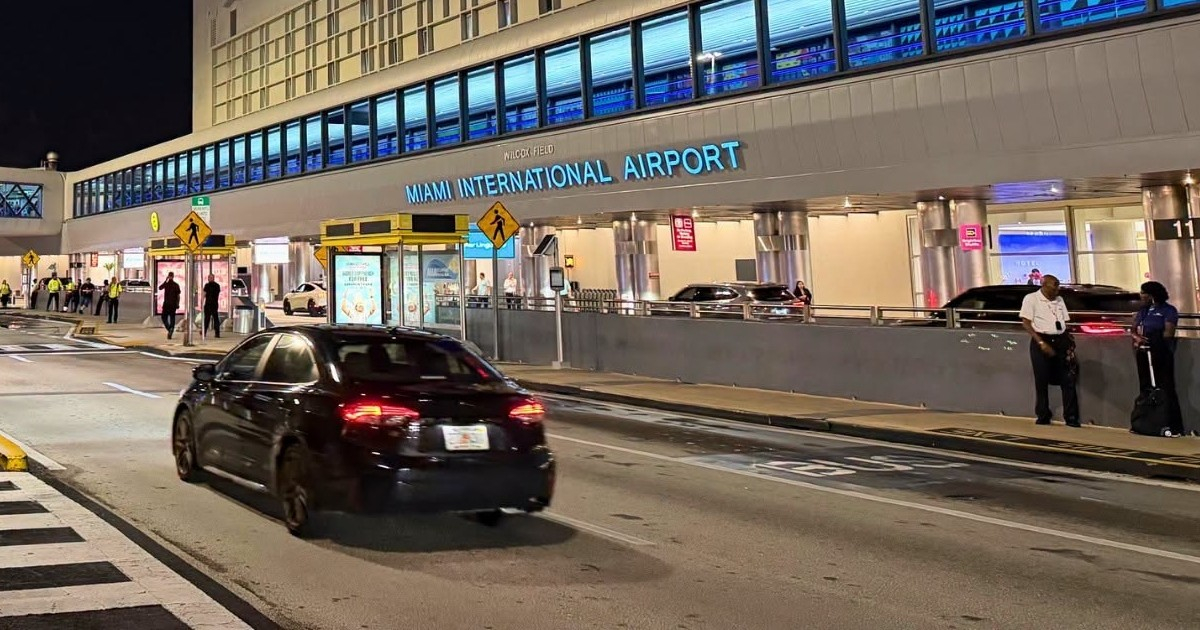
The Miami International Airport (MIA) issued a travel alert this Friday asking passengers for patience following the order from the Federal Aviation Administration (FAA) to halt all outgoing flights in U.S. territory due to a massive communication failure.
In a notification posted on their official social media, the airport advised those with flights scheduled for this day to check the status of their itinerary directly with their airline before heading to the terminal.
"A nationwide ground stop order from the FAA is currently in effect. If you are flying today, please check with your airline regarding the status of your flight before heading to the airport. Thank you for your patience and understanding," stated the official airport account.
The FAA imposed a nationwide halt around 3:54 p.m. Eastern Time, citing "extraordinary circumstances and safety reasons." Transportation Secretary Sean Duffy confirmed that the cause was a communication failure that simultaneously affected the 22 regional air traffic control centers managing airborne traffic throughout the country's airspace, and announced that FAA technicians have started an investigation.
For his part, Secretary of Homeland Security, Markwayne Mullin, appeared before the press on the grounds of the White House to alleviate the alarms that immediately arose among public opinion. “This is not another 9/11 — I simply cannot repeat it enough. People are making that assumption. This is a disruption in telecommunications. This is very different,” he stated.
Mullin confirmed that President Donald Trump was informed of the incident and that the government is operating in a "total crisis response mode". "There is no reason for the public to be afraid," the official insisted, adding that all flights that were already in the air have been accounted for and are being managed individually.
The measure only affected flights that had not yet taken off; aircraft already in the air were allowed to continue to their destinations. Incoming international flights would be managed on a case-by-case basis, according to the agency.
The impact was significant: an initial notice from the FAA reported up to 2,950 affected flights, with maximum delays of 71 minutes and an average of 33 minutes. A subsequent notice reduced the number to 647 flights with delays of up to 66 minutes. The platform FlightAware recorded nearly 7,000 delayed or canceled flights in total as a result of the shutdown, which lasted approximately from 3:10 to 4:30 p.m. Eastern Time.
Preliminary reports from police officials indicated that the incident did not appear to be a cyberattack, although the investigation remained ongoing. An internal communication from Alaska Airlines mentioned issues with communications and radar during the episode. Before the national order, the airports of Chicago O'Hare and Midway had already registered suspension alerts due to equipment disruption.
This was the third total national ground stop in the history of U.S. aviation. The most recent precedent occurred in January 2023, when the FAA's NOTAM system collapsed due to the accidental deletion of files, resulting in more than 10,563 delays and 1,300 cancellations. Before that incident, the only previous occurrence was the complete closure of airspace following the September 11, 2001 attacks, which lasted nearly two days.
The incident occurs as the FAA is making progress on an incomplete modernization of its infrastructure: Congress approved $12.5 billion in July 2025 for the project, although the agency had only replaced about half of the copper wires with fiber optics by the time of the ruling. The Trump administration recently requested an additional $30 billion to complete the technological upgrade.
Related videos:
Filed under: