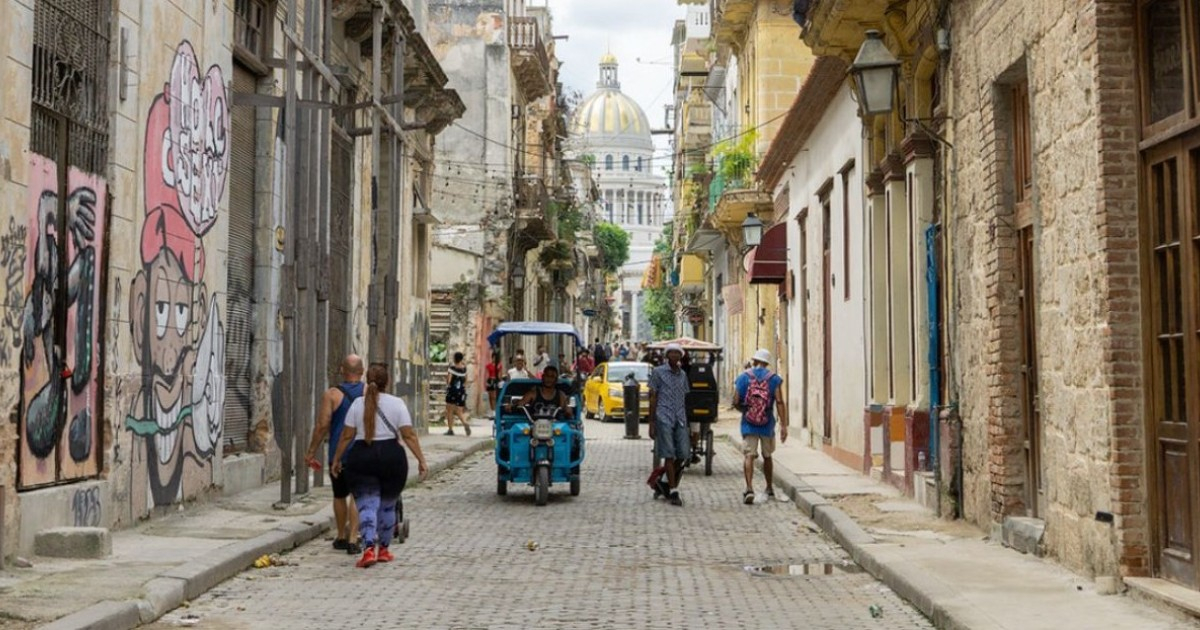
A 21-year-old woman named Danaray Morales lives with her young son in a Havana home that is at least a century old, which authorities themselves declared uninhabitable after a partial collapse, but she remains there because the regime offers her no alternative.
Your case is the focus of a report published this Wednesday by NBC News, written by journalists Orlando Matos, Carmen Sesin, and Roberto León, which depicts the housing crisis in Havana as a national emergency overlooked by the dictatorship.
The dilemma facing Morales is the same experienced by hundreds of families in the Cuban capital: stay in a structure that could collapse at any moment or be left without a roof over their heads. There is no third option because the state simply does not provide one.
The figures that support this drama are devastating. Cuban officials estimate that around 1,000 buildings collapse each year in Havana, resulting in fatalities and displaced families.
The national housing deficit exceeds 929,000 homes, approximately 35% of the real estate stock is in regular or poor condition, and by the end of 2025, the capital recorded 185,348 deteriorated properties, of which 46,158 required major repairs.
The regime's response has been systematic inaction. In 2025, the State completed only 2,382 homes out of the 10,795 planned, achieving just 22% compliance. In 2018, the government promised to eliminate a deficit of nearly one million units in ten years; by 2026, that deficit remains unchanged.
Tragedies are piling up with a regularity that no one in Cuba can ignore any longer. On September 20, two elderly people were crushed by the collapse of the front porch of their house in the Lawton neighborhood, Diez de Octubre municipality, in a home that had shown significant prior deterioration.
Three days later, a neighbor from the building at Dragones 165, across from the Capitol, video recorded the imminent risk of collapse of a structure that was hanging over the staircase used daily by dozens of people, including children. "I am tired of calling them, and calling them, and calling them," said the woman. "When there's a death, then they'll come."
In November 2025, a mother and her son died in the collapse of their home in Old Havana, on Compostela Street. In July of that same year, two collapses in a single day resulted in four deaths, including a seven-year-old girl. The rains in September 2026 caused 26 total collapses and 122 partial ones in the capital, with 148 people moved to state facilities and 762 self-evacuated.
The contrast with the regime's priorities is impossible to ignore. While the housing stock is crumbling, GAESA —the military conglomerate that controls the Cuban economy— is accumulating hotels through its subsidiary Gaviota, which in 2026 were operating with an occupancy of less than 10%.
Gaviota closed 20 hotels in Cayo Santa María, leaving more than 7,000 workers unemployed, and only 3,470 of more than 30,000 rooms linked to the conglomerate were operational in recent weeks. In the first half of 2023, investment in hotels and restaurants reached 2,325.3 million pesos, compared to 583.3 million allocated to health and social assistance.
The organization Human Rights Watch documented in July 2026 that 76 displaced persons from landslides were living in overcrowded conditions in an old school, without a bathroom, using plastic bags as a sanitary alternative, and having electricity available only two to three hours a day.
The pattern described in the NBC News report is always the same: neighbors report the deterioration, authorities do not respond, and the tragedy ultimately unfolds. The housing crisis in Cuba is not the result of external factors, but rather decades of deliberate neglect by a regime that prefers to build empty hotels rather than provide a decent roof for its own people.
Related videos:
Filed under: