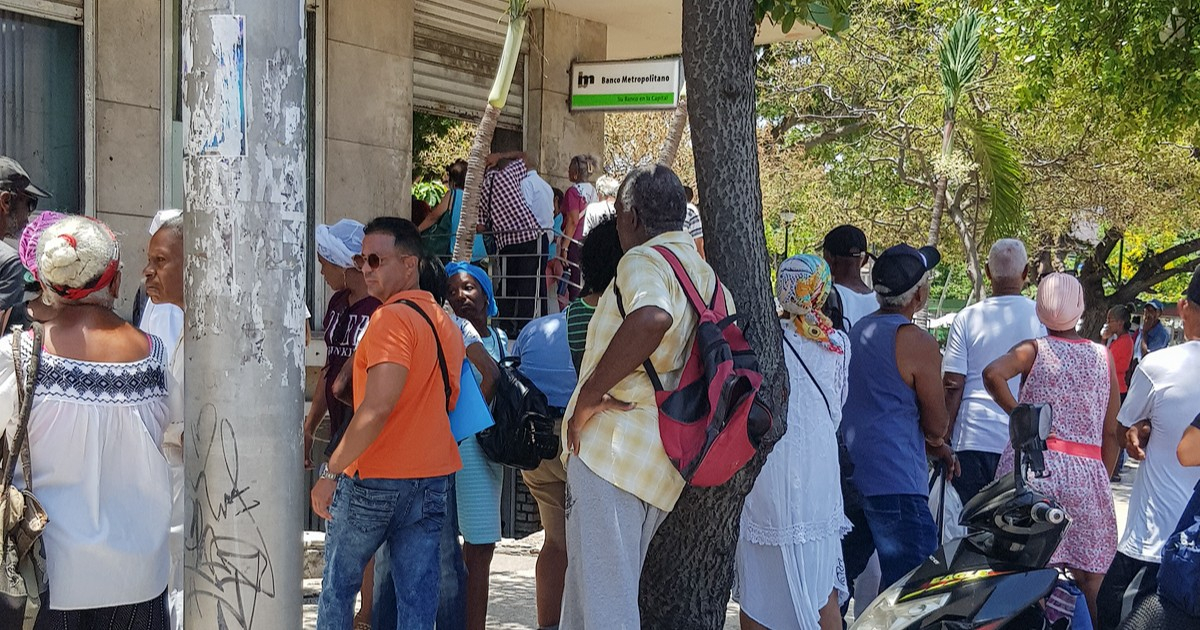
A professor from the Faculty of Communication at the University of Havana described on Wednesday the ordeal she faced that same day to withdraw her salary from the bank, in a story that encapsulates the monthly nightmare of millions of Cubans in the face of a collapsing banking system.
Iraida Calzadilla, retired journalist from the state newspaper Granma and university lecturer, published a post on Facebook titled "The Monthly Via Crucis" in which she recounted leaving her house at six in the morning and still waiting in line five hours later, with a long queue ahead of her.
"Today I have electricity and water in my home, and it’s a day when I miss out on those expected opportunities amidst the distress that shapes the survival of Cubans," wrote Calzadilla, highlighting the cruel paradox of sacrificing two scarce resources—light and water—due to the obligation of going to the bank.
"Since 6 in the morning, I left home and arrived in less than half an hour. The advantages of proximity. It’s 11, and I still have a crowd of people in front of me, which allows me to guess that I have quite a bit to go before reaching the checkout," he reported.
But the wait was not the only complaint. Calzadilla pointed out specific irregularities that recur every month at the counters: "The NO has already reemerged, half of what is owed, the cap on the figures, and even the false code. And the arrogance of petty power has flourished."
The journalist also questioned the official narrative regarding banking: "And the curse of the lie that keeps getting repeated about the obligation to receive payments by transfer." Regarding the inspectors responsible for ensuring compliance with the regulations, she was direct: "Everything is visible, everything is verifiable, all with the approval of the supposedly trustworthy inspectors who, in the end, leave citizens completely defenseless." She concluded with a warning to the authorities: "Proclaimers of solutions: make sure to also check that they are being fulfilled."
The comments on his post reflected that the experience is collective. One internet user pointed out that "the bank situation is a disaster, and on every corner, you find people offering cash in exchange for 30%." Another shared that he had waited two months with the "My Turn" system without being able to collect. Retirees and teachers responded en masse with expressions of solidarity and their own accounts of the same hardship.
The episode on Wednesday is not the first that Calzadilla has publicly documented. Last July, she spent eight hours sitting on the edge of a sidewalk in front of the Ministry of Transport's bank, where retirees were trying to withdraw up to 5,000 Cuban pesos —less than nine dollars at the informal exchange rate— in a facility without adequate infrastructure.
On that occasion, the educator described "eight divine, sweltering, overwhelming, and frustrating hours" and concluded that "we have denounced these terror-filled days with so many voices, yet there are no real solutions."
The symbolic weight of her denunciations lies in the fact that they do not come from the opposition, but from a veteran of official journalism who also erupted against the government in July with a question that resonated widely: “I want to see who dares to ask me for more creative resistance when basic needs and even less basic needs are well covered.”
The banking crisis depicted by Calzadilla has structural roots. The policy of mandatory banking, implemented since August 2023, has expanded electronic payments in a country where the banking infrastructure could not guarantee access to cash. In November 2026, more than 60% of the ATMs in Havana remained out of service.
According to figures released in July, only 3.77% of transactions were conducted through digital means, while the cash shortage fueled an informal market with fees ranging from 35% to 50% for converting transfers into physical cash.
More than 1.7 million Cuban retirees rely on this broken system to receive their pensions each month, and teachers are not exempt: in Camagüey, there were reports of at least two months of unpaid salaries for teachers last September.
Related videos:
Filed under: