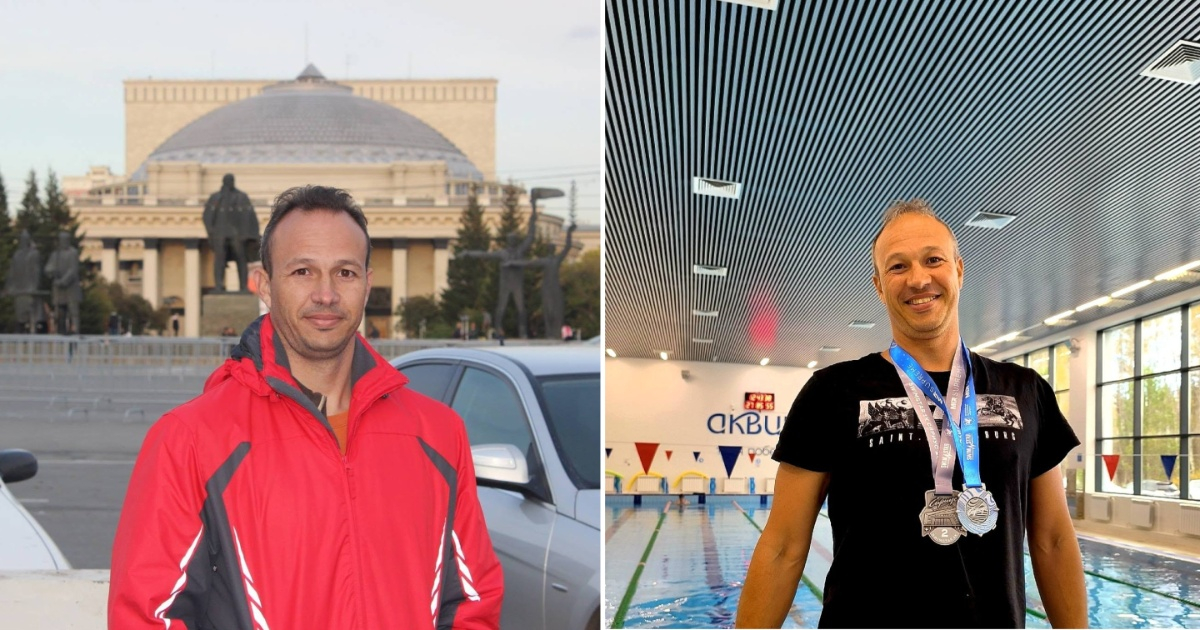
A Cuban born in Novosibirsk who spent 32 years separated from his Russian mother returned to Siberia in 2017 to reunite with her, featuring in a report by the Russian regional portal NGS.ru published on November 11, which explores his life between two worlds and the daily clash between what he found in Russia and what he left behind in Cuba.
Alexander Luisovich Paneque-Meshchenkov was born in the Pervomaisky district of Novosibirsk in 1983, the son of a Russian mother and a Cuban father who had met while studying engineering at the then Electrotechnical Institute of Novosibirsk, now the Technical University (NGTU).
In 1985, when the boy was two and a half years old, his father took him to Cuba. His mother stayed in Russia.
"I was very little, so I hardly remember Novosibirsk. I grew up in Cuba, where I studied and practiced sports. Mom stayed in Russia, and I lived with Dad," Alexander shared in the report.
On the island, he graduated as a computer engineer and became a competitive swimmer: at eight years old, he won municipal competitions, was selected for a specialized sports school, and went on to win two bronze medals at the Cuban national championship.
The reunion with his mother took place in 2017, when Alexander was 34 years old. According to him, processing the documents to leave Cuba was a complicated process. Additionally, he had to relearn Russian from scratch: despite it being his native language until he was two, he didn't speak a single word of it when he arrived.
"I always wanted to see Mom and the city where I was born. The meeting was very important for both of us. I knew Mom through photographs and phone conversations, and then suddenly we were together. It was a strong shock for both of us," he recalled.
She humorously summarized her adaptation to the Siberian cold: "You just have to bundle up more." But the real discovery was culinary.
"I tried sour cream for the first time here: dairy products, in general, were a novelty for me. In Cuba, the variety of products isn't as extensive, and in Russia, I discovered many new things. The cured meats as well: there is an enormous variety here, many things I had never seen before," he explained.
In Novosibirsk, Alexander became a multifaceted professional. He works as a lifeguard at the Koltsovo Sports Facilities Center, trains children in swimming, and leads the "Koltsovo Sports Veterans" team, made up of older women whose technique, according to the report, would inspire envy in young swimmers.
He also teaches computer science to school students and spent a year teaching Spanish at a local university.
In terms of sports, he continues to compete: in October, he placed second in his age category (40-49 years) in the one-kilometer event of SWIMSTAR-2026, held in Sirius, Sochi. In 2021, he swam across the Obi River —approximately 3.6 km— during the "Siberian Wave" festival.
"This is not ours," said Tamara Lisitsyna, the leader of the veterans' team, as she draped the team's trophies around her coach's neck. "It's his achievement."
The family is spread across three countries: the father and two brothers remain in Cuba, while one sister lives in the United States. Alexander says he has "two roots" and that he loves Cuba, but his life is in Russia.
The case of Alexander falls within a little-documented generational phenomenon: that of the children of mixed Cuban-Soviet marriages born during the decades when between 100,000 and 300,000 Cubans studied in the USSR through university scholarships, many of whom were left separated from one of their parents following the Soviet collapse in 1991.
Related videos:
Filed under: