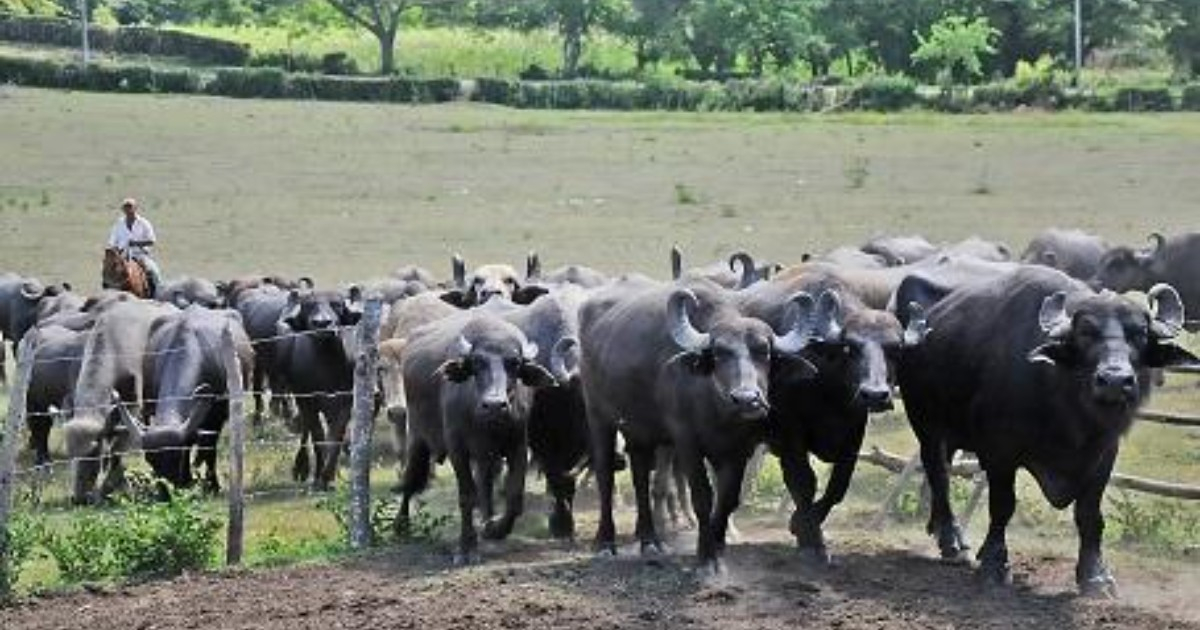
More than four decades after the Cuban regime introduced the water buffalo as a solution to the shortage of meat and milk, the Food Monitor Program (FMP) concludes that the program remains a promise without verifiable results, while Cubans continue to see little of its products on their tables regularly.
The State imported 2,984 specimens in 1983 with the argument of utilizing swampy lands that were poorly suited for cattle. The herd grew to reach 63,050 heads in 2009, but by the end of 2020, it had fallen to 54,100 animals, with 91% under state ownership. Since then, there has been no public national series reporting how many buffalo remain or in what productive conditions they exist.
What does exist is a repeated pattern: the official discourse announces potential, but never provides accountability. The National Television News once again presented the buffalo as a "promise" to increase meat and milk deliveries by mid-year, repeating a script that has been periodically refreshed without results reaching the population.
“More than forty years later, the official discussion continues to focus on potential rather than a national assessment of results,” highlights Food Monitor Program in its analysis.
The available provincial data reveals poor management. In Ciego de Ávila, the authorities themselves acknowledged in 2016 that 85% of the provincial buffalo population was wandering uncontrolled across various municipalities. Four years later, in 2022, only 365 scattered individuals were captured, at a rate lower than that of the uncontrolled animals' reproduction.
In Las Tunas, the herd concluded 2023 with 2,128 animals, 400 fewer than the previous year, although 71.6 tons of meat were reported to have been delivered to the industry, along with 60,451 liters of milk. In Granma, state media reported over 200 tons of meat produced in 2022, intended for the meat industry, tourist areas generating foreign currency, and state entities, with the milk directed towards small cheese and yogurt industries. These results are specific figures that are hard to independently verify, FMP stated.
The structural problems are well-known: a deficit of fences, a shortage of food and medicine, lack of veterinary care, absence of economic incentives for workers, and a lack of stable mechanisms to complete the production cycle. In 2024, the president of the Livestock Business Group himself admitted that livestock records "had lost clarity" and needed to be updated to identify and track the animals.
This scenario is part of a structural livestock crisis that is worsening: Cuba has lost more than 900,000 heads of cattle since 2019, collected only 41.1 million liters of milk in 2024, and the meat industry reached just 71% of its plan that year.
The food crisis affecting the population makes the demand for transparency more urgent. According to data from the Food Monitor Program on hunger in Cuba, 72% of Cuban households follow unhealthy diets, 29% eat only twice a day, and one in four Cubans goes to bed without dinner.
In light of this situation, the Food Monitor Program concludes that "after four decades, the product derived from buffalo farming should be seen in regulated or liberated markets and social programs, which, in practice, does not happen with this or any other product of the many that are mystified by a productive potential that Cubans never came to witness."
Related videos:
Filed under: