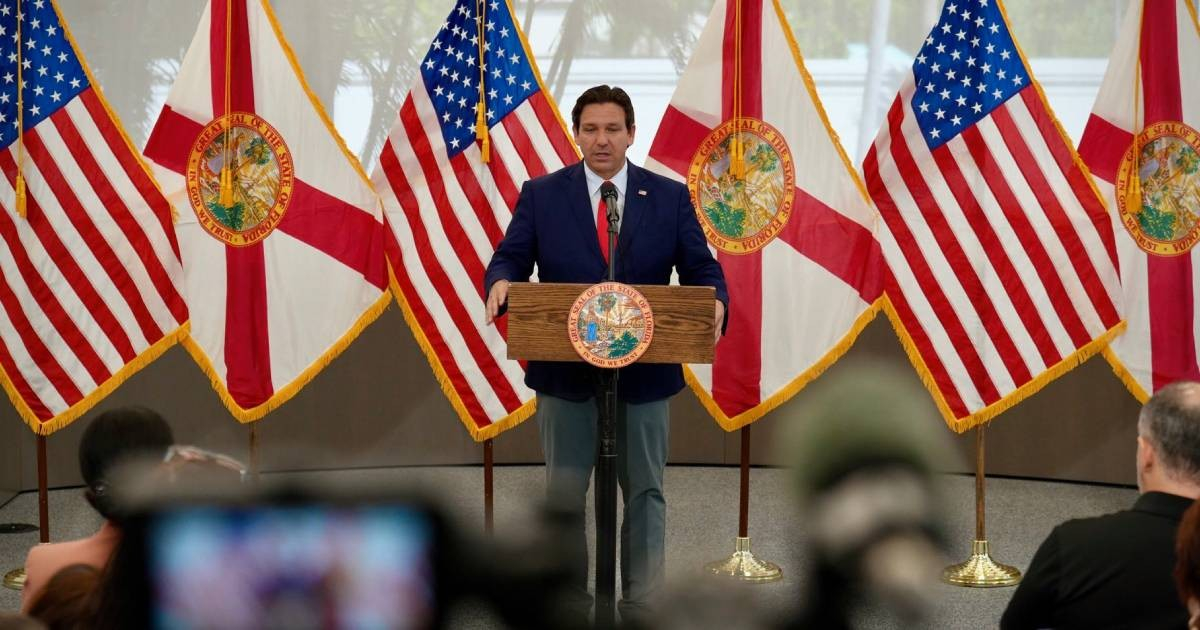
The governor of Florida, Ron DeSantis, has renewed the state's immigration emergency declaration for the twenty-fourth time, extending it until January 16, 2027, as Florida surpasses $1.2 billion spent from its disaster preparedness fund on immigration control operations.
A report from the Tampa Bay Times published on Wednesday details that the funds come from the Emergency Preparedness and Response Fund, a fund established by the Florida Legislature in 2022 to allow the governor to respond to natural disasters without the need for prior legislative approval.
The renewal, signed on November 17, also has a direct political implication. The emergency will expire days after the elected governor Byron Donalds takes office, allowing him to inherit that extraordinary authority from the very first day of his term.
El gasto de Florida en operativos migratorios y las políticas de DeSantis son parte de un panorama más amplio que sigue cambiando; mantente al día con todo lo que ocurre en nuestra sección de
The accumulated expenditure includes contracts with the 67 county sheriffs—who signed 287(g) agreements with the Immigration and Customs Enforcement (ICE) in February 2025—overtime for personnel, equipment, and the operation of two state detention centers.
The most expensive was Alligator Alcatraz, installed in the Everglades between July 2025 and June 2026, with a fee of $249 per detainee per night and a capacity of 4,100 people.
The federal government promised to reimburse $608.4 million through FEMA's Detention Support Grant program, but by mid-September, Florida had only received $84.5 million, just 14% of the total amount pledged.
DeSantis acknowledged in August that refunds "were starting to arrive, but FEMA was moving slowly," and stated that the amount received so far was "a hundred and some million."
The state emergency management agency (FDEM) projects a deficit of up to 1.5 billion dollars for the fiscal year 2026-27, in a scenario that anticipates two major hurricanes and an additional 500 million allocated for immigration.
This situation is particularly concerning this week, as southern Florida has recorded over 30 centimeters of rain in some areas of Miami-Dade. Public schools in the county closed this Thursday, and the flooding has reignited the debate about whether the disaster fund should be reserved exclusively for natural emergencies.
The origin of all this machinery dates back to January 6, 2023, when DeSantis issued Executive Order 23-03 in response to the massive arrival of Cuban and Haitian migrants in the Florida Keys. Today, that same instrument finances operations that directly affect the Cuban community.
More than 4,000 Cubans received deportation orders in Florida between October 2025 and June 2026, making them the fourth most affected nationality after Guatemalans, Venezuelans, and Hondurans.
Detentions of Cubans by ICE increased by 463% between October 2024 and January 2026, and at least 612 were deported in the first five months of this year.
The political impact of the offensive became evident in the elections on November 3. Congressman Mario Díaz-Balart won his re-election by just 1,704 votes, compared to previous margins of nearly 40 points, and described the migration offensive of the Trump administration as a "major political mistake."
The Florida Legislature attempted to set limits on the use of the fund. The House proposed to restrict it to natural emergencies, while the Senate preferred to maintain a broader usage. The law SB 7040, in effect since June, subjected the use of the fund in renewed emergencies to budgetary review and established mechanisms for legislative authorization.
With the extension signed this week, DeSantis leaves the door open for Donalds to continue the immigration policy with the same emergency powers, in a state whose disaster fund faces a projected deficit that could reach 1.5 billion dollars.
Related videos:
Filed under: