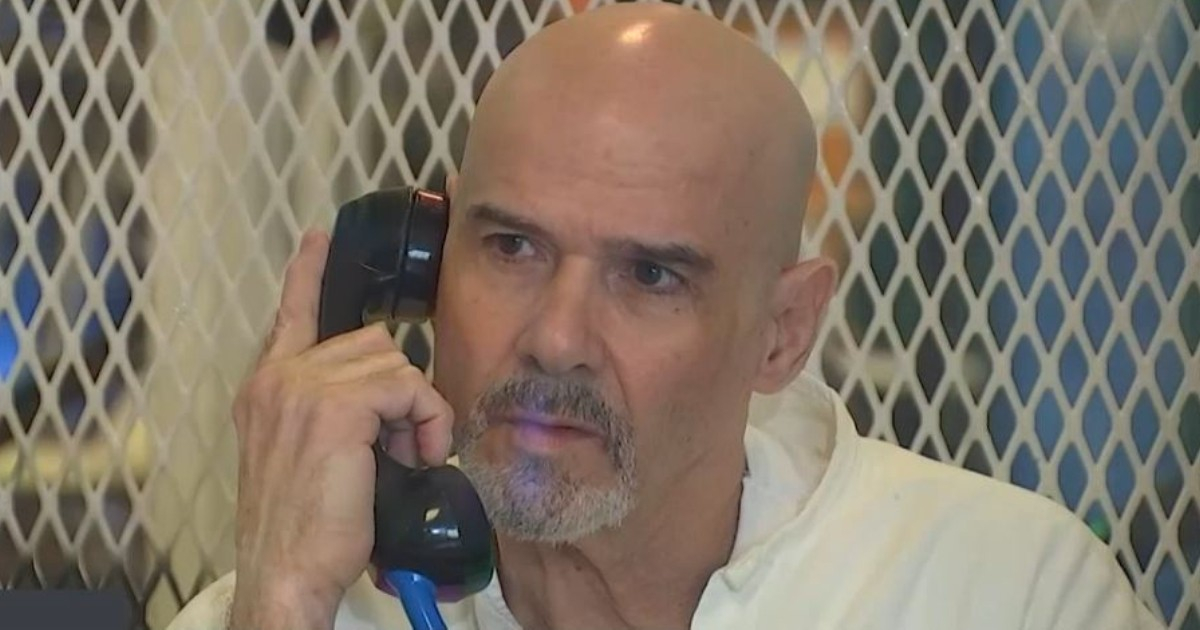
Reinaldo Dennes, a 70-year-old Cuban, will be executed by lethal injection this Thursday at the Huntsville Unit in Texas for the murder of diamond merchant Janos Szucs during a robbery in Houston that took place 30 years ago.
According to the report from Telemundo, he will receive the lethal drug at 7:00 p.m. and will become the ninth person executed by that state this year.
Dennes was born in Arroyo Naranjo, Havana, in 1956 and emigrated to the United States with his family when he was a child. He grew up in Miami, where he learned the trade of jeweler from his father.
The crime dates back to January 24, 1996, when Dennes—who had his own jewelry design office in the same building where Szucs worked in Houston—planned the robbery with the help of his brother and a cleaning staff member to whom he offered $5,000 to open the back door of the property outside of regular hours and distract the security guard.
That night, Dennes and his brother entered the building disguised. The security guard was shot twice but survived, and while pretending to be dead, he was able to later identify Dennes as his attacker.
Upon entering the jeweler's office, the police found Szucs's body with multiple gunshot wounds and the safe completely empty: the thieves had made off with diamonds valued at approximately 3.6 million dollars and around 200,000 dollars in cash.
The jewels were never recovered. Dennes himself acknowledged years later: "All of that was lost, buried, and gone."
Sentenced to death in 1997, he spent nearly three decades on death row at the Polunsky prison in Livingston, Texas, where inmates live in almost total isolation. During that time, he focused on creating artwork and studying languages and religion.
In 2022, Dennes granted an interview to Telemundo 51 in which he spoke publicly about his case for the first time and admitted his guilt: "I did those things, so I am guilty," he stated, adding that he regretted taking a man's life.
On that occasion, he expressed his desire to die: «What I want is to leave this world. If they want to gain anything from my death, then let them be happy, but that won't bring joy to anyone.»
The prosecution used those statements as key evidence in recent court documents, countering the defense's arguments that there was insufficient evidence to prove that Dennes had fired the deadly weapon.
"I regret everything. I was worth more than all that. People go crazy for diamonds, gold, and all that is trash," Dennes said then. He also admitted that, had he not been caught, he would probably have continued causing harm.
A year after his sentencing, his brother José Albert Dennes pleaded guilty to homicide and was sentenced to 45 years in prison. He was released on parole in 2019.
The defense also argued that a key witness during the sentencing phase was actually a confidential informant for the Houston Police, a fact that the prosecution allegedly did not disclose. The Fifth Circuit Court of Appeals rejected that argument in January 2020, and the United States Supreme Court dismissed the final appeal in December of that year. A new request for a stay was submitted to the Supreme Court on Wednesday.
The execution of Dennes takes place in a context of intensified capital punishment in the country. This Thursday, Florida is set to execute Thomas Mitchell Overton, 71, convicted of murdering a couple and their unborn child in the Florida Keys in 1991, which would mark the twentieth execution in the state in 2026, a historical record since the reinstatement of the death penalty in 1976.
According to a report by the Associated Press, the occurrence of two executions of septuagenarians on the same day highlights the aging of the death row population in the United States.
Related videos:
Filed under: