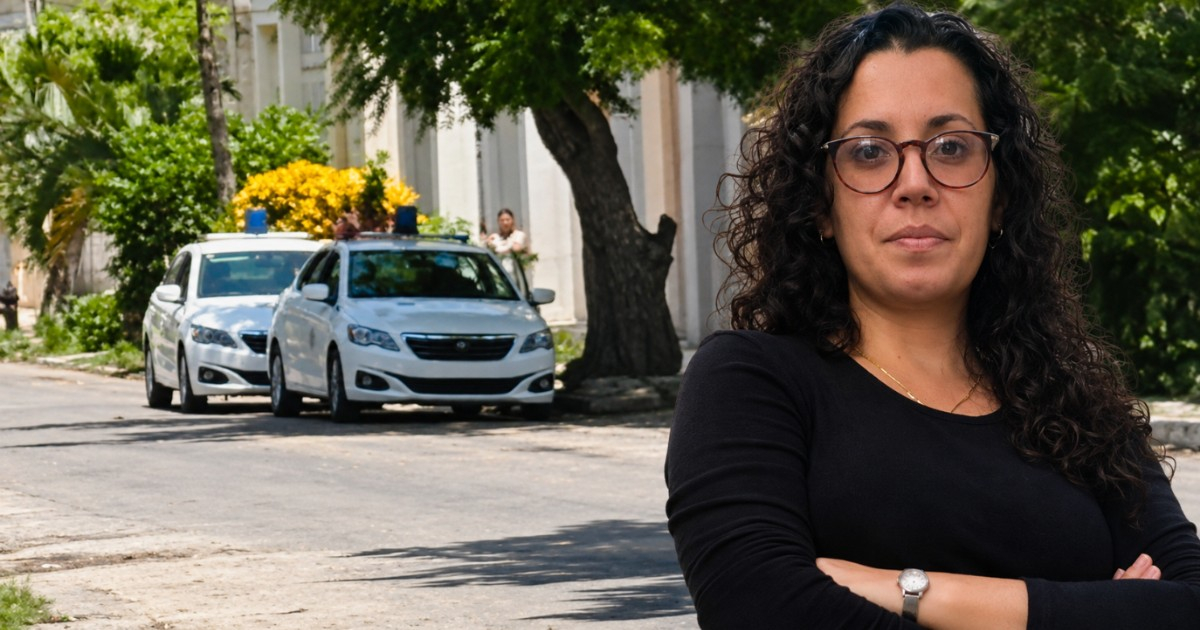
Camila Acosta, correspondent for the Spanish newspaper ABC in Havana and contributor to CubaNet, publicly denounced the systematic harassment that the Cuban State Security imposes on her and her husband, the writer and former political prisoner Ángel Santiesteban Prats, who were to appear this morning before the police in Havana accused of the alleged crime of "attempted assault”, which carries penalties of between two and five years in prison.
The citation was communicated on Tuesday by Colonel Márquez, head of the police station at Zapata and C, in the Havana municipality of Plaza de la Revolución, who refused to disclose who made the complaint or the specific details supporting it.
Acosta recorded a video from Havana to expose what he called "another maneuver by State Security" aimed at forcing her to abandon her work or pushing her into exile.
"What is certain is that this is yet another setup by State Security to pressure us, whether to abandon our activism or our work as independent journalists," the journalist stated.
The accusation, according to Acosta's suspicion, may be related to a video she recorded at the end of October, when an agent of State Security dressed in civilian clothes prevented her from leaving her home without showing a court order or identifying himself.
The images were released by CubaNet, after which the authorities claimed that the agent and his family had received threats, attempting to hold the journalist responsible.
Just two weeks prior to the new accusation, on November 3rd, Acosta was detained for more than eight hours while she was on her way to the veterinarian with her cat: two plainclothes officers and two uniformed police officers handcuffed her with her hands behind her back and forced her into a patrol car, without a court order or explanation.
She was released with a warning notice that she refused to sign, and her phone was returned to her unusable, allegedly damaged by a corrosive substance.
In an extensive testimony published by ABC, Acosta describes in detail life under constant surveillance: agents stationed in front of his building, arbitrary house arrests occurring between 40 and 50 times a year, confiscation of work equipment, and defamation campaigns in official media.
"You can't leave your house. Orders from above," they are usually told by men in plain clothes who don't even identify themselves and show up without prior notice or a court order.
The State Security interrogations include direct threats to their family members. "We know your grandparents are ill, and if they end up in a hospital, whatever happens to them will be your fault," one of those agents said to him on one occasion.
Since 2019, the journalist has accumulated dozens of arbitrary arrests. After being detained for four days while covering the protests on July 11, 2021, she started carrying a "basic kit" in her purse at all times: toilet paper, soap, water, candy, underwear, a toothbrush, and medicine, in case she gets locked up again.
The case of Acosta is part of a broader wave of repression against independent journalism in Cuba during November 2026.
The CubaNet reporter Vladímir Turró reported last week that three agents forcibly took him out of La Habana, brought him to a secluded location, pointed a gun at him, and forced him to record a video renouncing journalism.
Henry Constantín, director of La Hora de Cuba, has been imprisoned since September in the high-security Kilo 7 prison in Camagüey, accused of “disobedience.”
According to Prisoners Defenders, Cuba closed October with 1,353 political prisoners, a historical record, following the registration of 39 new additions during that month.
Acosta summed up in one phrase the price of practicing independent journalism on the island: "This Thursday, my husband and I will attend the summons and we will be prepared for the worst: to be taken directly to prison. It is the price of defending truth and freedom in a dictatorship."
Related videos:
Filed under: