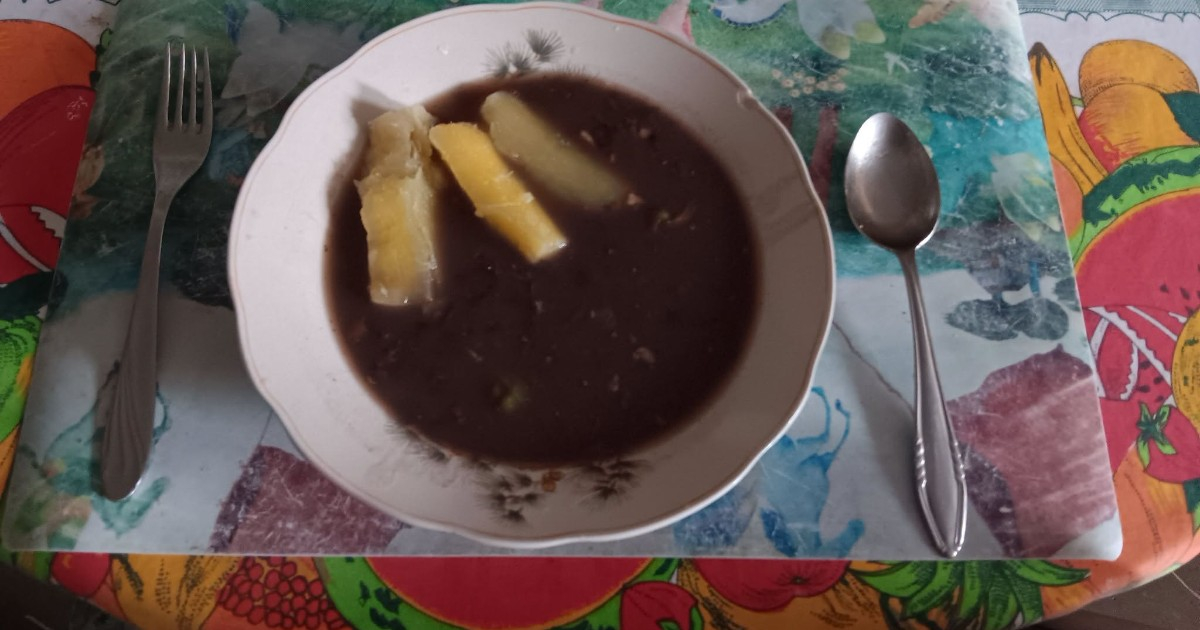
"Without the intention of sounding dramatic, our current reality, with depressed agricultural production and the outrageous prices of imported products in relation to average incomes, is determined to surpass the food crisis experienced by our grandparents," wrote Jesús Álvarez López, a state journalist from the CMHW station in Villa Clara, on Facebook in a text titled "Neither yuta nor fole, nor anything."
Álvarez recounted witnessing in the agricultural market of Paseo de la Paz, in Santa Clara, how an elderly woman gathered 90 pesos in five-peso bills to buy two pounds of burro bananas. "It torments me not to know what she could have purchased the next day. Anyone who does not feel a tightness in their chest upon seeing scenes like this has lost their sensitivity, if they ever had it. In my opinion, they have no right to expect forgiveness, not even from God," he wrote.
The journalist reported that "the monthly income of hundreds of thousands of compatriots is no longer enough to even buy rice due to its exorbitant price", and that the price of pumpkin has increased from 30 to 300 pesos per pound. Pharmacies lack vitamins to alleviate nutritional deficiencies, and soap and toothpaste are also inaccessible to large segments of the population.
"The surprising announcement that price controls would be lifted caused the prices of essential foods to multiply several times within hours, driven by speculation, precisely when the ration book was gradually fading away until it disappeared without a sound," he stated. The regime eliminated the maximum prices for chicken, oil, and other essentials in June 2026, and then followed suit with rice through Decree 156/2026, signed by Prime Minister Manuel Marrero Cruz.
Staying true to his position, Álvarez López attributes part of the problem to the U.S. embargo, although he acknowledges that there are "several internal" factors. He avoided questioning the structural causes and urged to act "with the urgency that the moment demands." He even quoted Raúl Castro from the 1990s — "if there is food for the people, the risks don't matter" — to emphasize that this risk is now the greatest of all.
Cubans who responded to the text did not forgive the evasion. "Pure consequence, always avoiding questioning the causes. Shortages, lack of production, inflation, and loss of purchasing power are not the fault of the merchants, but of poor economic policies [...] You have to be blind not to see that the problem is structural. It's the system, sir, the system!" wrote one commentator.
Others rejected the comparison with the past before the triumph of the Revolution: several pointed out that their families, although poor before 1959, had three meals a day. "What we're going through is very difficult, but my grandmother used to tell us, ‘With your grandfather, I raised 14 children; the worst day was Monday, we would have soup with a lot of tubers, malanga, yuca, a little piece of pumpkin, and that burro banana didn't exist. It was pig food. I studied at the University from 1999 to 2005, and I heard my 90-year-old grandmother talking, and I always knew that at school they didn't tell me the whole truth about what life was like before '59," shared one person.
"Now there’s not even yuca and beans because they are outrageously expensive, and according to my grandfather, who owned the store La Montaña on Paula and Picota, in Old Havana, the very poor would buy a kilo of anything to eat or they would charge it on credit. Now you can't even ask your neighbor because they don't have it either, so it's better not to dwell on the past lest I find myself stuck in it," expressed another user.
In November 2026, rice is sold for between 390 and 500 pesos per pound; black beans reach 700 pesos and red beans up to 1,500 pesos. Preparing a plate of yellow rice with pork chop can exceed 10,000 pesos, more than the average monthly state salary of 7,354 pesos. The Cuban economist Javier Pérez Capdevila estimated in a study published in May that a person needs about 96,000 pesos per month to cover their basic needs, almost 30 times the official minimum wage of 3,210 pesos.
Related videos:
Filed under: