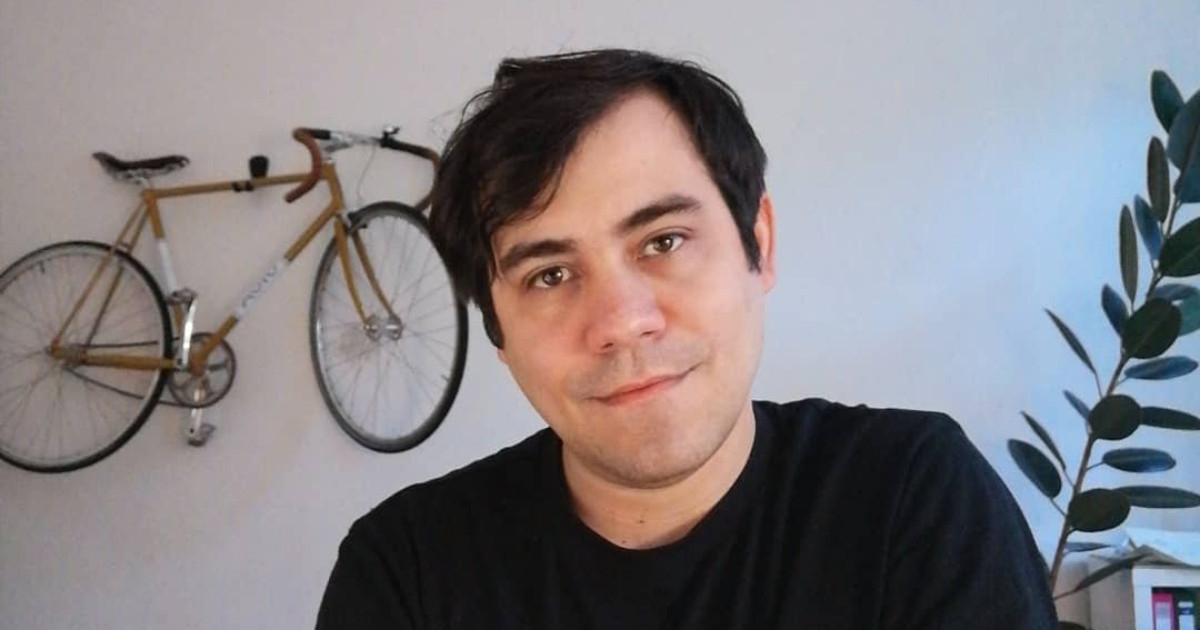
The Cuban visual artist Hamlet Lavastida obtained refugee status in Germany on October 21, after five years of exile characterized by migratory uncertainty since his forced departure from Cuba in 2021.
The resolution will allow him to access travel documentation under the 1951 Geneva Convention, after having remained in German territory on temporary permits related to scholarships and artistic projects.
"At last, I have managed to have a state behind me that can provide me with documentation. From now on, I can at least access a travel document, a passport under the 1951 Geneva Convention," he declared in an interview with the independent digital newspaper 14ymedio.
The 43-year-old artist currently resides in a shelter in Nuremberg and hopes to complete the pending administrative procedures by January 11, including the issuance of his residence permit and the connection of his health insurance to the support institutions for refugees.
Lavastida also contrasted the institutional support he receives in Germany with the treatment he experienced in Cuba. "By imprisoning me in 2021 without any justification, the Cuban state was essentially saying that it was denationalizing me, through law and exile," he stated.
The news also has a personal dimension. Their partner, the Cuban artist and graphic designer Claudia Patricia, is in Spain under a similar immigration situation. "It's really great news because it could mean our soon reunion, seeing each other again," they expressed.
Lavastida was arrested in June 2021 after returning to Cuba from an artist residency in Berlin, and remained 87 days in Villa Marista, the headquarters of State Security in Havana. The Ministry of the Interior accused him of "incitement to commit a crime" for suggesting in a private Telegram chat that people should mark bills with logos of the San Isidro Movement and the 27N group.
Amnesty International declared him a prisoner of conscience. His release was contingent upon leaving the country with the poet and activist Katherine Bisquet, who described that departure as "the price of exchange" for his release. They initially traveled to Poland and, since December 2021, they have been welcomed by the Berlin museum Künstlerhaus Bethanien.
From exile, the artist maintains a body of work focused on Cuban political memory and the mechanisms of repression. In January, he publicly identified the State Security agent who arrested and interrogated him in 2021, claiming that this individual has visited his mother to warn her about the consequences of a possible return to the Island.
In his assessment of the Cuban situation, Lavastida stated that "objectively and practically, Cuba has changed for the worse." He described an "institutional debacle" characterized by the collapse of health and education systems, mass exodus, and "galloping repression," under what he termed "a military junta disguised as the Communist Party and vice versa."
Despite this situation, he believes there is a growing social unrest. "There is a silent layer that has expanded significantly. It’s like a great magma down there that is about to erupt in a volcano of creative disobedience against oppression," he asserted.
On Monday, November 24, Lavastida will inaugurate his exhibition "Mea Culpa" in Mérida, Yucatán, curated by Marco A. Castillo, as part of the Yucatán Biennial 2026.
The exhibition features four works of hand-cut text on paper that reproduce letters of self-criticism from figures connected to the Cuban revolutionary system who ultimately found themselves in opposition to it, including the poet Heberto Padilla and General Arnaldo Ochoa Sánchez.
Related videos:
Filed under: