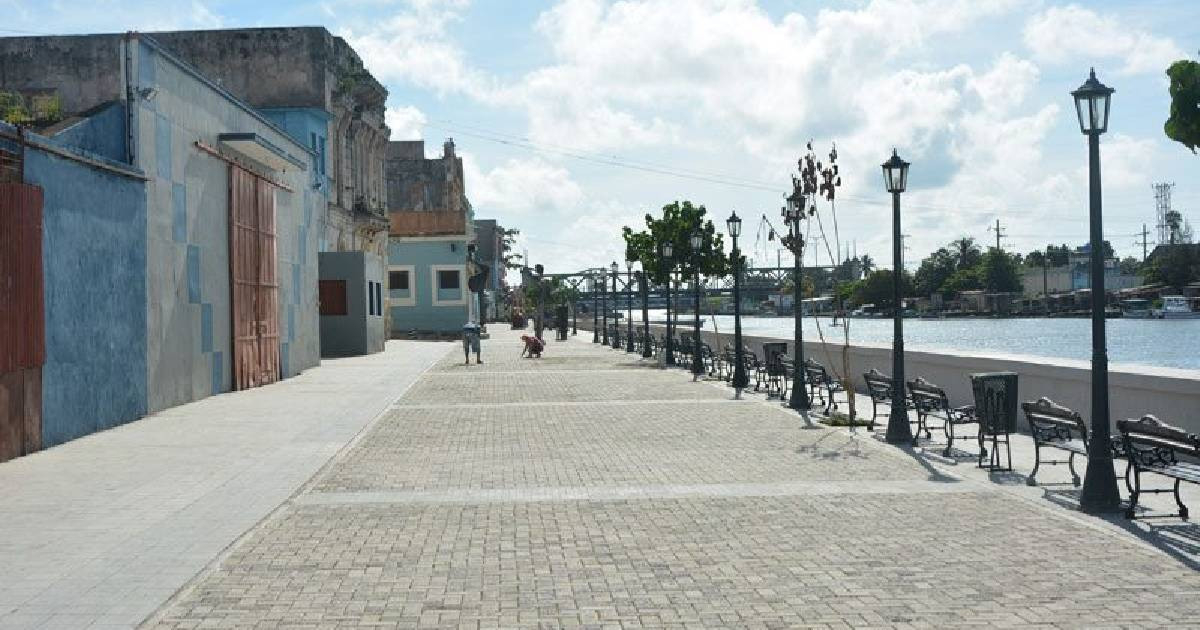
Children between the ages of seven and 15 are asking passersby for money, riding electric motorcycles at high speeds, and according to a citizen's complaint, some have been seen with knives on the Paseo de Narváez in the city of Matanzas.
The alert was shared this Saturday on Facebook by Yunier Galindo, who described the deterioration of one of the most iconic public spaces in the city, where he noted that only four bars are still in operation.
"What worries me the most is the number of children asking for money. Children from seven years old up to 14 and 15 years old. Children who are there from early on and are not in school, children who do have parents but they don't care, children riding electric scooters at 100 down that promenade, putting at risk other children who are playing under their parents' watch. Children that I have seen with blades," he wrote.
Galindo stated that every five minutes someone approaches to ask for money on the promenade, among vulnerable individuals, people with alcoholism issues, and minors. He also questioned the lack of institutional intervention. "Don't the authorities see this? What should the State do about it?" he asked.
The comments on the post reflected the concern of other residents about the presence of minors on the streets and the deteriorating conditions of the environment.
A neighbor claimed that some parents send their children to ask for money and then keep what they collect. "Going out on the street today makes me want to cry. There are people in need, but it's appalling how many shameless individuals there are asking for money, and parents who send their children to beg only to take the money from them and live without working," she wrote.
Another resident shared that she brings extra money when she visits Matanzas because she expects to encounter people asking for help. "Sometimes there are as many as 10, because when they see you giving to one, more come. They are children and the elderly; it really is very sad to see life today here in our country," she recounted.
Criticism also extended to the police authorities. One commentator questioned that while patrols are maintained around the provincial headquarters of the Communist Party of Cuba, other areas require greater surveillance. "It is more important to protect the provincial Party headquarters than to combat crime and care for such a vulnerable area," he stated.
Another resident lamented the physical deterioration of the promenade and noted that, despite previous improvements, the place has lost some of its appeal for public enjoyment. "It was so beautiful along that riverbank, and they haven't even left any benches to sit on, extreme dirtiness, and a bad atmosphere," he commented.
Galindo warned about the deterioration of security and the lack of responses to the problems he describes. "We are declining with the highest crime rate and we do nothing, and if we do something like catching someone in the act of stealing, the next day they're back on the street, or you might die in the attempt to help," he wrote.
The issue of minors involved in thefts and vandalism has also been acknowledged by official media in Matanzas. In October, the newspaper Girón published a report on these incidents and described how some children, due to their appearance and young age, go unnoticed while committing crimes.
At the beginning of November, at least five children aged between nine and 11 were recorded on video asking for money at night from travelers in terminal three of José Martí International Airport in Havana, with no reports of police intervention.
Matanzas topped the national burglary record in the first half of this year, with 155 cases, a figure higher than the 143 reported for all of 2025, according to the Cuban Observatory of Citizen Audit.
The country has Law 178 of 2025, known as the Code for Children, Adolescents, and Youth, which expressly prohibits using minors to solicit money and classifies this behavior as child exploitation.
At the end of 2025, the Cuban government acknowledged that nearly 200,000 children and adolescents were in situations of vulnerability or risk. The Cuban Conflict Observatory recorded 71 reports of child labor and begging across the country last year.
Related videos:
Filed under: