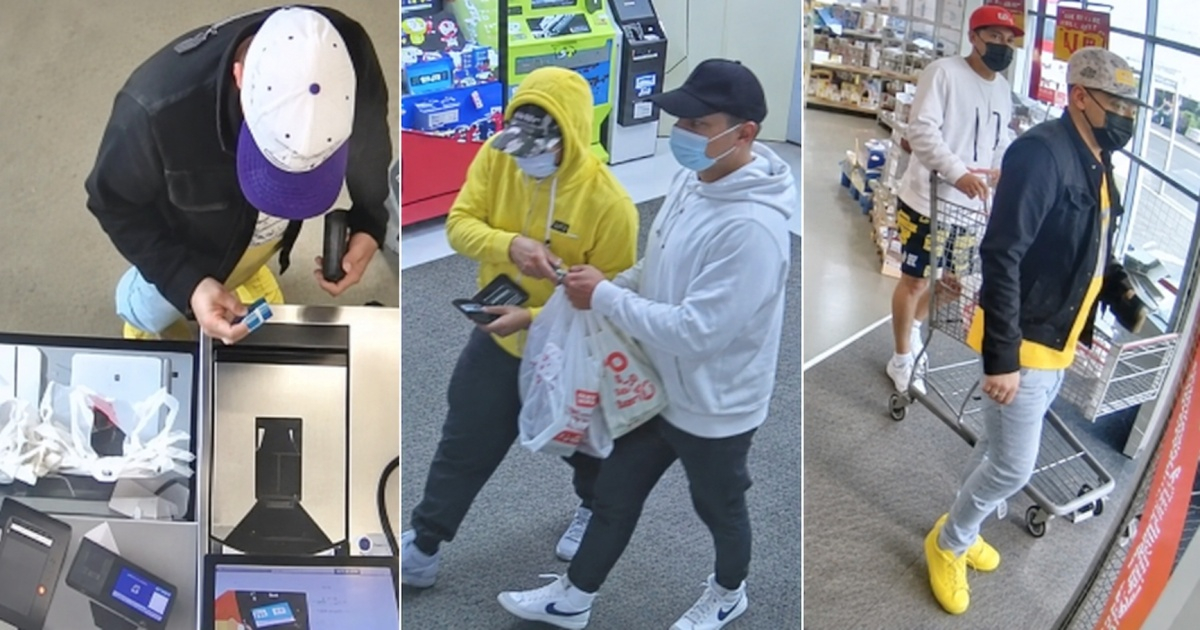
Two Cuban citizens residing in Laredo, Texas, were sentenced to federal prison for participating in a fraud scheme that compromised over 1,500 credit and debit card numbers, including the government card of a U.S. Customs and Border Protection (CBP) agent.
Orlandi Castillo Leon, 35 years old, received a sentence of 37 months in prison, while Liover Leon-Hernandez, 33, was sentenced to 46 months, as reported on November 19 by the Federal Prosecutor's Office for the Southern District of Texas.
Both pleaded guilty to possessing 15 or more counterfeit or unauthorized access devices with intent to defraud and to deliberately using another person's identity information without legal authorization.
Castillo Leon admitted his guilt on April 8, 2026, and Leon-Hernandez did so on May 6.
Federal judge Ivan L. R. Lemelle imposed the sentences.
According to the authorities, Leon-Hernandez is a legal permanent resident in the United States, while Castillo Leon is an asylum seeker.
Both are expected to face deportation proceedings once they complete their sentences.
How did they discover the fraud with the cards?
The investigation began on March 31, 2025, when a special agent of the CBP reported fraudulent charges made with his government travel card at a supermarket in Laredo.
What was striking was that the physical card remained in the possession of the agent, who was in Houston when the transactions took place.
The surveillance camera images allowed for the identification of Castillo Leon and Leon-Hernandez using seven credit or debit card accounts belonging to other people to purchase gift cards and personal items.
The investigators traced the data from several compromised cards to a location where the victims had made payments.
The common point turned out to be a Valero gas station in Laredo, where authorities discovered a card cloning device, known as an skimmer, installed at one of the fuel dispensers.
These devices allow for the capture of banking information during payment transactions.
The obtained data can later be used to carry out fraudulent transactions or create counterfeit cards.
He tried to swallow a USB drive with 1,530 stolen card numbers
One of the most astonishing episodes of the investigation occurred on July 16, 2025, when authorities executed search warrants at the residence shared by the two Cubans.
During the operation, Leon-Hernandez attempted to swallow a USB drive that contained 1,530 stolen credit and debit card numbers, according to the Department of Justice.
In the residence, the agents also seized a magnetic stripe card reader and recorder, gift cards, money orders, and a counterfeit American Express card that contained banking information of a client from Illinois.
The investigation was conducted by the FBI and the Office of Professional Responsibility of the CBP, with the collaboration of the Laredo Police Department and the Texas Financial Crimes Intelligence Center.
Assistant U.S. Attorneys Ann Booth Zeller and Henry Thomas Sekula were in charge of the judicial prosecution.
According to the statement from the Prosecutor's Office, both convicted individuals were in federal custody awaiting their transfer to penitentiary facilities that had not yet been determined at the time of the announcement.
Other cases of fraud involving cards that include Cubans
In April 2026, three Cubans were arrested in Hewitt, Texas for installing cloning devices on gas pumps.
The detainees were identified as Yordanys Castillo Bejerano, Jeilier Sarria Gutiérrez, and Lázaro Raúl Piñero Rodríguez, who were caught during a police operation on April 16.
According to the authorities cited at the time, the suspects used hidden devices inside the dispensers to obtain customers' bank data.
In a later search of a residence in Austin, investigators found equipment for cloning cards and numerous duplicate cards.
Official estimates released in that case indicated that the police intervention could have prevented potential losses of up to 19 million dollars.
Another case was reported in March 2026, when five members of a criminal network, including two Cubans, were sentenced in Florida for participating in fraudulent operations that generated over 3.5 million dollars in false charges.
Among the convicted were the Cubans Willan Pupo and Miriam Pupo, who received sentences of 11 years and three years and one month in prison, respectively.
In that scheme, the members of the organization used stolen cards, point-of-sale devices, and shell companies to process fraudulent transactions and transfer money to accounts under their control.
Related videos:
Filed under: