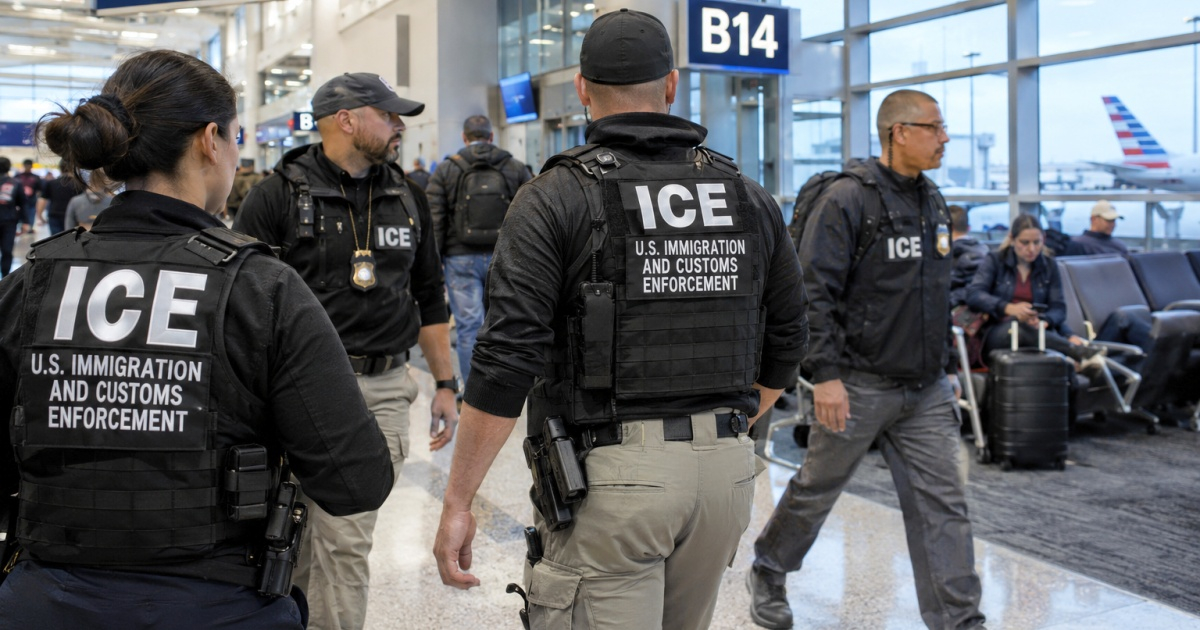
Immigration lawyers in the United States are warning of the risk of new detentions of immigrants at airports during the Thanksgiving holidays, even among those who have valid work permits, pending asylum applications, or ongoing regularization processes.
The warning comes on the eve of Thanksgiving, which is celebrated this Thursday, November 26th, and follows several arrests by Immigration and Customs Enforcement (ICE) that have raised concerns among the immigrant communities in the country.
According to a report published on Monday, November 23, by NBC News, an increasing number of attorneys are advising their clients to avoid air travel whenever possible, due to what they consider a "huge risk" for certain immigrants.
The American Automobile Association (AAA) estimates that 81.5 million people will travel within the United States at least 50 miles from their homes between November 24 and November 30, of which 5.96 million will take domestic flights.
Orlando, Fort Lauderdale, and Miami top the list of the most popular domestic destinations among travelers who booked through AAA.
Seattle authorities warn of potential new arrests
In a letter sent this Tuesday to members of Congress, six officials from the Port of Seattle warned that, without legislative intervention, it is likely that detentions at the country's airports will occur again.
The statement comes after masked agents from ICE arrested a father and his daughter from Mexico last Saturday at the boarding gate of a flight to Los Angeles.
The lawyer for both, Olia Catala, stated to the broadcaster KUOW that her clients had entered the United States legally in 2015, had valid work permits, and were traveling to California to attend a family baptism.
Both had pending asylum applications, and the young woman had also applied for permanent residency through marriage to a U.S. citizen. The Department of Homeland Security (DHS) claims that they had exceeded the authorized duration of their visa stay.
According to the DHS, the young woman was not the initial target of the arrest but was detained after allegedly throwing hot coffee at the officers. Her lawyer and a witness challenged this account, claiming that the coffee was spilled during the struggle.
Another recent case is that of Eva Yi Xie, a Chinese PhD student in neuroscience at Princeton University, detained on November 19 at Ronald Reagan National Airport in Washington, located in Virginia, while returning from an academic conference.
DHS maintains that Xie exceeded the authorized period of her visa and lacked permission to study in the United States. Her attorney, Kerry Doyle, asserts that the young woman has a pending asylum application that allows her to remain, work, and study in the country while her case is being resolved.
Although federal authorities have not announced a special operation for Thanksgiving, Seattle airport officials recommended that non-citizen travelers consult with their lawyers before flying.
Why there is also risk in domestic flights
The Transportation Security Administration (TSA) shares passenger information with ICE, under an agreement formalized in May 2025 and disclosed in July 2026 by the organization American Oversight.
According to CBS News, this collaboration has expanded to include individuals suspected of civil immigration violations.
The American Immigration Lawyers Association (AILA) has also raised concerns about the increase in detentions of passengers on domestic flights.
The immigration lawyer Ana Valenzuela warns that having a pending immigration application or a work permit does not necessarily protect an individual from detention or deportation proceedings.
Which immigrants are at greater risk
The legal organization Asian Law Caucus and the National Immigration Law Center (NILC) identify several groups of immigrants who should take extra precautions before traveling:
- Individuals without valid immigration status.
- Immigrants with deportation orders, including old ones.
- Asylum seekers or permanent residents with pending cases and without any other valid legal immigration status.
- Beneficiaries of parole, TPS, or DACA, especially if their protections have expired or been revoked.
- People with criminal records or certain prior arrests, including permanent residents.
Asian Law Caucus explicitly recommends that individuals without valid immigration status avoid air travel, including domestic flights, due to the risk of detention by immigration authorities.
In the case of Cubans, the National Immigration Law Center (NILC) had already warned in December 2025 about the risks for those who entered through the CHNV humanitarian parole or via CBP One and whose permit has expired or been canceled.
Cubans with I-220A should also consult their individual situation with a lawyer. This parole document does not, by itself, confer legal immigration status, and an application for residency under the Cuban Adjustment Act does not guarantee protection from detention.
What do lawyers recommend before traveling?
The lawyer Jazmin Preciado, from the Centro Legal de la Raza, recommended in statements to KQED to assess whether the need for travel justifies the risks involved.
Asian Law Caucus and NILC offer the following recommendations for those needing to travel by airplane:
- Consult with an immigration lawyer before traveling, especially if there are questions about immigration status.
- Bring the documents that verify your immigration status and any pending procedures.
- Permanent residents must carry their residency card, and U.S. citizens can present their passport as proof of citizenship.
- Share the itinerary and the lawyer's information with a family member or a trusted person.
- Keep a written record and memorize the emergency phone numbers and the contact information of the legal representative.
- In case of detention, request legal assistance and do not sign documents whose content is not understood.
The American Civil Liberties Union (ACLU) also provides a guide on the rights of travelers when interacting with authorities at airports and other points of entry into the United States.
Specialists remind that a work permit or an ID accepted by the TSA does not equate to a guarantee of protection from ICE.
How to check if you have a deportation order
The NILC warns that some individuals may have old deportation orders without knowing it, even stemming from immigration proceedings initiated when they were minors.
Those who have a foreign registration number (number A) can check the information of their case file through the official case information system of the Executive Office for Immigration Review (EOIR) or by calling 1-800-898-7180.
If the system does not show information about a deportation order, this does not guarantee that one does not exist. In case of any doubt, it is advisable to consult the file with an immigration attorney before traveling.
Related videos:
Filed under: