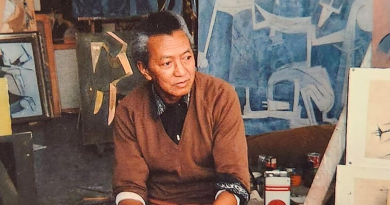
Wifredo Óscar de la Concepción Lam, better known as Wifredo Lam, was a Cuban artist born on December 8, 1902, in Sagua la Grande, Villa Clara, Cuba. Lam sought to portray and revive the enduring spirit of Afro-Cuban culture.
Inspired by some of the most renowned artists of the twentieth century, with whom he also had contact, Lam blended his influences and created a unique style characterized by the prominence of hybrid figures.
Although he was predominantly a painter, he also worked with sculpture, ceramics, and engraving. Lam's diverse multicultural heritage, as well as his connection to Santería, is extensively reflected in the artist's work.
He was born and raised in Sagua La Grande, a town in the sugar-producing province of Villa Clara, Cuba. He was of mixed heritage: his father, Yam Lam, was a Chinese immigrant, and his mother, Ana Serafina Castilla, was born to a Congolese slave and a Cuban mulatto father. In Sagua La Grande, Lam was surrounded by many people of African descent; his family, like many others, practiced Catholicism alongside their African traditions. Through his godmother, Matonica Wilson, a priestess of Santería, he was exposed to the rites of African orishas. His contact with African celebrations and spiritual practices turned out to be his greatest artistic influence.
In 1916, Lam moved to Havana to study law, a path his family had encouraged him to take. At the same time, he also began studying the tropical plants at the Botanical Garden. From 1918 to 1923, he studied painting at the School of Fine Arts. However, he did not feel drawn to the academic teaching of law and left for Madrid in the fall of 1923 to continue his studies in art.
In 1938, he moved to Paris. Picasso quickly became a strong advocate for his work, introducing him to many of the leading artists of the time, such as Fernand Léger, Henri Matisse, Georges Braque, and Joan Miró. Picasso also introduced him to Pierre Loeb, a Parisian art dealer; Loeb gave Lam his first exhibition at the Galerie Pierre Loeb in 1939, which received an enthusiastic response from critics.
Picasso and Lam showcased their work together at the Perls galleries in New York in the same year. The Cuban artist's work evolved from displaying the influence of Matisse, evident in his still lifes, landscapes, and simplified portraits, to reflecting the influence of Cubism.
During World War II, Lam spent most of his time in the Caribbean, alongside Claude Lévi-Strauss, André Masson, and André Breton, whose poem Fata Morgana Lam illustrated in 1940.
In 1941, he returned to Havana where he was strongly influenced by the theories of Carl Jung. By the end of 1942, he began his significant work "La Jungla" (1943).
Like many of the most recognized artists of the 20th century, he combines radical modern styles with "primitive" arts. While Diego Rivera and Joaquín Torres García drew inspiration from pre-Columbian art, Lam was influenced by Afro elements of the time.
It radically synthesizes surrealist and cubist strategies while incorporating the iconography and spirit of Afro-Cuban religion. For this reason, his work does not belong exclusively to a single artistic movement.
He embodied the belief that society was too focused on the individual and sought to portray humanity as a whole in his work. He painted generic figures, creating the universal. To further his goal, he often painted faces as masks. While Cuban culture and mythology permeated his work, which dealt with the nature of man, it was entirely easy for non-Cubans to relate to it.
In 2015, there was an exhibition of Lam and a retrospective of his works at the Centre Georges Pompidou in Paris; this exhibition later traveled to the Museo Reina Sofía in Spain and the Tate Museum in London.
Lam died in Paris on September 11, 1982. He is buried in his hometown.
In 1917, his work "A Tres Centímetros de la Tierra" was sold for $5.2 million at an auction in Paris. The painting "Mujer con Pájaro," drawn by Wifredo Lam in 1949, was auctioned in November 2019 for exactly $1.59 million by Sotheby’s, which had estimated the piece's value between $800,000 and $1.2 million, but the bidding exceeded expectations. In June 2020, the same auction house sold the painting titled "Omi Obini," dated 1943, for a record $9.6 million.