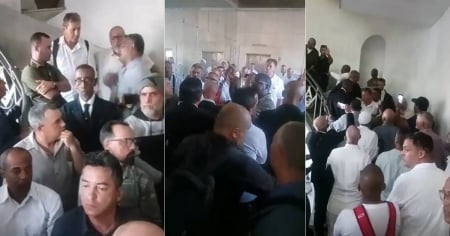
In a new escalation of the repression against the Cuban masonry, State Security interrogated José Ramón Viñas Alonso on Friday, a Freemason leader accused by the regime in what many are labeling a political persecution.
The Sovereign Grand Commander of the Supreme Council of the 33rd Degree in Cuba was again summoned to testify before State Security at the police station of Acosta and Diez de Octubre, independent outlet Cubanet reported.
The independent medium released a video showing “dozens of Freemasons” who gathered outside the police station to support their leader.
The writer Ángel Santiesteban-Prats stated that the repression against Cuban Freemasonry has intensified in recent hours, according to reports
"Repression against Freemasons is increasing. At this moment, Sovereign José Ramón Viñas Alonso is being interrogated by the political police, who are building a case against him to remove him from his position, in retaliation for the letter dated July 11, 2021, opposing the 'combat order' against the people," Santiesteban-Prats reported on Facebook this Friday.
"I am besieged by patrols and repressors to prevent me from responding to the call for support for the Freemasons at the police station. We have received information that they have set up a command post for the SE very close to the location." He concluded with a call for support: "We ask for international solidarity against the blatant murder being committed against Freemasonry in Cuba," he added.
A source within the organization, who spoke to Cubanet on the condition of anonymity, stated that the summons for Viñas Alonso was “to give a statement directly with his lawyer,” after he had previously “refused to continue testifying until he had his lawyer, which is his right.”
Open case
Last Tuesday, Viñas Alonso revealed on his Facebook profile that he was summoned by State Security and charged with the crime of currency trafficking, after being questioned about the trips abroad made by members of the organization and the source of the funds.
Viñas explained that the true reason seems to be linked to a unanimous agreement from the Masonic Board, which made two exchanges of 100 dollars this year among brothers to cover urgent expenses in national currency related to the asylum they manage.
The problem, according to the authorities, is that the exchange was made at an unofficial rate of 370 pesos, instead of the state exchange rate of 120, which would constitute an economic crime.
"We are told that currency trafficking is because it hasn't been exchanged at the bank... making it known that it is a punishable crime with a sentence of 2 to 5 years of imprisonment," denounced Viñas, who stated that precautionary measures have been implemented, such as movement restrictions (home-work) and migration regulations.
"We have no concerns because as citizens we don't even have a traffic ticket," wrote the Mason leader, asserting that there is a background to all of this that goes beyond money. "(...) We know what is intended with all of this; it will be what it will be, but I want to make it clear to my brothers about our innocence," he argued.
Interference of the regime
This new onslaught adds to the institutional conflict that has shaken Cuban masonry since May, when hundreds of brothers removed the then Grand Master Mayker Filema Duarte for attempting to prolong his tenure.
Despite the legality of the internal decision, the Ministry of Justice disregarded the process, supported Filema, and later imposed a new Masonic leader close to the regime.
Since then, Freemasons have been repressed, summoned by the police, expelled from their temples, and threatened with the freezing of accounts if they did not comply with the State's demands. Nevertheless, they have continued to resist, even meeting in the street, in front of the statue of Carlos Manuel de Céspedes, under heavy police surveillance.
"If the government wants to dominate us, we will not allow it," declared the elected Grand Master, Juan Alberto Kessell Linares.
Furthermore, this occurs just 24 hours after the Minister of Justice, Óscar Manuel Silvera Martínez, stated on national television that the government does not interfere in the internal matters of Freemasonry.
"It is an invasion of our private heritage that has never been used outside the benefit of asylum,” they reiterate in the text, claiming that all donations are justified through vouchers, accounting books, and the authorization of the Board.
Frequently Asked Questions about the Repression of Freemasonry in Cuba
Why was José Ramón Viñas Alonso interrogated by the Cuban State Security?
José Ramón Viñas Alonso was interrogated by the Cuban State Security in what is considered a political persecution against Freemasonry. He was summoned to testify about an alleged crime of currency trafficking, an accusation that seems to be linked to an internal financial disagreement within the Masonic organization. However, the background of this case indicates a strategy by the regime to discredit critical leaders like Viñas Alonso.
What is the context of the accusations of currency trafficking against Masonic leaders in Cuba?
The accusations of currency trafficking against mason leaders in Cuba stem from an internal agreement to exchange dollars at an unofficial rate to address urgent expenses. The regime accuses the masons of exchanging at a rate of 370 pesos per dollar, instead of the state rate of 120, which the government classifies as an economic crime. Many view this situation as an attempt to suppress and control one of the few independent organizations in the country.
How has the Cuban Freemasonry responded to the regime's interference in its internal affairs?
The Cuban masonry has responded with unity and resilience to the regime's interference in its internal affairs. Despite threats of account freezes and the imposition of regime-aligned leaders, the masons have reaffirmed their institutional sovereignty and have continued to meet even in public spaces. They have rejected the government's attempts to control their structures and have demanded respect for their internal processes.
What role has the Ministry of Justice played in the conflict with Cuban Freemasonry?
The Cuban Ministry of Justice has supported decisions that favor the regime and challenge the autonomy of Freemasonry. It has disregarded legitimate internal processes, backing leaders imposed by the State, and has threatened to withdraw official recognition of Freemasonry if these impositions are not accepted. This intervention has been criticized by Freemasons, who defend their right to sovereignty and to conduct their internal procedures without external interference.
Filed under: