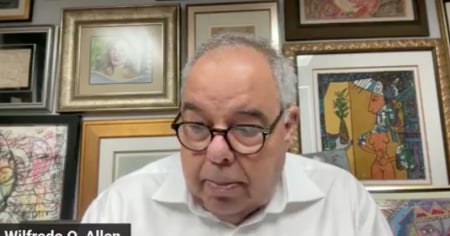
The Florida attorney Willy Allen is not concerned about the announcement regarding the tightening of evidence review for asylum applicants in the United States because Cubans, being the foreigners who receive the most asylum in the U.S., do not exceed a 25% approval rate.
"Getting asylum is always difficult. If asylum law were applied as it should be, 80% of Cubans would not be granted it," he said in remarks to CiberCuba, referring to the fact that most of those applicants "actually were never opposition members nor confronted the government."
In the program that airs every Monday at 11:00 AM (Miami time) with Willy Allen on CiberCuba, the immigration expert explained that this strict review of political asylum evidence will help Miami cease being the golden retirement haven for Cuban repressors over the age of 65 who wish to retire in the United States after having been part of the machinery of the Castro dictatorship.
That does not mean, clarified the lawyer, that this rigor applies only in suspected cases, because the law is the same for everyone and, as expected, it will affect all asylum seekers in general.
In this regard, Willy Allen recommends that the truth be told. Not all asylum cases are "winnable," but efforts should be made to ensure they are "defensible," and one should arrive before the judge with Plan A, Plan B, and Plan C, for whatever may happen.
Therefore, to those who have been part of the regime's repressive machinery, Willy Allen advises that upon arriving in the United States, they should acknowledge that they made poor choices in Cuba. In other words, they should enter with the truth and not try to hide behind anonymity.
He explained that he has won asylum cases for influential people in the regime who fled to the United States and came forward with the truth. On the other hand, in his opinion, there are those who lie. In both cases, he acknowledged, we are dealing with collaborators of the dictatorship, but some admit what they have done and ask for forgiveness, while others hide it.
And it is precisely this that he advises against. To defend an asylum case, one must come forward with the truth, he insisted. That’s why he says he is not worried about a thorough review of the social media of those seeking asylum or a deep examination of asylum evidence, because the idea is that those who politically persecuted in Cuba do not arrive in the United States and live alongside their victims, who at times find it very difficult to prove their victim status, while the oppressors manage to regularize their situation, sometimes with ease.
At the beginning of this August, the U.S. Citizenship and Immigration Services (USCIS) announced a significant update to its evaluation policies for asylum and refugee applicants. As of August 1, new guidelines have been implemented that strengthen security investigations and background checks for foreigners submitting Form I-485, Application to Register Permanent Residence or Adjust Status. This measure aims to combat fraud, threats to national security, and other public safety risks.
Filed under: