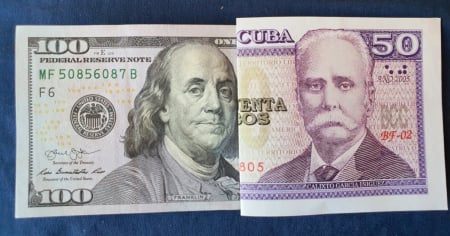
The informal currency market in Cuba closed on Friday, October 3, without any changes compared to previous days, consolidating a historic record that reflects the country's deep economic crisis.
According to the Representative Rate of the Informal Market (TRMI) published by elTOQUE, the US dollar remains at 440 CUP, the euro at 500 CUP, and the freely convertible currency (MLC) at 210 CUP.
This scenario marks the third consecutive day without changes in the main foreign currencies, following Wednesday's breach of the symbolic barrier of 500 pesos by the euro, a level never before recorded since the monitoring of the parallel market began.
On the same day, the dollar also reached 440 CUP, solidifying a rising trend that had been building up over the previous weeks.
Exchange Rate Evolution
Since then, the currencies have stabilized at record levels that reflect the extent of the collapse of the Cuban peso.
A deceptive stability
The apparent calm of the past few days does not signify tranquility; rather, it indicates the solidification of a critical level of devaluation that directly impacts the population.
With one euro at 500 CUP and one dollar at 440, the purchasing power of the salary in national currency is reduced to a minimum, exacerbating the difficulties of accessing food, medicine, and basic necessities, the trade of which is increasingly dollarized.
The MLC, used in state stores that sell essential goods, remains at 210 CUP, which reflects lower volatility compared to the euro and the dollar.
However, its value still triples the official exchange rate set by the government at 120 CUP, a gap that fuels distrust in state institutions and solidifies the informal market as the real benchmark for transactions.
Wednesday's record: a turning point
On October 1st, it became a historic day: the euro climbed from 498 to 500 CUP and the dollar rose from 438 to 440 CUP, reaching unprecedented figures.
Since January 2021, when elTOQUE began publishing the TRMI, such high values had never been recorded.
The Observatory of Coins and Finances of Cuba (OMFi) has explained that these figures reflect structural imbalances: the contraction of GDP, the energy crisis, the decline in tourism, the paralysis of productive investments, the dollarization of trade, and the control of reserves by military conglomerates.
All of this is compounded by massive emigration, which further weakens the economy and the fiscal structure of the island.
Impact on the daily lives of Cubans
For ordinary Cubans, the stability of foreign currencies at historic highs translates into increasingly severe precariousness. The average monthly salary in Cuban pesos barely suffices to purchase a few dollars in the informal market, which restricts access to basic imported goods.
The gap between official figures and the reality in people's pockets has never been wider.
While the State maintains artificial rates at CADECA and state banks, the majority of the population relies on a parallel market that sets values four times higher than the official rates.
A government response still pending
The government announced at the end of 2024 its intention to establish a floating exchange rate system that would bring the official rate closer to that of the market. However, nearly a year later, it has not presented a concrete plan nor shown signs of implementing the measure.
Independent economists warn that any attempt at currency unification must start with figures close to the TRMI, which would imply officially acknowledging the collapse of the Cuban peso.
For now, the historic record set on Wednesday remains in effect. And while the dollar and euro stay strong at their peaks, millions of Cubans are facing a reality marked by uncontrolled inflation, rising daily living costs, and a lack of immediate relief prospects.
Frequent questions about the informal currency market in Cuba
What is the current value of the dollar and the euro in the Cuban informal market?
The US dollar is currently trading at 440 Cuban pesos (CUP) and the euro at 500 CUP in the Cuban informal market. These values reflect a historical record in the devaluation of the national currency, exacerbating the economic crisis on the island.
Why is the informal market relevant for Cubans?
The informal market has become a crucial reference for Cubans because official rates do not reflect the true value of foreign currencies. Due to the significant difference between official values and those of the parallel market, the population relies on the informal market to carry out actual transactions and access basic goods.
How does this record affect daily life in Cuba?
The devaluation of the Cuban peso against the dollar and the euro drastically reduces the purchasing power of salaries in national currency. This makes access to food, medicine, and other essential goods, which are often priced in dollars, more difficult, intensifying the precariousness experienced by the population.
What measures has the Cuban government announced to address the currency crisis?
The Cuban government has announced, since late 2024, its intention to implement a floating exchange system to reduce the gap between the official and informal value of currencies. However, no concrete plan has been presented nor have effective measures been taken so far, which exacerbates distrust and the economic crisis.
Filed under: