
Related videos:
A recent statement from the Palace announced, with an enthusiastic and positive tone, an “offensive for a better capital,” led by the ruler Miguel Díaz-Canel to improve basic services in Havana.
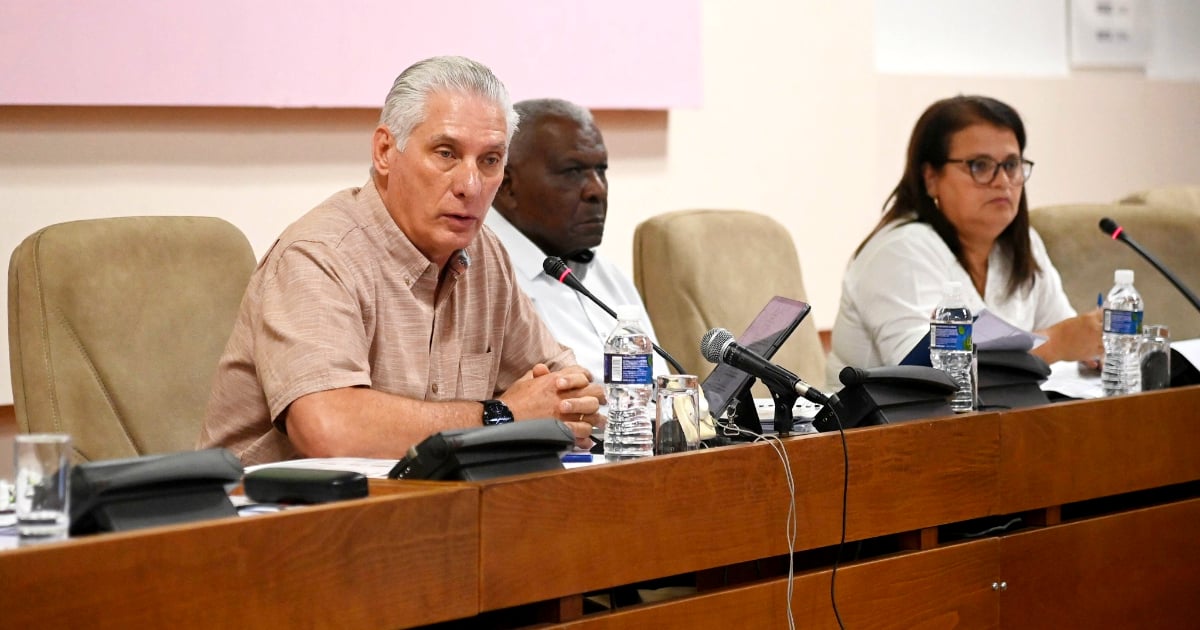
According to the text, he, also the First Secretary of the Communist Party, leads meetings every Saturday with the main leaders of the Communist Party, where progress in electricity, water supply, waste collection, and urban maintenance is analyzed.
The note prepared by the palatial head of press, Leticia Martínez Hernández, presented the initiative as a coordinated action of the State, the Party, local agencies, and "the people of Havana" to restore the city's image and improve the quality of life for its residents.
However, the analysis of the content and tone of the statement allows us to identify it not so much as a management report, but rather as a propaganda exercise, consistent with the communication strategy that the Cuban regime has maintained for decades: to exalt the figure of the leader, shift responsibilities to lower levels, and project an image of effectiveness, even amidst structural failure.
The figures presented in the text appear to be designed to support that narrative rather than to provide transparent information. It is claimed that 32,484 people have recently benefited from water supply and that 267,787 cubic meters of solid waste have been collected in the capital.
However, the information lacks context: it does not specify the period during which this supposed progress was made, what the previous situation was, or how the sustainability of the actions is measured.
The statement itself acknowledges that in several municipalities, water distribution cycles exceed ten days— a figure that in any city would indicate a crisis and require immediate intervention, with solutions demanded by the citizens almost in a state of unrest.
In the energy sector, the official text mentioned a "better planning of power outages," but it avoids providing data on the frequency, duration, or impact of the interruptions on the daily lives of Havana residents.
In recent weeks, various reports from the Electric Union and independent media have confirmed that daily power outages continue, even in central areas, due to generation deficits and transformer failures.
The claim that planning has improved may be technically true—perhaps outages are announced more orderly—but it does not imply that the problem has been resolved. On the contrary, it reveals the Cuban government's perception of its management: Díaz-Canel presents a "better planning of blackouts" as an effective measure, as if a well-planned blackout were a solution to the energy crisis.
In that sense, the language of the statement reinforces its political nature. It makes use of terms like "offensive," "checks," "rigor," and "priority," which reflect the military style that the Cuban state has historically employed to convey the notion of control and discipline in civil management.
Díaz-Canel's role as the central figure, accompanied by high-ranking members of the Party, follows the logic of triumphant reports: the leader directs, supervises, and demands results with authority and severity, while subordinates rectify the mistakes.
Martínez Hernández framed his message around the idea of collective effort and the continuous oversight of the top leader, but he omitted an essential element: concrete results.
At no point was the lack of resources, the obsolescence of infrastructure, or the inefficiency of the state-owned companies responsible for services addressed. The structural causes of the problems were also not acknowledged, which range from administrative centralization to corruption and the decline in public investment.
In this context, the statement served a clearly political function: to manage the perception of the crisis.
The "offensive" is not merely a material operation, but a discursive mechanism to regain narrative initiative at a time of deep citizen discontent. The staging of meetings, assessments, and guidelines aims to convince the population that the State is maintaining control, even as living conditions continue to deteriorate.
The text does not provide a real accountability or a verifiable description of the facts. What is offered is a carefully crafted narrative designed to uphold the legitimacy of the leadership and the notion that the solution once again depends on hard work, discipline, and loyalty to the Party.
The conclusion that Martínez Hernández inadvertently left is that the Cuban regime continues to use its old mechanisms of political propaganda to cover up structural deficiencies.
Instead of acknowledging the magnitude of the service crisis facing Havana, the official discourse prefers to insist on the rhetoric of effort and supervision. However, the narrative of constant action does not replace the results: the streets remain filled with trash, blackouts persist, and water does not arrive regularly.
The "offensive" may be intense in the media, but in the daily reality of the people in Havana, the capital continues to wait for improvements that do not arrive.
Filed under: