
Related videos:
The Communist Party of Cuba (PCC) signed a "roadmap" with the Belarusian political party Belaya Rus to strengthen interparty cooperation and expand economic and political ties between both regimes, in a new gesture of rapprochement between Havana and Minsk, strategic allies of the Kremlin.
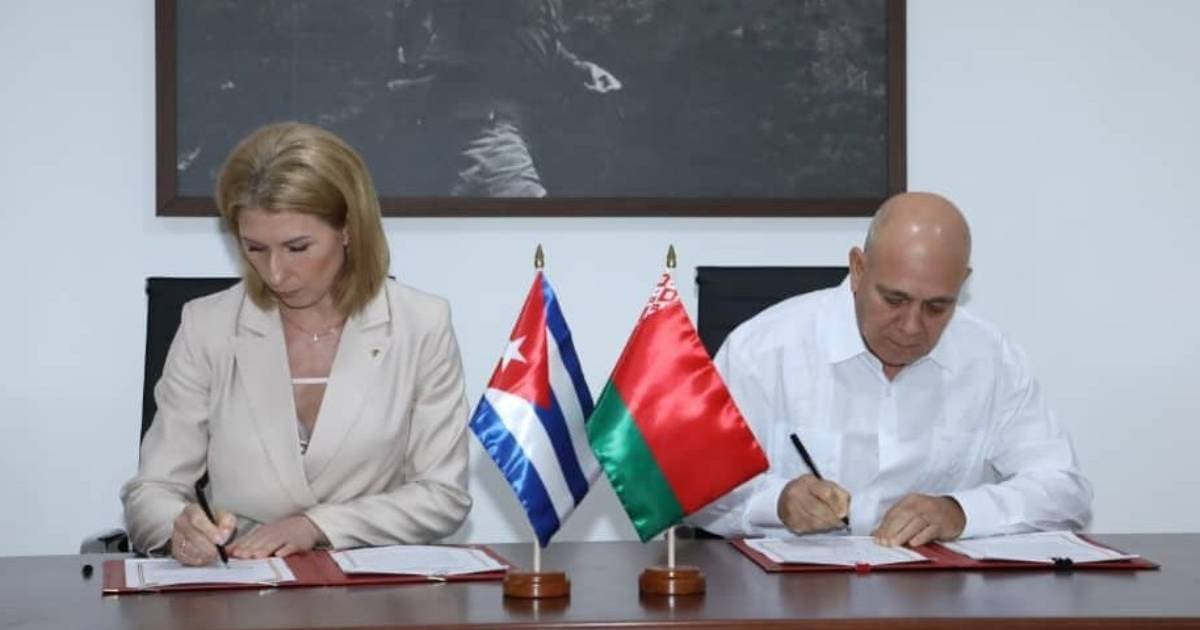
The agreement, signed at the headquarters of the Central Committee of the PCC in Havana by Roberto Morales Ojeda, Secretary of Organization of the Central Committee, and Olga Chemodanova, President of Belaya Rus, establishes an action plan in the areas of politics, economy, youth, and international relations, according to the Belarusian state agency BelTA.
According to the report, the roadmap aims to "practically implement" the exchange and cooperation agreement signed in Minsk during Miguel Díaz-Canel's visit to Belarus in June 2025, when the Cuban leader met with Alexander Lukashenko, one of the closest allies of Vladimir Putin's regime.
Political and economic commitment
The document commits both parties to coordinate international actions "to strengthen the sovereignty of Belarus and Cuba" and to carry out exchanges of political information, mutual visits, and joint activities between youth organizations such as the Cuban Union of Young Communists and the youth movement Iskra.
According to the PCC itself, the agreement also aims to "support the strengthening of economic, trade, financial, and cooperation relations between nations", in an effort to create opportunities for collaboration in strategic sectors, despite the structural crisis facing the Cuban economy.
On his X account, Morales Ojeda stated that the commitment aims to "continue deepening inter-party ties" and support the development of bilateral relations with Belarus.
An axis under the shadow of Moscow
The rapprochement between the Cuban regime and Belarus has intensified in recent years, alongside the strengthening of the political and military axis between Moscow, Minsk, and Havana.
During his visit to Belarus in June, Díaz-Canel sought new economic agreements with Lukashenko while in Cuba millions of citizens faced daily blackouts of up to 24 hours, shortages of food and medicine, and increasing social unrest.
In October, a delegation from the Revolutionary Armed Forces (FAR), led by General Roberto Legrá Sotolongo, Chief of the General Staff, traveled to Minsk to discuss the modernization of the Cuban army and military training programs.
These actions are carried out "under Russian supervision," as part of a geopolitical framework that connects Cuba with the defense and combat doctrines of the Kremlin.
Ideological diplomacy in the face of internal collapse
For the Havana regime, agreements like the one signed with Belaya Rus strengthen the narrative of "sovereign resistance" and legitimize its alliances with authoritarian governments in Eastern Europe. However, critics point out that these diplomatic maneuvers do not translate into tangible benefits for the population, which continues to suffer the effects of the economic collapse and political repression.
Díaz-Canel himself acknowledged during his last visit to Minsk that developing ties with Belarus is "a priority of Cuban foreign policy." A priority that, in practice, deepens Havana's dependence on regimes sanctioned by the West, while distancing the country from potential avenues of cooperation with democratic partners.
The signing of this roadmap, presented by official media as another step in the "friendship between sovereign peoples," confirms the ideological direction of the Cuban government: to rely on symbolic political alliances while the internal crisis drives thousands of citizens into exile and disillusionment.
Impact of the "Roadmap" between Cuba and Belarus
What is the main objective of the "roadmap" signed between Cuba and Belarus?
The primary objective of the "roadmap" is to strengthen interparty cooperation and expand economic and political ties between the Communist Party of Cuba and the Belarusian party Belaya Rus. This agreement aims to coordinate international actions to reinforce the sovereignty of both countries and promote exchanges in politics, economics, and youth.
How does this agreement affect the Cuban population?
Although the agreement is presented as a gesture of rapprochement between the governments of Cuba and Belarus, it does not translate into tangible benefits for the Cuban population, which continues to suffer from blackouts, food shortages, and social unrest. Critics point out that these agreements are more symbolic and do not alleviate the internal crisis.
What is Russia's role in the agreement between Cuba and Belarus?
Russia plays a crucial role in this agreement, as cooperation between Cuba and Belarus is developing under the supervision of the Kremlin. Both countries are part of a political and military axis that reinforces Russian influence in Latin America and Eastern Europe, consolidating strategic and military alliances.
Why does the Cuban government prioritize relations with Belarus?
The Cuban government prioritizes relations with Belarus to strengthen its narrative of "sovereign resistance" and legitimize its alliances with authoritarian governments. These alliances allow Cuba to seek support from regimes sanctioned by the West, even if they do not provide concrete solutions to the internal crisis the country is experiencing.
Filed under: