
Related videos:
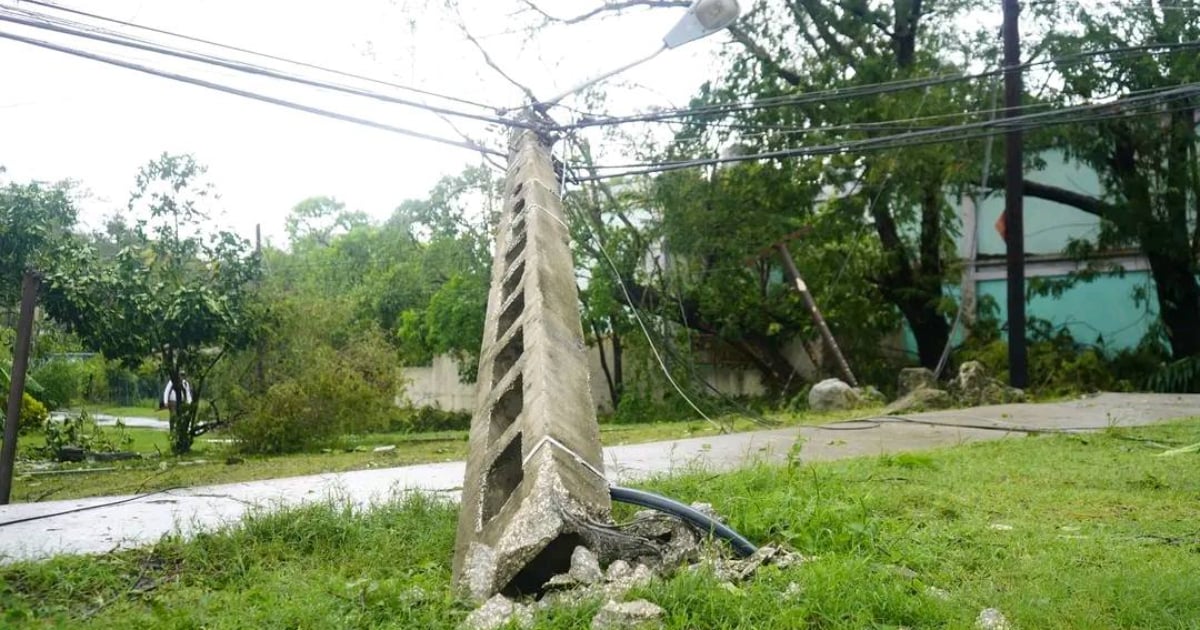
The Electric Union of Cuba (UNE) warned this Thursday that the country will face new and prolonged blackouts due to a lack of generation capacity, while the eastern part of the country remains disconnected from the national system following the passage of hurricane Melissa.
According to the , the current availability of the National Electroenergy System (SEN) is 1,050 megawatts (MW) compared to a demand of 1,910 MW, resulting in an impact of 850 MW. For the nighttime peak, UNE anticipates an availability of 1,348 MW and a maximum demand of 2,450 MW, leading to a deficit of 1,102 MW and estimated blackouts of 1,172 MW.
The official statement details that yesterday the electrical service was affected for 24 hours, with a maximum impact of 1,298 MW at 7:40 p.m., while 653 MW remain out of service in the eastern provinces from Las Tunas to Guantánamo, as a result of the hurricane's impact.
Among the main incidents, the company reports breakdowns in Unit 3 of the Santa Cruz CTE, Unit 3 of the Carlos Manuel de Céspedes CTE, and Unit 2 of the Felton CTE —the latter located in Holguín— as well as scheduled maintenance at the plants in Cienfuegos, Nuevitas, and Santa Cruz del Norte. Additionally, there are thermal limitations due to 501 MW out of service and fuel issues that have left 46 distributed generation plants and 177 MW idle due to a lack of lubricants, bringing the total to 627 MW offline for that reason.
In Havana, the Electric Company reported that the service was interrupted for 24 consecutive hours and that, at the close of their report, the supply had still not been fully restored, with 124 MW offline in blocks 3, 4, and 6. They also published a new schedule of blackouts that spans from 10:00 a.m. on Thursday, October 30, to 10:00 a.m. on Friday, October 31.
Meanwhile, in Santiago de Cuba, the provincial electric company announced that it has been unable to begin repair work due to the area remaining in a cyclone alarm phase. Technicians are awaiting authorization from Civil Defense to start the work, although they warned that the thermoelectric plants in the eastern region (Camagüey–Guantánamo) remain out of service, which means recovery will be gradual and priority will be given to hospitals, water pumping, and evacuation centers.
In the neighboring province of Granma, the electric company also asked the population for “patience” regarding the extension of the general blackout following Hurricane Melissa. The entity explained that the restoration of service will be a gradual process, prioritizing hospitals, water pumping, and evacuation centers before restoring residential circuits.
The Minister of Energy and Mines, Vicente de la O Levy, traveled to Santiago de Cuba and assured that “we will move forward” after the passage of Hurricane Melissa, while specialized crews were attempting to assess the damages to the transmission lines and power plants in the east.
Before the arrival of Hurricane Melissa, the Electric Union decided to disconnect the thermoelectric plants Antonio Maceo (Renté), Lidio Ramón Pérez (Felton), and the Fuel Central of Moa as a precautionary measure, leaving a large part of the eastern region of the country without electricity. Since then, these plants have not been reactivated, and the area remains practically in the dark following the hurricane's passage.
With a demand that far exceeds generation capacity and a partially collapsed electrical system, Cuba faces one of the most critical energy scenarios of the year, with thousands of households without electricity and essential services compromised.
Filed under: