
Related videos:
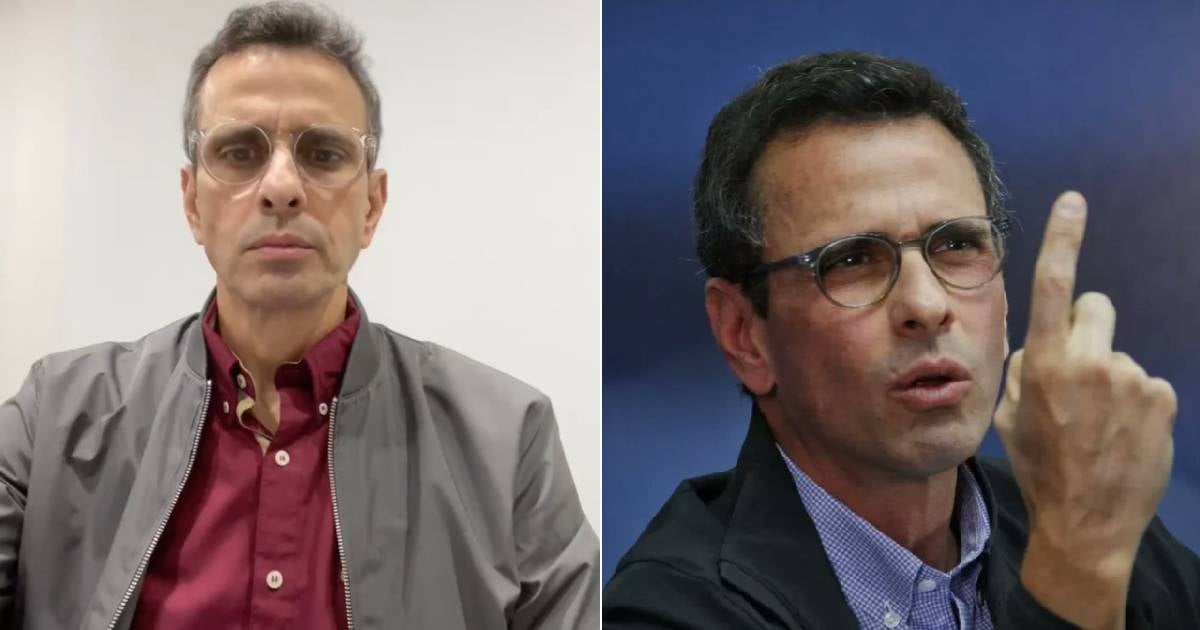
The Venezuelan politician and opposition figure Henrique Capriles, who was deprived of two presidential elections by chavismo - first in 2012 against the late Hugo Chávez and then in 2013 against Nicolás Maduro - and who was later politically disqualified by the regime, stated this Wednesday that there should be a process of direct negotiation between the dictator and U.S. President Donald Trump.
In a live broadcast shared on his X account, Capriles stated that the way out of his nation's crisis lies in a dialogue between those who truly hold power: “There must be a negotiation process… This has to involve the Trump Administration and Mr. Maduro, who is the one in control of the territory, institutional control, and military support.”
His statements come amid a rise in diplomatic tensions following the U.S. military deployment in the Caribbean, an operation that Washington describes as part of a drug strategy and that Caracas denounces as “a threat.”
Trump opens the door to talks, and Maduro expresses willingness
Last Sunday, Trump stated that “there could be discussions” with Maduro because “Venezuela wants to talk,” while on Friday he mentioned that he had already made a decision —yet to be revealed— regarding the measures to be implemented against the oil-rich country, according to the agency EFE.
Maduro, for his part, assured on Monday that he is willing to have a "face-to-face" meeting with his American counterpart.
In this scenario, Capriles believes that a direct negotiation should include essential points, such as the economic and humanitarian crisis in Venezuela, one of the most severe in the continent, as well as the release of all political prisoners, despite Maduro's insistence on denying their existence and claiming that "they are all criminals."
"Tomorrow you change the head of the Executive, and what lies below is absolute chaos," emphasized Capriles while insisting that the crisis is not limited to a change of president.
Military tension between Caracas and Washington
Since August, the White House has been maintaining a strong air and naval mobilization in the Caribbean, which includes the largest U.S. aircraft carrier. Washington claims that it is an operation against drug trafficking, while Maduro's regime interprets it as an attempt at "regime change."
Maduro warned on Monday that a military attack against Venezuela would mark the "political end" of Trump, who responded that "all options are on the table."
The tensions are compounded by the announcement from the U.S. State Department designating the Cartel de los Soles as a foreign terrorist organization, a group identified in Washington as part of the criminal structure linked to Maduro and high-ranking Venezuelan military officials, a claim that Caracas dismisses as an "invention."
A call for dialogue from a position steeped in history
The words of Capriles do not go unnoticed. The politician was:
Presidential candidate in 2012, when Chávez defeated him with results that the opposition questioned.
Candidate again in 2013, when Maduro won amid widespread allegations of electoral fraud.
Disqualified in 2017 by the regime, preventing him from competing politically.
His current call —for the United States and Maduro to negotiate directly— is viewed by some as a pragmatic bet in an extreme context, and by others as a concession to a regime that persecuted him, marginalized him, and stripped him of the opportunity to compete on equal terms.
Filed under: