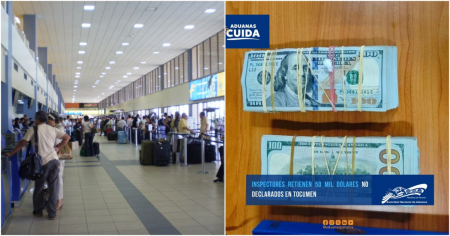
A new case of undeclared money by a Cuban traveler has raised alarms again in Panama.
This time, inspectors from the National Customs Authority seized 10,100 dollars hidden inside a pair of jeans from a passenger arriving from Havana at Tocumen International Airport, as reported by the institution itself on Facebook.
The traveler, whose name has not been disclosed, omitted in the sworn statement that he was carrying cash above the legal limit allowed (10,000 balboas, which is equivalent to 10,000 dollars).
During routine checks, inspectors detected inconsistencies in the information and proceeded to a secondary inspection of the luggage, where the concealed money was found. As per protocol, the case was reported to the Public Prosecutor's Office for the necessary procedures.
The Panamanian outlet Mi Diario also reported the incident, noting that the money was "meticulously hidden" inside a pair of pants, a practice that authorities have identified as common among travelers attempting to evade customs controls.
The newspaper noted that failing to declare cash constitutes an offense that can lead to withholdings, financial penalties, and even legal proceedings.
Fourth case in just over a week
This episode is the fourth case in just eight days involving Cuban travelers detained in Panama with large amounts of undeclared money, which confirms a worrying growing pattern for the authorities.
On November 17, a 48-year-old Cuban was caught in Tocumen with 135,300 dollars hidden in hidden compartments of backpacks, despite having declared only five thousand.
One day later, on November 18, another passenger arriving from Havana was detained with 16,067 dollars, some of which were hidden in her intimate areas, according to a report from Customs Panama.
And on November 21, two Cuban women traveling on the same flight were detained in Tocumen with a total of 50 thousand dollars during a body search, although both claimed not to know each other.
This chain of incidents, all linked to Cuban travelers, has prompted Panama to strengthen surveillance at airports, warning about the risks associated with the irregular transfer of cash in a regional context where controls against money laundering and other financial crimes are tightening.
A practice that reflects desperation and risk
Although Panamanian authorities emphasize the importance of declaring any amount exceeding the legal limit, these cases also reveal the harsh reality faced by thousands of Cubans who travel carrying family savings, capital for ventures, or resources intended for increasingly expensive and dangerous migration routes.
Hiding money in backpacks, jeans, notebooks, or even on one's body not only violates regulations but also puts travelers in a vulnerable situation, as they could lose all their funds, face legal processes, and even see their future migration movements restricted.
Meanwhile, Panama insists on a message that is repeated in every report: the law applies to everyone, regardless of the origin or purpose of the money.
Filed under: