
Related videos:
In a regulatory offensive presented as economic relief for consumers, President Donald Trump announced the elimination of the fuel efficiency standards established by the Biden administration, a decision that the White House described as "a victory for American families and automobile manufacturers."
The government assured that the change will reduce the prices of new vehicles while reversing what it describes as a "covert mandate" for electric vehicles (EVs) imposed by previous regulations.
The announcement came accompanied by an intense official communication campaign.
In X, the White House stated that Trump is "making significant progress for families" and assumed that reversing Biden's regulations amounts to "crushing the hidden increases in the cost of living" that the previous regulation would have caused.
The official statement published on the website of the White House detailed that the measure restores Biden's Corporate Average Fuel Economy (CAFE) standards to levels that "can realistically be met" using conventional gasoline and diesel technologies.
According to the Trump administration, the requirements approved under the Biden administration were not only "extraordinarily strict," but also "illegal," as they exceeded the powers granted by Congress and effectively acted as a forced push towards electric vehicles.
The statement emphasized that the previous standards were impossible to achieve with the advancements available for combustion vehicles, and that this regulatory gap pushed manufacturers to sell electric cars at a loss, consequently compensating for those costs by raising the price of gasoline cars.
The White House estimated the impact of that pressure to be an increase of nearly $1,000 in the average price of a new vehicle if Biden's regulations had remained in effect.
For Trump, the modification of the standards will save consumers $109 billion over the next five years.
The government also anticipated consequences in terms of road safety: it estimates that by facilitating the purchase of more modern vehicles, the change will prevent approximately 1,500 deaths and nearly a quarter of a million serious injuries by 2050.
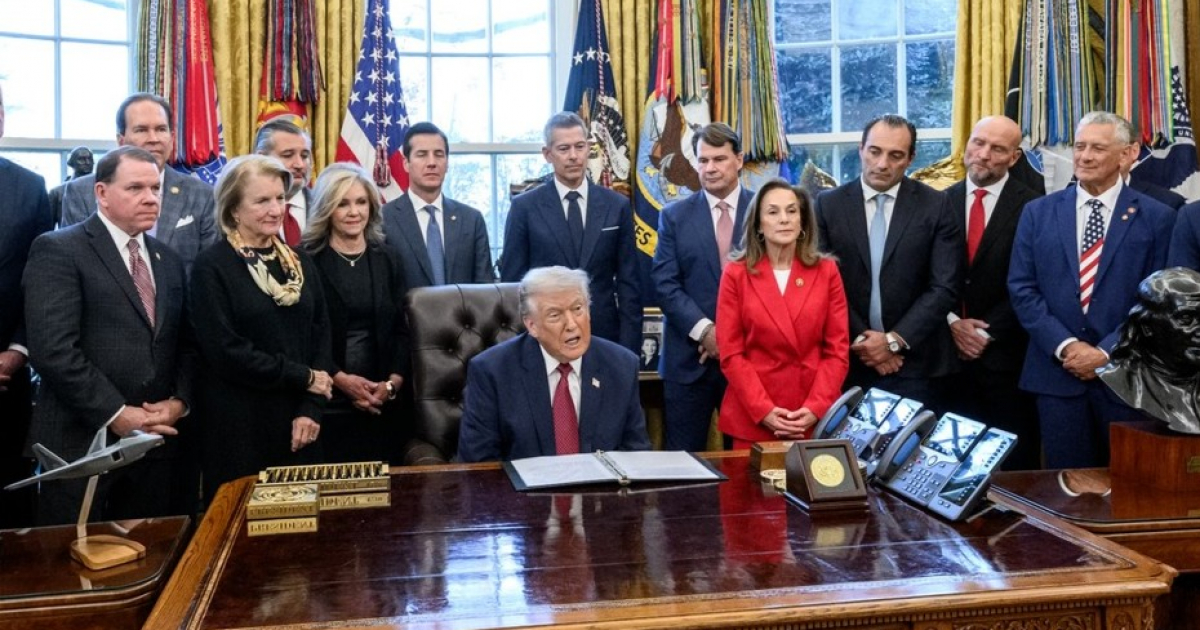
Trump announced the decision in the Oval Office, surrounded by top executives from the automotive sector.
According to CNN, among them were the CEOs of Ford and Stellantis, as well as a representative from General Motors.
In his remarks, the president stated that previous regulations "forced manufacturers to build vehicles with expensive technologies that increased prices and worsened the product," and he asserted that the action will save the typical consumer "at least $1,000," a figure he considered a conservative estimate.
The Transportation Secretary, Sean Duffy, supported that stance during the same event.
He stated that the policies of the previous administration did not lower vehicle prices but rather made them more expensive, and he argued that the easing of standards will allow more Americans to access new cars, which, according to him, will result in greater road safety and more jobs in the industry.
The automotive executives present expressed their explicit support.
Ford's CEO, Jim Farley, praised "President Trump's leadership" and argued that aligning regulations with "market realities" enables progress in energy efficiency without sacrificing affordable options for consumers.
From Stellantis, Antonio Filosa emphasized that the changes better align with actual demand and allow for offering vehicles at prices that customers "can afford," while also inviting continued collaboration with the NHTSA on “environmentally responsible” policies.
The White House framed the decision as part of a series of measures aimed at countering what it describes as regulatory burdens imposed by the Biden administration concerning electric vehicles.
He recalled that in June, Trump signed a resolution aimed at preventing electric vehicle mandates in California—which would have resulted in a total ban on new gasoline cars by 2035—and that in July he enacted a law that sets fines for non-compliance with CAFE standards to zero.
He also mentioned a proposal from the EPA, presented under his presidency, to reverse the 2009 Declaration of Emergency, which according to the statement has been used to justify over one trillion dollars in costs to the economy.
The document concludes that the adjustments aim to safeguard the rules to prevent future democratic governments from imposing "unviable" standards, and it emphasizes that the policy is complemented by the deduction of interest for loans on cars manufactured in the United States, a measure that—according to the administration—further reduces the cost of accessing new vehicles.
This announcement comes in the same week when Trump promised to lower the cost of a gallon of fuel to two dollars, or even less.
"Now we are at about two dollars and fifty cents a gallon. I think we will be at $2 a gallon. We might even lower that at some point," he stated at a press conference.
Trump, who has made fuel prices a recurring theme in his speeches, emphasized that this goal could be achieved more easily "if we weren't building the national reserves strategy that Biden emptied before the elections, so they could try to get elected."
In his direct critique of his predecessor, he accused him of using the Strategic Petroleum Reserves (SPR) for electoral purposes rather than for genuine emergencies.
"They emptied these strategic national reserves that are really meant for something else. They are not meant to keep people happy with their gas prices. They are meant for war; they were intended for problems. Big problems," he said.
According to Trump, that policy of releasing reserves during the global energy crisis did not have the desired effect.
"It didn’t work very well for him. And they practically brought him down to the lowest level, I believe, in history. It didn’t have much impact because the prices were very high," he emphasized.
In contrast, he defended his current management by stating: "Our prices now for energy... gasoline is very low. Electricity is going down. And when that drops, everything else drops," he said, referring to the domino effect on production costs and consumer goods.
Filed under: