Nicolás Maduro once again starred in an unusual episode amid the rising tension between Venezuela and the United States.
During a political event in Caracas, the Venezuelan dictator interrupted his speech to sing and dance snippets of the song Don’t Worry, Be Happy, popularized by Bobby McFerrin in 1988, in a message directed—according to his own words—to American citizens who oppose military escalation.
With a wide-brimmed Caribbean straw hat and a microphone in hand, Maduro addressed the audience and stated: "To the American citizens who are against the war, I respond with a very famous song: Don’t worry, be happy".
He then sang a few verses adapted to the political moment: "No to war, be happy. No, no to crazy war, be happy," while accompanying the scene with dance moves in front of his supporters.
The gesture occurred in a context marked by increased international pressure on his government and by recent events that have heightened the confrontation with Washington, including the seizure of an oil tanker off the coast of Venezuela ordered by a U.S. judge.
According to U.S. authorities, the vessel was linked to Iranian oil smuggling and, on this occasion, was transporting Venezuelan crude.
The Chavista regime described the event as a "brazen theft" and an "act of piracy."
In his subsequent statements, Maduro linked his musical message to the demand for a "cessation of illegal and brutal interventionism" and reiterated his condemnation of the "regime change" policies allegedly promoted by the United States.
Far from limiting himself to the musical tone, the leader combined singing with a confrontational speech.
In that same event, he urged farmers and fishermen in the country to be prepared to "knock out" the United States if necessary.
"The same productive hands that we have are the hands that hold the rifles, the tanks, the missiles to defend this sacred land from any invading empire, from any aggressive empire," he stated during the march for the 166th anniversary of the Battle of Santa Inés.
Maduro insisted that the country must maintain an attitude of "warriors," working and producing, but also ready to respond militarily.
According to him, there is a "powerful public opinion movement" around the world that rejects a military aggression by the United States against Venezuela and the Caribbean, an argument he used to bolster his narrative of resistance against Washington.
The singing scene also coincided with a symbolically uncomfortable day for chavismo.
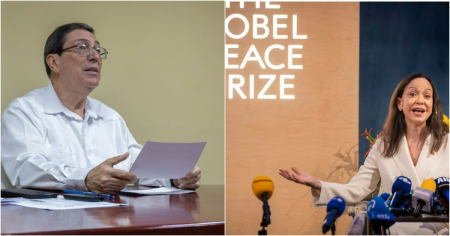
While Maduro was dancing in Caracas, opposition leader María Corina Machado was traveling to Oslo, where she successfully arrived after leaving Venezuela in a secret operation following more than a year in hiding.
Although he was unable to arrive on time for the official ceremony of the Nobel Peace Prize, his daughter accepted it on his behalf, in an event that once again brought international attention to the political crisis in Venezuela and the persecution of dissent.
These gestures occur while Venezuela faces strong international isolation, new sanctions, and a U.S. military deployment in the Caribbean that Washington justifies as part of operations against drug trafficking and oil smuggling.
The Venezuelan government, for its part, presents it as a direct threat.
In that climate, Maduro has intensified his warlike rhetoric and ordered the high military command to maintain "maximum alert," while his government highlights joint military exercises with allies such as Russia, Iran, and China.
All of this contrasts with the scene of a dictator who, amidst slogans and warnings of war, chose to sing an old American pop song as a political response, in a moment of high national and international tension.
Filed under: