
Related videos:
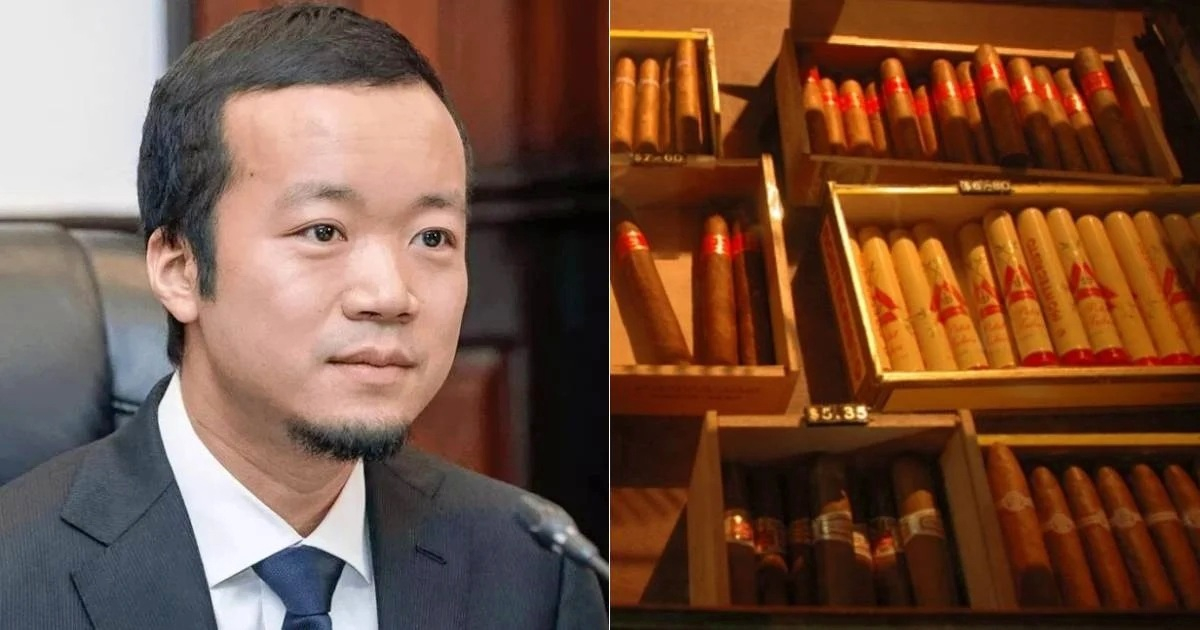
The Spanish Tabacalera, a shareholder in the joint venture Habanos S.A. alongside the Cuban state enterprise Cubatabaco, announced that it is taking urgent measures to sever any ties with the British-Cambodian entrepreneur Chen Zhi, who has been sanctioned by the United States and the United Kingdom.
According to a statement made to the agency AFP by a spokesperson for Tabacalera, “the necessary measures are being taken to ensure that Chen Zhi is completely removed from our operations.”
The company also confirmed that it is in the process of internal restructuring to definitively exclude him, following the revelation that Zhi, who is currently a fugitive, is the majority shareholder of Allied Cigar Corporation, the parent company that has controlled Tabacalera since 2020.
Habanos S.A., responsible for the global marketing of Cuban cigars, is a joint venture formed equally by Cubatabaco and Tabacalera, making the Spanish company a key player in the most valuable tobacco export business of the Caribbean nation.
The scandal: A fugitive linked to cigars
The international alarm was raised when specialized media and Swedish authorities revealed documents that directly link Chen Zhi to the control of key companies in the Cuban tobacco chain, through shell companies registered in tax havens such as the Cayman Islands, the British Virgin Islands, and Hong Kong.
The businessman, founder of the Prince Group conglomerate, is accused by the U.S. Department of Justice of leading a forced labor network, digital scams, and large-scale money laundering in Southeast Asia.
It also faces sanctions from the United Kingdom and asset freezes worth over 130 million dollars in London, in addition to seizures amounting to 350 million in Taiwan, Singapore, and Hong Kong.
Through that opaque control structure, Zhi was able to infiltrate Allied Cigar Corporation, and thus, into the very heart of the global Cuban tobacco business.
Confirmation: Zhi is listed as the "ultimate beneficiary."
The most concrete revelation came from a regulatory process in Sweden. The distribution company Elite Trading Scandinavia, when registering its corporate structure with the Gothenburg city council, submitted an organizational chart that identifies Chen Zhi as the "beneficial owner" of several companies linked to the cigar distribution chain.
This information was shared with the AFP by municipal authorities and confirmed by Tabacalera through its spokesperson.
The spokesperson added that the minority shareholders of Allied Cigar wish to buy Zhi's share to completely sever any ties with him.
"The company is undergoing a restructuring process in order to exclude Mr. Chen Zhi from the group," he assured.
The impact on business: luxury, speculation, and silence
The hidden dominance of Zhi not only has legal or ethical implications but also altered prices and the functioning of the Asian cigar market.
Since 2021, the value of a box of Cuban cigars in Hong Kong has quadrupled, and special editions have been sold for speculative sums.
According to The Standard, the strategy imposed from Asia was clear: inventory control, planned scarcity, and luxury pricing.
In parallel, Habanos S.A. reported record revenue of 827 million dollars in 2024, thanks to its positioning strategy as an exclusive product, with particular emphasis on the Asia-Pacific region, which now accounts for 24% of its sales.
All of this, while the United States remains a closed market due to the embargo.
Who is Chen Zhi?
Although described by some media outlets as a "Chinese fugitive," Chen Zhi holds British and Cambodian nationality and has a long-standing reputation as an influential businessman in Southeast Asia.
But behind his facade as a young mogul and philanthropist, another reality emerged: criminal networks linked to online scams, cryptocurrencies, and clandestine detention centers where thousands of victims were forced to work in closed facilities in Cambodia, Myanmar, or Laos, according to reports from the U.S. and the UK.
The benefits of those activities were channeled through platforms like HuionePay, identified by the Financial Crimes Enforcement Network (FinCEN) as one of the largest money laundering hubs globally.
Part of that capital ended up infiltrating legal sectors such as art, real estate, and ultimately, Cuban tobacco.
Spiderweb capitalism and stained cigar
The model used by Zhi has been described by PANews as a "2.0 web capitalism": a transnational system that combines offshore structures, cryptocurrencies, and human exploitation, with the goal of laundering money through legitimate businesses.
For years, that network went unnoticed. But the documents revealed in Europe and Asia, along with investigations by specialized media, have reconstructed the scheme: firms such as Asia Uni Corporation, Instant Alliance, and other opaque entities repeatedly pointed to the same name: Chen Zhi.
Cuba remains silent
While the scandal spreads, neither Habanos S.A. nor Cubatabaco have made public statements.
Nor has the Cuban government done so, despite the fact that the cigar business is one of the country's main sources of income.
The revelation that an international fugitive indirectly controlled 50% of the business has caused unease both within and outside the sector.
The most uncomfortable fact: China, the main destination for cigars, was for years a market under the partial influence of the Zhi holding, which raises questions about the level of control and oversight over the Cuban state business.
Tabacalera attempts to close ranks
The current management of Tabacalera -which belonged to Imperial Brands until it was sold in 2020 to the consortium Allied Cigar Corporation- assures that it is doing everything possible to sever ties with the fugitive businessman.
But the restructuring process is not yet complete, and there are still unanswered questions regarding the level of prior knowledge that the involved parties had.
Meanwhile, the story of Cuban cigars is intertwined with a criminal network that used luxury and tradition as a façade for shadowy financial operations.
The lit Cohíba in a private club in Shanghai may have passed, unbeknownst to anyone, through hands marked by human trafficking.
Filed under: