
Related videos:
I notice that Luis Manuel Otero Alcántara has not been online on Messenger for twenty hours. On Tuesday, November 21, he was detained at the police unit of Zapata and C, Vedado, Havana. He and his girlfriend, Yanelys Núñez, have since been released. Just two days ago, while Luis was sharing a bit about the launch of the #00Biennial call, he let me know that on Tuesday the 21st they would file a complaint with the Military Prosecutor’s Office regarding the illegal search by the Cuban police in his home in Old Havana on November 6. “Tomorrow Yanelys and I will file a complaint against the police at the Military Prosecutor's Office,” he wrote. “To apply pressure,” he said to me. “An independent lawyer filed a complaint for us because they used a bunch of illegal tactics.” And then we moved on to other topics.
I think about everything that could happen during the twenty hours that Luis has not connected to Messenger: sleeping, waking up, going to a Prosecutor's Office, filing a complaint, being arrested, and then being released. Since the detention of Alcántara and Núñez, I've only been able to find out that at Zapata and C they warned him of the following: the #00Biennial of Havana "is not happening."
However, despite the warning from the authorities, it seems there will be a #00Biennial in Havana. I'm not the one saying this; it's Luis. His messages from Monday night—before he was imprisoned again—were brief and to the point. On Sunday, November 19, they managed to hold a conference to announce the call for the artistic event, after the police disrupted a scheduled gathering on the 6th. Luis was happy. Around 100 people attended his house on Damas and San Isidro. Luis was excited. The meeting started at 7:30 PM, without any interference from the authorities. Luis only remembers that when it was already midnight, and he and some friends were having a few beers on the street, a "security" agent whom Luis knows well greeted him. "All good," he said. Luis was, let's say, happy up until that moment.
Friends of Luis, partners of Luis, independent artists, renowned artists, musicians, theater people, visual artists, and people Luis had never seen before, all betting on what will be the #00Bienal of Havana, from May 5 to 15, 2018. The only sad thing in all of this, Luis said, is seeing friends drift away out of fear.
"For me," he assured, "fear is an inherent part of being human; and only to the extent that you adapt or not to it can you consider yourself more or less brave."
Luis has indeed felt fear. And because he has felt fear, we could assert, he creates art.
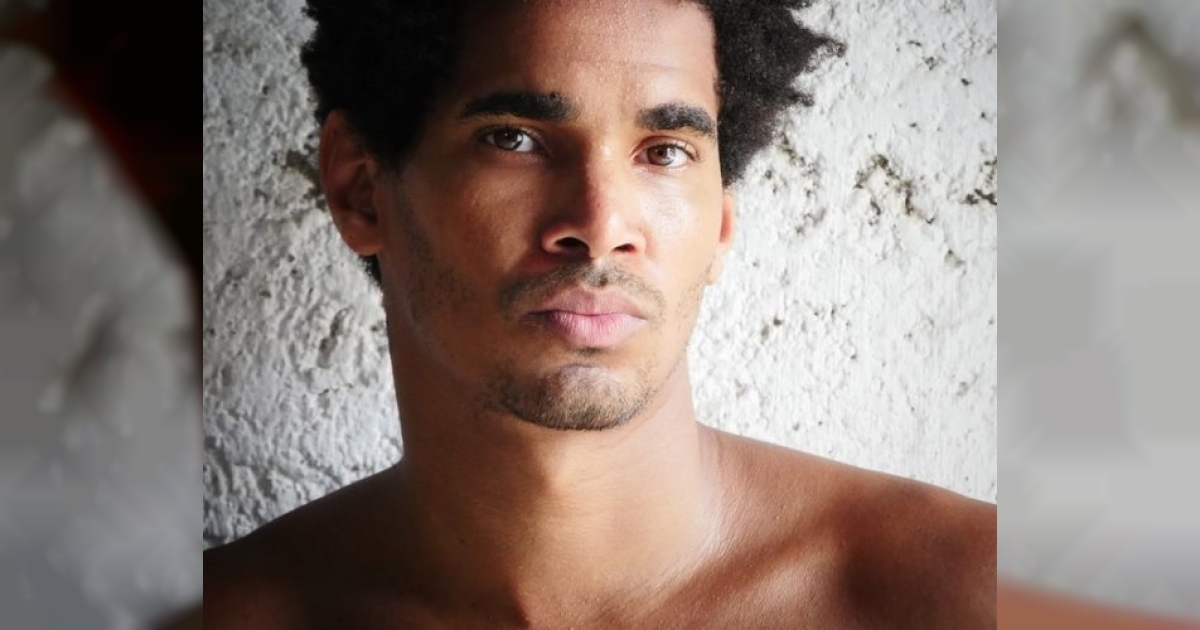
Nevertheless, I can't seem to grasp the fear in Luis. I've stalked his Facebook profile several times. There’s a photo on his timeline from November 10, showing him from the torso up, revealing a smooth, brown complexion, a sparse chin, tight lips, afro hair, and challenging brown eyes. Luis is beautiful. The beauty in his face emanates from a strength that seems to belong to a man who has never known fear.
There are other photos on his wall: Luis in a Buddhist meditation pose. Luis with friends on the streets of Havana. Luis wearing a pink turban. I can't quite capture the fear in Luis, but it exists. Only those who have felt fear in their bodies at some point can understand his work. To participate in the performance of Luis Manuel Otero Alcántara, I must clarify, one must have felt fear in Cuba and be willing to eradicate it.
Neither Luis nor I imagined that this story would be read when he and his girlfriend were released from some jail in the city. That's how things are in Cuba.
That is why this story is about fear and against fear. Is it that people want to die, or do they want to live consumed by panic?
"In Cuba, you wake up with fear and go to bed with fear. And even more so when you have a job that questions the system and offers a solution for a prosperous future for the people," Luis said.
In the video filmed by Yanelys during the arrest on November 6, Luis is truly brave. He is on the floor of his house, reluctant to leave with the officers, and when one tries to touch him, he suddenly says, “Get back, I see you.” Nothing suggests that Luis is afraid at that moment.
"The video where I appear sitting," he recounts, "is just a fragment. Before I sat down, I had already argued with the police. I am a very impulsive person, and I vigorously defend my rights and those of the people around me." Luis Manuel Otero
Luis was handcuffed that afternoon when he intended to announce the #00Bienal de La Habana, an independent initiative after the Ministry of Culture, the National Council of Plastic Arts, and the Wifredo Lam Center decided to postpone the XIII edition of the artistic event to 2019 due to the damage caused by Hurricane Irma.
On that same day, Yanelys posted on her Facebook profile: “At 3 in the afternoon, the house where we were going to hold the event was searched by Cuban police officials looking for construction materials. When some bags were found—many of them spoiled due to humidity and the long time they had been stored—Luis was taken, not without protesting, to the station at Cuba and Chacón, where he remains until this hour.”
From Cuba and Chacón, Luis remembers everything perfectly: “Upon arriving at the station, I decided not to drink any water or eat until I was released, knowing I could be there for a long time. That very night, an officer took me out of the cell and stood me in front of some supposed materials that they told me had been confiscated from me."
Luis says: “I refused to testify that they were mine and maintained my statement that the materials found in my house were given to me by my aunt. This officer spoke to me disparagingly and accused me of being counter-revolutionary and sent me back to the cell.
"Whenever I was asked, I would say that materials were a cowardly justification, that the real reason was my position as a political artist, as the Cuban system was disturbed by being told the truth to its face and by people proposing development projects for the community."
The police officers attending to you there have vastly different personalities—some are more aggressive, while others are more permissive, and their relationship with the inmates is hostile. Those responsible for opening and closing the cell doors, who had the most contact with the inmates, were overwhelmed by confusion, as their salaries are really pathetic, and for the most part, they are as much victims as the other part of the population. They have to meet a daily quota of inmates.
The jails in Cuba are unpleasant and very uncomfortable places, measuring about six square meters, where up to twenty people can be crammed together. There were some with AIDS who threatened to cause bleeding in hopes of improving the conditions. The bathroom is disgusting, there’s no door, you sleep on the dirty floor, and there are many mosquitoes.
Amid these conditions, various people come and go, some more aggressive than others. What's interesting is that being in such a small space for so long makes you connect; you feel empathy for one person and then another, learning their life stories, most of which are very difficult. Some are individuals with mental health issues, and the police do not take this into account, keeping them detained for an entire night. Others are indeed murderers and scammers. Yet, you also meet a 35-year-old father and his 16-year-old son, both awaiting a long sentence for possessing 100 pounds of unexplained beef, and even another young person facing a one-year sentence for buying soap and reselling it. These are stories that are utterly incomprehensible to me.
"During my time in prison, I thought that a large percentage of common crimes committed in Cuba are not really crimes, or at least not until the country's economic structure allows you to live. In a nation where the salary is insufficient, selling soap cannot be a crime; I don't understand how a judge can live in peace condemning this."
However, that was not the first time Luis had contact with the Cuban police. He has been taken to the patrol car for not carrying his identity card; State Security has summoned him regarding his project -together with Yanelys- Museum of Dissent in Cuba, where dissidents like Fidel Castro and Oswaldo Payá converge, along with anyone who has ever disagreed in the history of the country. When I ask Luis if he considers himself a dissident, he replies: “I consider myself a dissident; I dissent from the way my country is governed, from how my mother treats her children, and from how the world turns.”
Another time Luis confronted the Cuban police was last September, when he was accused of possession of firearms due to the distribution of "weapons" in the play Chong chong gang. Luis tried to convince them that they were handmade weapons, but they did not understand. “They told me those weapons were real, that several experts had determined this through the images I had posted on social media. I told them that those artifacts didn’t work, that they were sculptures, a fiction I had constructed. However, they continued with that accusation.”
At this moment, according to Luis, there has been a shift in his dialogue with State Security. "As part of my strategy to avoid spreading fear and paranoia, I never reported those encounters because for people inside the Island, just receiving a call from a security agent is enough to steer away from a contentious project or to fear for their job security."
Yanelys describes Luis as follows: he is an restless, hyperactive person. "The moment of rest for him only exists in extreme cases, even though he sleeps a lot." According to his girlfriend, he is very talkative and fun. "He has the talent to captivate with a first impression or provoke a completely opposite effect."
What Luis enjoys the most, he claims, is creating. "He is always fantasizing. He also likes to experiment with new forms of leisure and pleasure, as he gets bored very quickly."
Luis speaks about Yanelys in the following way: “She is a super special and essential person in my life. We have been in a romantic and professional relationship for three years, during which we have become one in body and mind. She knows my darkness, and I know hers. We have a lot of trust, which is important in this battle we are in.”
The day they took Luis to the station, the first thing he told Yanelys was that the #00Bienal of Havana should go on. He also thought they might take her into custody. “At that moment, I was a bit scared because she has never been in a cell, but I quickly calmed down because I knew she was ready for anything; she is very strong and brave.”
On Tuesday, November 21, Yanelys experienced for the first time what it is like to be in a prison in Cuba. A few days earlier, she had told me: “During this time, I have been eliminating many fears, since Luis is a very daring and bold person, and he has infused me with all that energy and outlook on life. However, when you see what the State Security is capable of, such as setting up a whole trap to make you suffer imprisonment, you can't help but feel scared, but above all, you feel a great sense of helplessness due to the legal vulnerability in which we live.”
On November 8, at noon, Yanelys reported on her Facebook account: “Luis Manuel Otero Alcántara is in Vivac prison since last night. According to a captain from the station, the measure taken by the prosecutor's office is secret.”
This is how Luis recounts what he remembers of those days at the Vivac:
"They took me to the Vivac without informing my family of anything and supposedly waiting for a response from the prosecutor's office. I know this from another inmate who accompanied me and mentioned it, because the authorities remained in absolute silence. They transported me along with four other people: the soap salesman, someone who was imprisoned for drug trafficking and with whom I developed a good friendship, a 70-year-old man detained for harassing tourists, and a girl for prostitution."
We arrived at the Vivac around eight in the evening, and I was already feeling very weak. They gave us two sheets, a blanket, and a towel. There was no personal hygiene available for anyone. I was presented to a doctor to report my health status, as I was on hunger strike. The doctor tried to suggest that I at least drink some water, but I resisted. The police officer present told me that was the behavior of ignorant people, and I asked him if he knew Gandhi. When he nodded, I mentioned that he had been one of the most important advocates of hunger strikes as a peaceful method of social struggle. At that, the officer was left speechless.
“On the second day of the hunger strike, you feel very bad, but by the third day, it’s no longer just hunger; it’s a lot of pain that you feel. The conditions at the Vivac were not bad. The beds and hygiene were good. However, the prisoners there wanted to get out because that place is very uncertain; you could be released with just a fine or end up with 30 years in prison. It’s a place with a very strange energy because it’s the threshold between the supposed freedom of the streets of Cuba and its horrible prisons. The other thing is that the police in this place know nothing about your case. Everything that is decided about you is happening 20 kilometers away.”
"Both in Cuba and Chacón, as well as in the Vivac, the prisoners supported me a great deal and showed solidarity; they even asked me for any independent movements or press organizations they could join or protest with. In Cuba, the government has a macabre mechanism of disinformation, and people feel isolated in their struggles and ideas. Recently, I have noticed that the general public is very upset with the regime and supports causes like mine to change this system."
On November 9, Luis Manuel was released from Vivac prison after paying a bond of 1,000 Cuban pesos, under the charge of "receiving stolen property."
From the beginning, Luis and Yanelys told the authorities that the construction materials for which he was supposedly detained had been obtained legally from Luis's aunt (we're talking about 11 bags of sand and two bags of cement). "My aunt had lent me these few construction materials to try to reinforce the foundations of the house where an independent cultural center will be located, as well as my home and that of my friends," says Luis.
Luis's aunt, for her part, confesses that "when I lent him the materials a few months ago, I told my nephew that if he had any issues, he should reach out to me, as I would handle the paperwork."
That’s why she claims that when Yanelys informed her of her arrest, she felt calm thinking that everything was in order. Luis's aunt also approached the authorities. “Upon arriving at the unit,” she says, “the atmosphere was very aggressive, as if we were criminals, and they barely let us speak. When we showed them the documents, the tone changed, and they said we had to take the papers to the Prosecutor's Office so they could decide whether there was a case or not. However, the next day, when we thought they would release her because the prosecutor would dismiss everything, we were told that the prosecutor's decision was confidential and that we could not know it.”
"I am not an artist nor do I understand that world, although I've seen a bit through my nephew. For me, arresting him for a few bags of cement is very ridiculous. The leaders of this country were once young and restless too; they don't understand this because they think differently, especially regarding art that harms no one. It's not a crime, or at least that’s what I believe; art is beauty. Seeing my nephew imprisoned causes me a lot of anxiety; I don’t understand why this is happening to him. Even when he explains it to me, I can't grasp why a young man who is not a criminal, who works, who cares for his family, and is an artist of his time should be in prison. What was really his crime?"
After Luis was released, while walking along a street in Cerro, where his family was born and still lives, a neighbor who had learned about the incident approached him to ask why he was doing this, if it was to leave the country. "She was quite surprised when I told her it would be very easy for me to leave and stay outside of Cuba, that I had been married to an American, and that even State Security had suggested I leave Cuba," Luis recalls. "When I told her that my struggle, among other things, was to ensure that her salary was enough to provide a decent life for her son, she commented, 'But just you?' I replied that no, that there were many people fighting for this, it was just that information wasn’t circulating."
The #00 Biennial of Havana, according to the announcement released on November 19, will take place from May 5 to 15, 2018, in the capital of the country. The event aims to bring together national and international artists in a space for exchange, exhibition, and dialogue, with a theme that is open to interpretation, and it will be held through fundraising initiatives. This #00 Biennial of Havana has the slogan "From the Official to the Unscrupulous."
The slogan is the response to an open letter from the Asociación Hermanos Saíz and the Unión Nacional de Escritores y artistas de Cuba published on September 27th, which declares: “Today we learned that some unscrupulous individuals are trying to organize provocations on social media regarding a decision that we understand and support. They will not be able to divide us. Cuban artists are convinced that Cuban cultural life, always rich and renewing, will rise against all adversities.”
Following the arrest of Luis Manuel, labels and videos began to circulate on social media announcing that the #00Bienal de La Habana had already started. Luis's performance, alongside the Cuban police and the country as its backdrop, prematurely inaugurated the artistic event.
“The #00Bienal,” Luis says, “is an event with a very performative character and arises as a response to the government's decision to suspend the official event at such a critical time for cultural processes that aim to somewhat renew Cuban reality. Therefore, everything happening around this event speaks to a reality; in this case, it reveals the repressive structure of the system and the intolerance toward the unofficial. There is a certain level of permissibility, but everything remains within the boundaries of what they continue to control.”
According to Yanelys, the objectives of this #00Biennial are straightforward: "To show institutions that artists, promoters, producers, and curators can unite under a common factor, that we are not afraid to protest when a decision affects us. But also, and this is something important, we wanted and want to demonstrate that the art world can bring about changes in the social environment, that it can engage in dialogue with the people, inspire them, make them reflect, and reveal a particular beauty to them."
"In Cuba, everything is uncertain," Luis Manuel asserts. "You don’t know whether to invest in a business because your licenses can be revoked for 10 years. You can’t even rely on the hope of being a potential emigrant, because they could suddenly eliminate the wet foot/dry foot policy. Cubans have to pray, light a candle, and live day by day."
The saddest part of this whole experience is seeing friends drift away out of fear of losing their jobs; a neighbor nearly giving my grandmother a heart attack by telling her I’ll be sentenced to many years for being counter-revolutionary; or my mom judging me as irresponsible, claiming that art is useless, that what I propose is garbage, and that I will cause my sister to lose her job.
"The most painful thing is all of this, having to distance myself from my family for fear of the reprisals they might take against them. Arguing with my brothers and my mother to the point of not speaking to each other, because I am no one and cannot be anyone to try to change this system."
“The good part is having the unwavering support of my aunts, Yanelys, my mother-in-law, and friends. People who have differing opinions but share the same commitment of their time and, from their positions, also fight tirelessly.”
Luis Manuel does not remember being a fearful child. But he knows that fear is always present. In fact, he has said on several occasions that his goal as an individual is to overcome fear.
"I fight against that tool of coercion; I do not want my children to grow up being opportunists or betraying their country for a trip to Singapore and a car with a license plate from the Ministry, or with the fear of losing their home, or working for a miserable salary. I also do not want them to be labeled as social pariahs for demanding their rights and those of their loved ones, as citizens."
"I was never afraid when they took me prisoner, nor am I afraid of death. Some time ago, I mentioned to a friend that I was somewhat depressed and that when I stepped outside in Cuba, everything made me feel bad: the Wi-Fi, which is an invasion of the Cuban's privacy, the quality of transportation, the lack of food—everything. In this context, the only way I found to overcome the depression was by fighting. Fighting and seeing the results makes me happy. I told the authorities that I would prefer to die fighting against the system than to take my own life or be depressed at home."
Luis performed a striptease in the wifi area in front of the Yara cinema for a video call with his girlfriend at the time. He questioned the disappearance of the old bust of Mella at the Hotel Manzana Kempinski and proposed "Game of Thrones: Cuba Elections 2018," a symbolic election so that Cubans could once choose their president.
But there was a moment in Luis's life when he couldn't imagine two men kissing. Two men's mouths mixing their tongues. One day, he went out with a friend to make some videos and they encountered a gay man who said his dream was for his boyfriend to fall in love with him, and to walk down the street without being shouted at as Catalina.
And this is what happened. "Seeing his face when he said all this," Luis recounts, "was so strong and impactful that it broke a layer of prejudice within me that harmed other people. That is the power of art."
Filed under:
Op-Ed Article: Las declaraciones y opiniones expresadas en este artículo son de exclusiva responsabilidad de su autor y no representan necesariamente el punto de vista de CiberCuba.